I wanted to make an animation for which a line is following a Hilbert curve. Since a Hilbert curve is not closed, I decided to join two of them:
Join two rotated Hilbert curves of n iterations:
In[]:=
n=4;δ=2^n-1;invδ=1/δ;rm=RotationMatrix[Pi/2];hc=First@HilbertCurve[n,DataRange->{{-1,1},{-1,1}}];hc1=(rm.#)&/@hc;hc2=(-rm.#+{2+2invδ,0})&/@hc;hc=Join[hc1,hc2,Take[hc1,1]];Graphics[Line[hc,VertexColors->(ColorData["Rainbow"]/@Subdivide[Length[hc]-1])],FrameTrue]
Out[]=
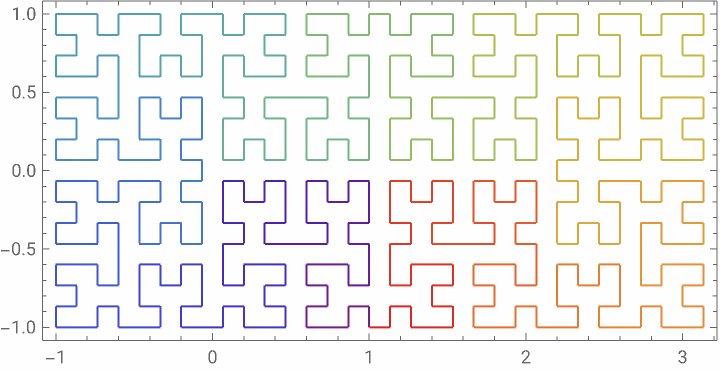
Turn the path into interpolation functions, and make a function that draws the line:
In[]:=
len=Length[hc];dist=Prepend[Accumulate[Norm/@Differences[hc]],0.0];totdist=Last[dist];ipx=Interpolation[Transpose[{dist,hc[[All,1]]}],InterpolationOrder1];ipy=Interpolation[Transpose[{dist,hc[[All,2]]}],InterpolationOrder1];ClearAll[ipf]ipf[d_]:={ipx[Mod[d,totdist]],ipy[Mod[d,totdist]]}ClearAll[MakeLine,MakeScene]MakeLine[τ_]:=Module[{loopdist,d1,d2,id,beginindex,endindex,midpoints,pts},loopdist=Join[dist,dist+totdist];d1=τtotdist;d2=(τ+0.5)totdist;beginindex=LengthWhile[loopdist,LessEqualThan[d1]];endindex=LengthWhile[loopdist,LessThan[d2]];midpoints=Take[loopdist,{beginindex+1,endindex}];pts=ipf/@Join[{d1},midpoints,{d2}];Line[pts]]ϵ=0.05;MakeScene[τ_]:=Graphics[{Thickness[0.51/δ],CMYKColor[1,0.63,0,0.02],MakeLine[τ],CMYKColor[0,0.02,1],MakeLine[τ+0.5]},PlotRange{{-1-(1-ϵ)invδ,3+(3-ϵ)invδ},{-1-(1-ϵ)invδ,1+(1-ϵ)invδ}},ImageSize400]MakeScene[0.333]
Out[]=
Make all the frames:
In[]:=
imgs=ParallelTable[Rasterize[MakeScene[t],RasterSize300],{t,Most@Subdivide[600]}];
Export as a video:
In[]:=
ai=AnimatedImage[imgs,"FrameRate"->30];SetDirectory[NotebookDirectory[]];Export["5050.mp4",ai]
Out[]=
5050.mp4
Export as a gif:
In[]:=
SetDirectory[NotebookDirectory[]];Export["5050.gif",imgs,"DisplayDurations"->1/30]
Out[]=
5050.gif