This is part of live presentation series called Mathematical Games in which we explore a variety of games and puzzles using Wolfram Language. In this episode, we explore fractals.
3D Deterministic Context-Free (DOL) Systems (by Aristid Lindenmayer, John Cicilio, Premyslaw Prusinkiewicz)
3D Deterministic Context-Free (DOL) Systems (by Aristid Lindenmayer, John Cicilio, Premyslaw Prusinkiewicz)
Out[]=
This Demonstration contains examples of a deterministic context-free system (DOL), a simple Lindenmayer system. Here we show some simple recursive string mappings using bracketed DOL systems. The examples used here were inspired by [1].


Regular k-ary Trees (by Stephen Wolfram)
Regular k-ary Trees (by Stephen Wolfram)
Out[]=
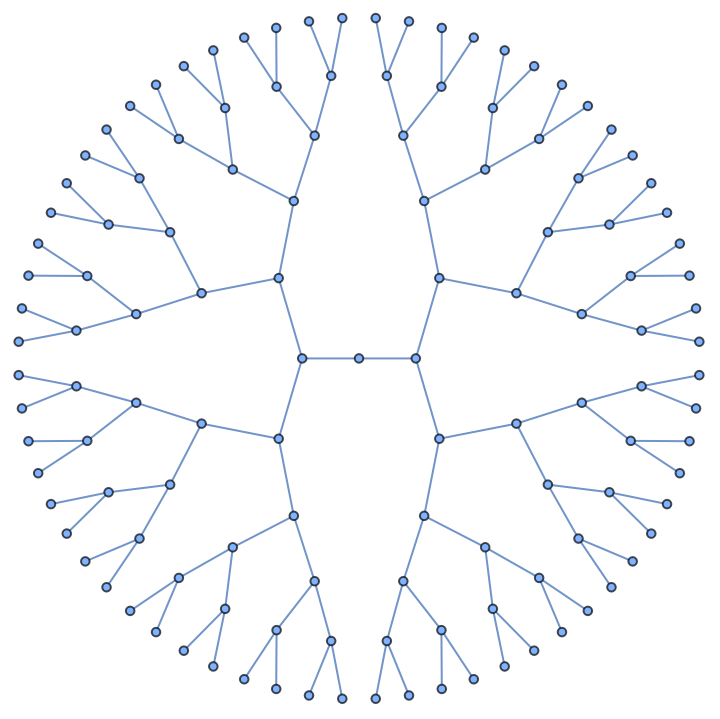
In a regular k-ary tree, there are k branches from every nonterminal node. See various ways to draw k-ary trees in two dimensions.
Limits of Tree Branching (by Stephen Wolfram)
Limits of Tree Branching (by Stephen Wolfram)
Out[]=
A single stem branches in two, then each branch in turn branches in two, and so on. At each step, the tips of the new branches have the same geometrical relationship to the previous branch as the first branches had to the original stem. Each dot represents the tips of branches. Vary the position of the first branch, and see the radically different limiting shapes produced.
Sierpinski Carpet (by Peter House)
Sierpinski Carpet (by Peter House)
Out[]=
This Demonstration steps through a few iterations of the Sierpinski carpet, a fractal created in 1916.
Sierpinski Sieve (by Peter House)
Sierpinski Sieve (by Peter House)
Out[]=
This Demonstration steps through a few iterations of the Sierpinski sieve (or gasket), which was described by Waclaw Sierpinski in 1915 but appeared earlier in Italian art.
Typeset Sierpinski Sieve (by Robert Dickau)
Typeset Sierpinski Sieve (by Robert Dickau)
Out[]=
This Demonstration uses Mathematica's typesetting functionality to create a Sierpinski sieve (or gasket) by nesting the Subsuperscript function.
Koch Curves (by Michael Sollami)
Koch Curves (by Michael Sollami)
In[]:=
Text@EntityValue[Entity["WolframDemonstration","KochCurves"],"Caption"]
Out[]=
Helga Von Koch's snowflake curve is the limit curve of an infinite sequence of polygonal curves. The Koch snowflake is an example of a fractal curve with finite area and infinite length. Change the angle of the updating rule to make interesting patterns. Typically the starting curve is a triangle or line, but any polygon will work.
Koch-Subdivided Polyhedra (by Robert Dickau, Stewart Dickson)
Koch-Subdivided Polyhedra (by Robert Dickau, Stewart Dickson)
Out[]=
This Demonstration shows a "graftal" technique to subdivide the triangular faces of a polyhedron. Many fractal curves can be generated using L-systems or string-rewrite rules, in which successive stages of the curve are generated by replacing each line segment with multiple smaller segments in a particular arrangement. The same technique can be extended to surfaces, where a stage is constructed by replacing each triangle with multiple smaller triangles. Here we apply this technique to two of the regular polyhedra with triangular faces.
Square Koch Fractal Curves (by Robert Dickau)
Square Koch Fractal Curves (by Robert Dickau)
Out[]=
The classic Koch fractal curve is recursively created by starting with a line segment and then recursively adding a triangular bend in the center of each segment. Variations can be created by using a square shape instead of a triangle in the replacement rule. The type 1 curve is a direct analogy to the classic Koch curve, replacing each line segment with five smaller segments placed at right angles. The type 2 quadratic curve—also known as the 3/2 curve and the eight-segment Koch curve—uses a similar motif that replaces each segment with eight smaller segments.
Cantor Set (by Eric Rowland)
Cantor Set (by Eric Rowland)
Out[]=
The Cantor set is obtained from [0,1] by removing the open middle third and iteratively removing the middle third of each remaining interval.
Cantor Function (by Douglas Rivers)
Cantor Function (by Douglas Rivers)
Out[]=
This Demonstration runs eight iterations of the Cantor function. You can zoom in close to the origin to see the fractal nature of the function.
Riemann's Example of a Continuous but Nowhere Differentiable Function (by Michael Trott)
Riemann's Example of a Continuous but Nowhere Differentiable Function (by Michael Trott)
The Modified Dirichlet Function (by George Beck)
The Modified Dirichlet Function (by George Beck)
Takagi Curve (by Borut Levart)
Takagi Curve (by Borut Levart)
Bolzano's Continuous but Nowhere Differentiable Function (by Izidor Hafner)
Bolzano's Continuous but Nowhere Differentiable Function (by Izidor Hafner)
Minkowski's Question Mark Function (by Oleksandr Pavlyk)
Minkowski's Question Mark Function (by Oleksandr Pavlyk)
The Fractal Nature of Partitions (by George Beck)
The Fractal Nature of Partitions (by George Beck)
Generalized Cantor Sets and Their Hausdorff Dimensions (by Erin K. Kline, Matthew A. Morena)
Generalized Cantor Sets and Their Hausdorff Dimensions (by Erin K. Kline, Matthew A. Morena)
What is nonperiodicity? Pinwheel tiling
What is nonperiodicity? Pinwheel tiling
Isopenta
Isopenta
Penrose Tilings and Wieringa Roofs
Penrose Tilings and Wieringa Roofs
Traditionally, the P3 Penrose tiling is made of thin and thick rhombi. However, by raising the vertices in three dimensions, it is possible to force all of the rhombi to be congruent. The resulting surface is known as a Wieringa roof. Due to similarities with three-dimensional quasicrystals, you can see rhombic triacontahedra and hexecontahedra hidden in the tiling.
Rep-Tiles
Rep-Tiles
More Reptiles
More Reptiles
What is non-periodicity? Even More Reptiles (order 5)
What is non-periodicity? Even More Reptiles (order 5)
Aperiodic Tilings
Aperiodic Tilings
A tiling set is aperiodic if
1. A non-periodic tiling is possible.
2. Arbitrarily large periodic regions or patches are impossible.
1. A non-periodic tiling is possible.
2. Arbitrarily large periodic regions or patches are impossible.
Aperiodic Tilings -- Robinson Tilings
Aperiodic Tilings -- Robinson Tilings
Aperiodic tiling showing hierarchical structure, published by Raphael M. Robinson in 1971.
Joseph Samuel Myers -- “It’s an infinite family”
Joseph Samuel Myers -- “It’s an infinite family”
Substitution Rules -- 1 Day Later
Substitution Rules -- 1 Day Later
Big Patches
Big Patches
Big Patches Y or Anti-Y Complete
Big Patches Y or Anti-Y Complete
Big Patches Y or anti-Y Partial
Big Patches Y or anti-Y Partial
Yoshiaki Araki
Yoshiaki Araki
Hat Triality Tree
Hat Triality Tree
Depict a larger patch of the mutual trees triality pattern:
Reduce, Replicate, Rebuild (by Stephen Face)
Reduce, Replicate, Rebuild (by Stephen Face)
Recursive Exercises II: A paradox (by Jaime Rangel-Mondragon)
Recursive Exercises II: A paradox (by Jaime Rangel-Mondragon)
Recursive Exercises III: Fire Patterns (by Jaime Rangel-Mondragon)
Recursive Exercises III: Fire Patterns (by Jaime Rangel-Mondragon)
Recursive Exercises IV: Rep-Tiles (by Jaime Rangel-Mondragon)
Recursive Exercises IV: Rep-Tiles (by Jaime Rangel-Mondragon)
Recursive Exercises VII: Stacks of Cubes (by Jaime Rangel-Mondragon)
Recursive Exercises VII: Stacks of Cubes (by Jaime Rangel-Mondragon)
Recursive Exercises XI: Homage to Escher (by Jaime Rangel-Mondragon)
Recursive Exercises XI: Homage to Escher (by Jaime Rangel-Mondragon)
LSystemPlot (by Robert Dickau)
LSystemPlot (by Robert Dickau)
SchmidtArrangements
SchmidtArrangements
Curlicue Fractal
Curlicue Fractal
Ghee Beom Kim
Ghee Beom Kim
Ratio = 1.118, which is 1/ϕ + 0.5 where ϕ is the Golden Ratio
Unsolved Questions
Unsolved Questions
Dissimilar 2D Penrose rhombs become similar in a 3D Wieringa roof. What other dissimilar-piece substitutions have a 3D equivalent?
What substitution systems haven’t been found yet?
I discovered many new substitutions by solving the problem of surrounding a 2D point with similar triangles. Who can solve the problem of surrounding a 3D point with similar shapes?
What substitution systems haven’t been found yet?
I discovered many new substitutions by solving the problem of surrounding a 2D point with similar triangles. Who can solve the problem of surrounding a 3D point with similar shapes?
Gecko feet were figured out less than 20 years ago. They work by a fractal application of Van der Waals forces. What are other applications?
CITE THIS NOTEBOOK
CITE THIS NOTEBOOK
Mathematical Games: Fractals Part 2 - applications, complex sets, and substitution rules
by Ed Pegg
Wolfram Community, STAFF PICKS, November 20, 2025
https://community.wolfram.com/groups/-/m/t/3578703
by Ed Pegg
Wolfram Community, STAFF PICKS, November 20, 2025
https://community.wolfram.com/groups/-/m/t/3578703