Introduction
Introduction
Dots representing the integers from 1 to 1200 are arranged along a generating spiral (p1) with variable angular spacing. The first 60 primes are highlighted. The dots appear along spirals, except when the angles are divisors of 2 Pi. In the figure shown below the initial angle is golden angle. It can substituted with any irrational numbers from 0,5 to 4 (e.g. E) to study the related spirals. The “set” contains the integers, and the “subset” represents the prime numbers.
In[]:=
ga=2Pi/GoldenRatio;Manipulate[p1=Table[{rSin[r],rCos[r],0},{r,1,1200,ang}];set={PointSize[0.008],Point[p1]};pp=Prime[Range[PrimePi[281]]];ppp=TakeList[pp,{60}];ext=Extract[p1,{ppp}];prp={PointSize[0.017],Point[{0,0,0}]};prp=Sphere[{0,0,0},20];subset=Map[Translate[prp,#]&,ext];Graphics3D[{Purple,set,Red,subset},ViewPoint->{0,0,100},Boxed->False,SphericalRegion->True,ImageSize->300],{{ang,ga,"angle"},0.5,4,Appearance->"Labeled"},TrackedSymbols->ang,ControlPlacement->Top]
Out[]=


Examining the arrangements with specific angles
Examining the arrangements with specific angles
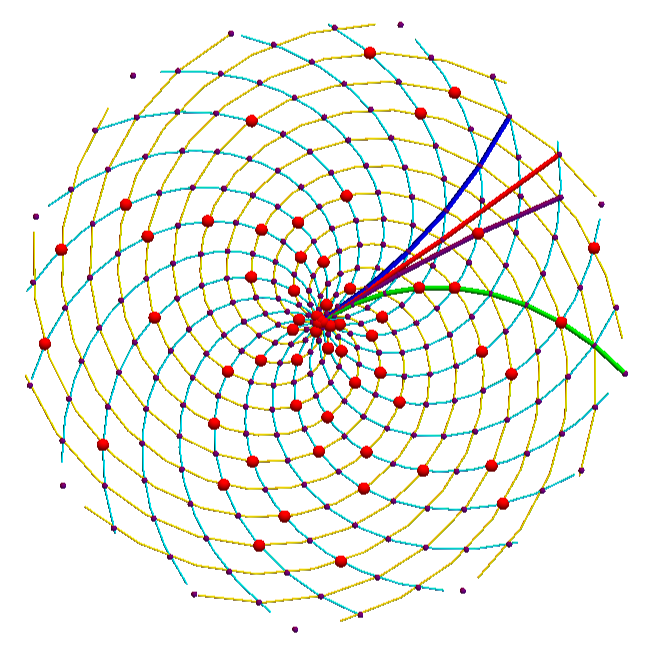
Since the primes are part of the integers, all primes are located on the spirals, but some spirals do not contain primes. A couple of examples are explored here with various angles.
1. With golden angle and in the integer range from 1 to 1200, containing the first 60 primes.
Spirals corresponding to any Fibonacci number appear depending on the number range.
In[]:=
fi=GoldenRatio;ang=2Pi/fi;p1=Table[{rSin[r],rCos[r],0},{r,1,1200,ang}];set={PointSize[0.009],Point[p1]};sp=Sphere[{0,0,0},12];set=Map[Translate[sp,#]&,p1];pp=Prime[Range[PrimePi[1000]]];ppp=TakeList[pp,{60}];ext=Extract[p1,{ppp}];sp1=Sphere[{0,0,0},24];subset=Map[Translate[sp1,#]&,ext];sp8=Tube[p1[[1;;;;8]],10];sp13=Tube[p1[[1;;;;13]],4];sp21=Tube[p1[[1;;;;21]],4];sp34=Tube[p1[[1;;;;34]],10];sp55=Tube[p1[[1;;;;55]],10];sp89=Tube[p1[[1;;;;89]],10];sp144=Tube[p1[[1;;;;144]],10];sp21a=Table[Rotate[sp21,i2Pi/21,{0,0,1}],{i,21}];sp13a=Table[Rotate[sp13,i2Pi/13,{0,0,1}],{i,13}];Graphics3D[{Red,sp144,Purple,sp89,Blue,sp55,Green,sp34,Cyan,sp21a,Yellow,sp13a,Purple,set,Red,subset},Boxed->False,SphericalRegion->True,ViewPoint->{0,0,100},ImageSize->400]
Out[]=
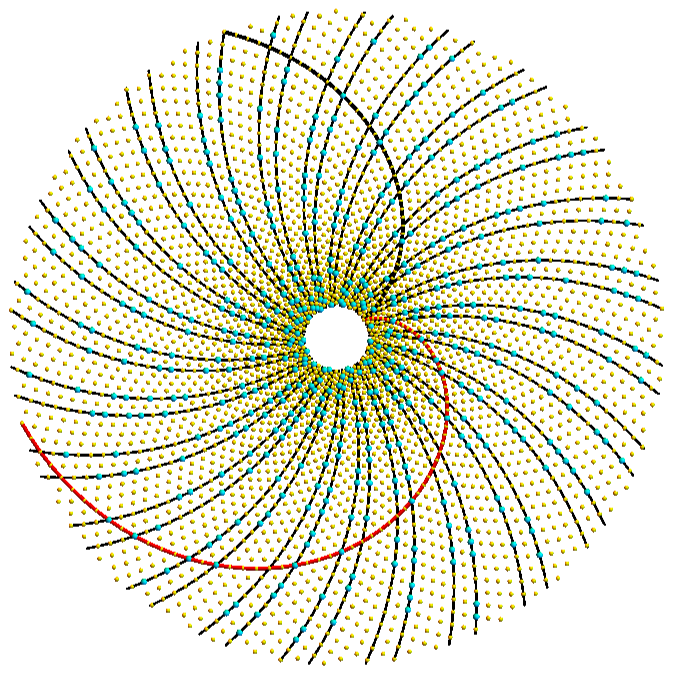
2. With golden angle and in the integer range from 1000 to 10000, containing the first 500 primes. The primes seem to be on 24 pieces of No.144 Fibonacci spirals.
In[]:=
fi=GoldenRatio;p1=Table[{rSin[r],rCos[r],0},{r,1000,10000,2Pi/fi^2}];sp=Sphere[{0,0,0},70];set=Map[Translate[sp,#]&,p1];pp=Prime[Range[PrimePi[10000]]];ppp=TakeList[pp,{500}];sp1=Sphere[{0,0,0},100];ext=Extract[p1,{ppp}];subset=Map[Translate[sp1,#]&,ext];spir144=Tube[p1[[1;;;;144]],40];ad1=Rotate[spir144,2Pi/72,{0,0,1}];spir144a=Table[Rotate[{ad1,spir144},i2Pi/24,{0,0,1}],{i,24}];sp55=Tube[p1[[1;;;;55]],60];sp89=Tube[p1[[1;;;;89]],60];Graphics3D[{Black,sp89,Red,sp55,Black,spir144a,Yellow,set,Cyan,subset},ViewPoint->{0,0,100},Boxed->False,SphericalRegion->True,ImageSize->400]
Out[]=
3. With ”one radian” angle and in the integer range from 600 to 4000, containing the first 460 primes. The primes seem to be on some of the No. 44 “one radian” spirals.
4. With ”2Pi/ln” angle and in the integer range from 600 to 10000, containing the first 160 primes. The primes seem to be on many “ln spirals”.
5. With ”2Pi/E” angle and in the integer range from 600 to 5000, containing the first 260 primes. The primes seem to be on many “E spirals”.
6. With ”2Pi/Sqrt[7]” angle and in the integer range from 700 to 50000, containing the first 260 primes. The primes seem to be on many “2Pi/Sqrt[7] spirals”.
CITE THIS NOTEBOOK
CITE THIS NOTEBOOK
Prime numbers aligned along spirals
by Sandor Kabai
Wolfram Community, STAFF PICKS, January 13, 2024
https://community.wolfram.com/groups/-/m/t/3024819
by Sandor Kabai
Wolfram Community, STAFF PICKS, January 13, 2024
https://community.wolfram.com/groups/-/m/t/3024819