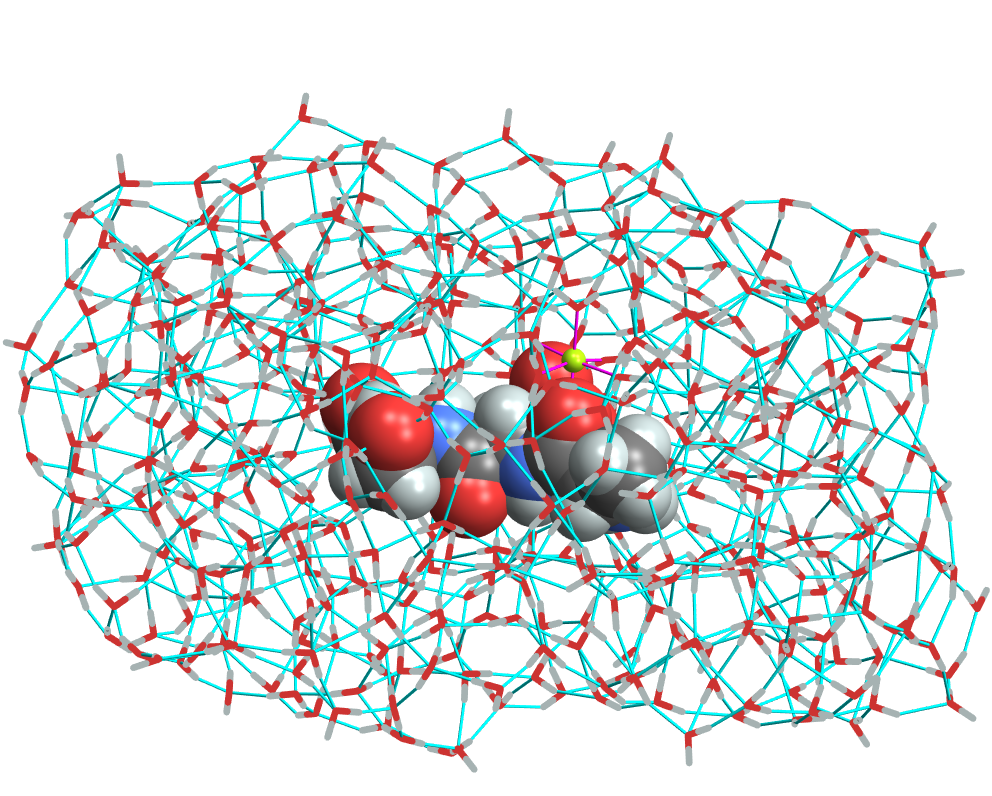
To clarify the positive effect of peptide additive in aqueous electrolyte, a model has been built by using the MoleculeComplex package for molecule manipulation, energy optimization and interaction visualization for the first time in Wolfram Language. An initial test of the inter-molecular energy capability of Merck Molecular Force Field (MMFF) has been performed and density of water nano-balls has been calculated for further verification of model reliability. In an optimized water nano-cylinder molecule complex with a tripeptide at the center and a cation nearby, we can observe hydrogen bonds in turquoise blue between water molecules, and water molecule and the peptide as well. In addition, the first solvation shell of the cation coordinates water molecules at five octahedral sites and the cation coordinates oxygen in the carboxyl group in the peptide at the sixth octahedral site.
Project Background
Project Background
Aqueous metal-ion batteries with metal anode (e.g., Zn, Mg, Al) are considered as a sustainable and safe alternatives to lithium-ion battery technology. Its practical applications are challenged by instability of metal anode due to dendrite growth and side reactions (corrosion and hydrogen evolution reaction) during metal deposition.[1] Peptide has been used as additive for aqueous electrolyte to achieve stable and efficient metal deposition.[2] The experimental results reveal multiple functions of the peptide as electrolyte additive to tackle the issues faced by metal anode and improve the performance of aqueous metal-ion batteries. The objective of this project is modeling aqueous electrolyte with peptide additive to clarify the interactions among water molecules, metal ions and peptide.
Methods
Methods
MoleculeComplex Package
MoleculeComplex Package
MoleculeComplex package has been used to manipulate a group of molecules. There are many functions as shown below, which we can use to create a molecule ensemble, optimize the energy, plot all or part of it, find and visualize bonds and do many other manipulations.
In[]:=
Import["https://www.wolframcloud.com/obj/8705f87a-da25-447b-9000-0e670999cd17"]
RandomPoints Function and Removing Overlapped Atoms
RandomPoints Function and Removing Overlapped Atoms
RandomPoints
In[]:=
cylinder8=Cylinder[{{-13.3,0,0},{13.3,0,0}},10];pointsCylinder8=RandomPoint[cylinder8,500];
The function is used to provide a random orientation.
randomRotationTransform
In[]:=
randomRotationTransform[]:=Module[{theta,phi},theta=Pi/2+ArcSin@RandomReal[{-1,1}];phi=RandomReal[{-Pi,Pi}];RotationTransform[RandomReal[{-180Degree,180Degree}],FromSphericalCoordinates[{1,theta,phi}]]]
Here is an example of before (blue) and after (red) orienting a brick shape.
In[]:=
SeedRandom[528984527];rrt=randomRotationTransform[]
Out[]=
TransformationFunction
0.436923 | 0.311707 | -0.843764 | 0. |
0.422919 | 0.7567 | 0.498542 | 0. |
0.793875 | -0.574668 | 0.198793 | 0. |
0. | 0. | 0. | 1. |
In[]:=
Graphics3D[{{Nest[Lighter,Blue,2],Cuboid[{-0.5,-0.2,-0.1},{0.5,0.2,0.1}]},GeometricTransformation[#,rrt]&@{Nest[Lighter,Red,2],Cuboid[{-0.5,-0.2,-0.1},{0.5,0.2,0.1}]}},PlotRange->{{-1,1},{-1,1},{-1,1}},ImageSize->Small]
Out[]=

Next, 500 water molecules are generated, given a random orientation, and then translated to the random positions. Finally, the molecule complex is optimized by minimizing the MMFF energy.
In[]:=
waterCylinder8=(p|->(MakeMolecule3D@Molecule["O"]//MoleculeModify[#,{"TransformAtomCoordinates",randomRotationTransform[]}]&//MoleculeModify[#,{"TransformAtomCoordinates",TranslationTransform[Quantity[p,"Angstroms"]]}]&))/@pointsCylinder8//MoleculeComplex
Out[]=
MoleculeComplex

Then, the cation and peptide can be added. Before the application of Merck Molecular Force Field (MMFF) to optimize the system at minimum energy, the water molecules which are overlapped or too close to the peptide and/or ions should be removed. As follows is the code to get keys of unwanted water molecules. Those molecules can be deleted by MoleculeComplexDelete function.
In[]:=
posMg1=MoleculeComplexPosition[complexADSMg1,mol_/;0<EuclideanDistance[MgsortedPoints[[1]],QuantityMagnitude@First@mol["AtomCoordinates"]]<2.24]
Out[]=
{Key[154],Key[201]}
Initial Tests
Initial Tests
Inter-Molecular Energy Capability of MMFF
Inter-Molecular Energy Capability of MMFF
An initial test of the inter-molecular energy capability of MMFF has been performed before modeling, considering that this is the first time to use this method in Wolfram Language. We built several hydrogen-bonded molecule clusters and compared their energies to those reported by Halgren,[3] as shown in the table.
The energy values obtained by MoleculeComplexEnergy function are very close and some of them are identical to those in the reference,[3] which means high reliability of this method. Note that Halgren did not report atomic coordinates and that we made our model based on the hand-drawn figure in the paper. That is a likely cause of the minor discrepancies.
Molecule number | Energy_test | Energy_ref | Structure |
1 | -6.609 |  | |
12 | -17.1 |  | |
22 | -6.864 |  | |
23 | -8.192 |  | |
25 | -7.692 |  | |
26 | -9.082 |  | |
28 | -8.061 |  |
Density of Water Nano-Ball
Density of Water Nano-Ball
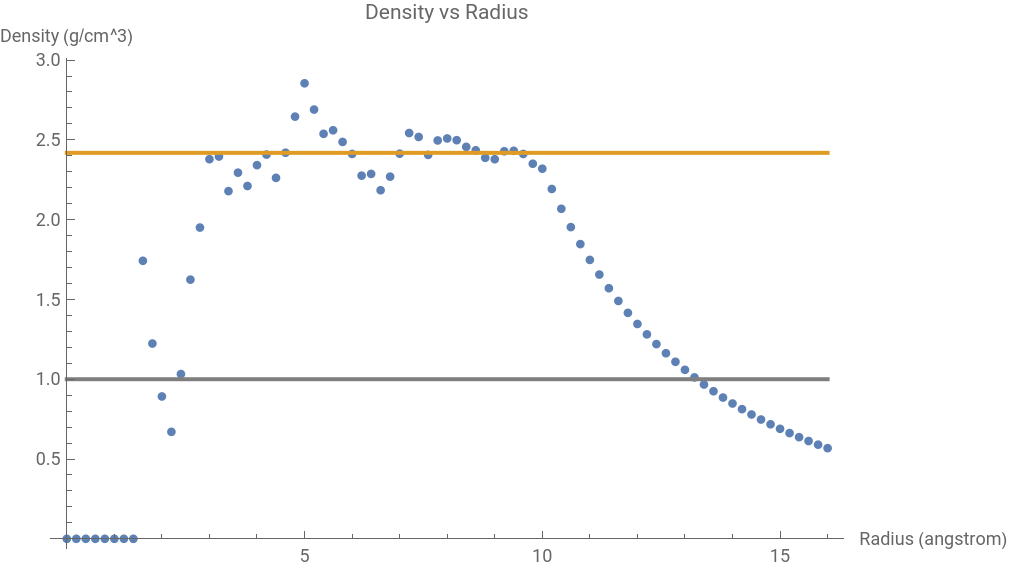
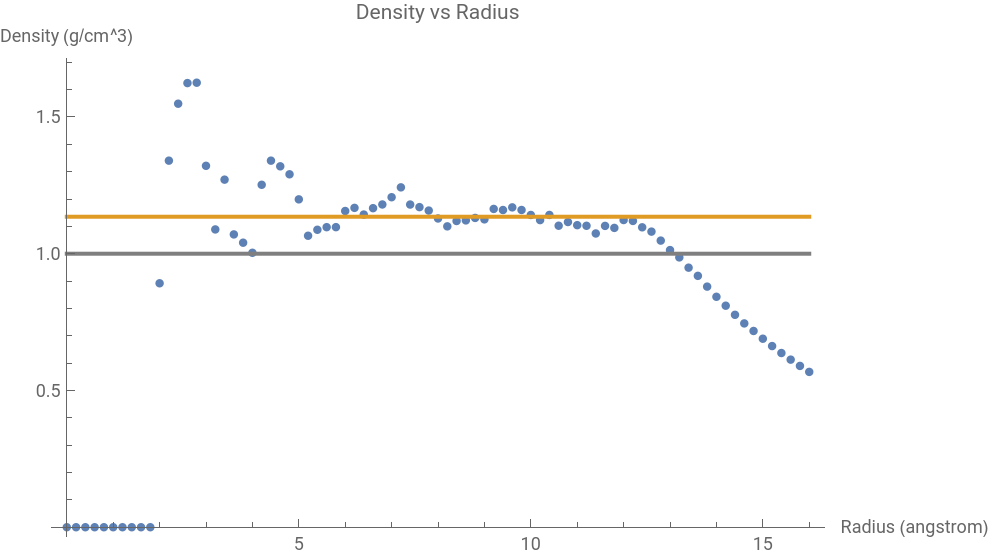
326 water molecules randomly distributing in a sphere (r = 1 nm or 10 Å) have been built and density values of the nano-ball before and after energy optimization have been compared to confirm that this is a good model of bulk water.
Before energy optimization, the density of nano-ball is much higher than the actual value (1 g ). The density decreases when the radius is larger than 10 angstrom because there is no water molecule outside that range. After energy optimization, the density is close to the actual value. This process has been repeated 5 times and the results show very similar density value, which suggests that we can rely on this model for the study of aqueous electrolytes.
-3
cm
Before energy optimization
Before energy optimization
After energy optimization
After energy optimization
Water Molecules Analysis
Water Molecules Analysis
The distributions of hydrogen bond distances and oxygen-hydrogen-oxygen angles in water molecules within the water nano-ball have been analyzed. The distance distribution follows a log-normal distribution, and the angle distribution follows a beta distribution.
Results
Results
Here, we show the case of Mg ion and Alanine-Aspartic acid-Serine (Ala-Asp-Ser or ADS) tripeptide in a water nano-cylinder at pH=7 where the -COOH group ionizes to lose proton and be negatively charged, and there is one positively charged -NH3 group in the peptide as shown below.
Random points have been generated as coordinates of Mg ion at different spots, and those overlapped with or too close to the peptide or water molecules have been deleted. Each coordinate has been assigned to the Mg ion by the following code. Only one Mg ion was introduced in the molecule complex with the peptide in the water nano-cylinder for analysis.
Selective spots of Mg ion migration before and after optimization in the complex are displayed below. The Mg ion located near ionized carboxyl group tends to be drawn to relocate along the direction of C=O or C-O bond after energy optimization, as in the case of Mg1 and Mg2. The Mg ion is surrounded by 5 water molecules and an oxygen at 6 octahedral sites, respectively. In contrast, if Mg ion (e.g. Mg8) is on the side of -NH3 group it is repelled away from the peptide, because they have same positive charge.
Mg1: Before energy optimization
Mg1: Before energy optimization
Mg1: After energy optimization
Mg1: After energy optimization
Mg2: After energy optimization
Mg2: After energy optimization
Mg8: Before optimization
Mg8: Before optimization
Mg8: After optimization
Mg8: After optimization
Here is the migration map of Mg ion at different spots before (labeled as b) and after (labeled as a) energy optimization. The Mg ion prefers to relocate close to carboxyl group and far away from positively charged amino group. Note that the position of the peptide here is before the introduction of Mg ion in the complex.
The presence of Mg ion can also affect the conformation of the peptide, as shown below in the code and plot.
Concluding Remarks
Concluding Remarks
The inter-molecular energy capability of MMFF in Wolfram Language has been tested to high reliability. The analysis results of density of water nano-ball, and hydrogen bond distance and O—H⋯O angle distributions of the water molecule complex suggest that this is a good model of bulk water. By modeling peptide and Mg ion in the water nano-cylinder, it can be found that the Mg ion tends to relocate along the direction of C=O or C-O bond and be away from positively charged -NH3 group after energy optimization. Overall, this study demonstrates the effective and flexible use of Wolfram Language for modeling, manipulating, and visualizing molecular ensembles.
Acknowledgments
Acknowledgments
I am deeply grateful for Robert Nachbar’s invaluable assistance and support as my mentor throughout this project. His patience, expertise in chemistry and biology, and insightful guidance have been instrumental. I also extend my thanks to Eric Parfitt for his help with coding. Finally, I would like to thank Stephen Wolfram and the entire Summer School staff for providing this wonderful learning opportunity and their continuous support throughout the project.
References
References
1
.H. Ahn, et al. (2023), “Challenges and Possibilities for Aqueous Battery Systems”, Communications Materials. https://www.nature.com/articles/s43246-023-00367-2.
2
.B. Wang, et al. (2022), “Synergistic Solvation and Interface Regulations of Eco-Friendly Silk Peptide Additive Enabling Stable Aqueous Zinc-Ion Batteries”, Advanced Functional Materials. https://doi.org/10.1002/adfm.202112693.
3
.T. A. Halgren (1995), “Merck Molecular Force Field. II. MMFF94 van der Waals and Electrostatic Parameters for Intermolecular Interactions”, Journal of Computational Chemistry. https://onlinelibrary.wiley.com/doi/10.1002/(SICI)1096-987X(199604)17:5/6%3C520::AID-JCC2%3E3.0.CO;2-W.
Full Code
Full Code
Cite This Notebook
Cite This Notebook