It’s almost 2/7. Did anything interesting happen 2/7/1828? Jules Verne was born the next day, I suppose that’s close enough.
Jules Verne used logarithms in one of his stories:
“Eureka!” he cried, “I have found it!”
“What have you found?” asked Sir John.
“An error in the last decimal of a logarithm of James Wolston’s.”
“Eureka!” he cried, “I have found it!”
“What have you found?” asked Sir John.
“An error in the last decimal of a logarithm of James Wolston’s.”
So what is E?
In[]:=
N[E,10]
Out[]=
2.718281828
It’s the reciprocal sum of factorials:
In[]:=
Sum[1/n!,{n,0,∞}]
Out[]=
x=E
1/x
x
In[]:=
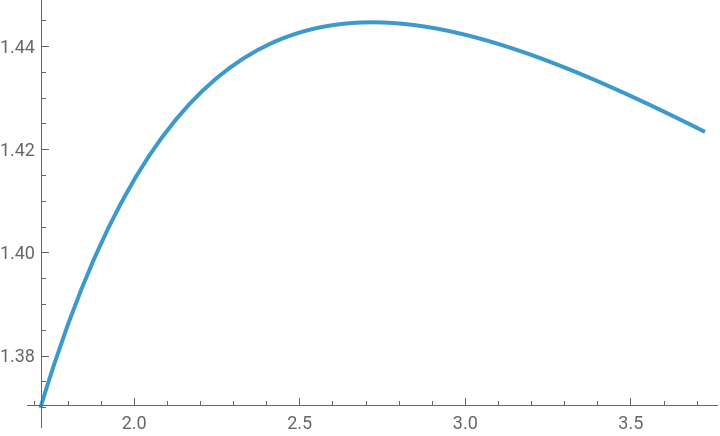
Plot[x^(1/x),{x,E-1,E+1}]
Out[]=
It’s the base for natural logarithms:
In[]:=
Log[E]
Out[]=
1
And there’s this famous equation:
In[]:=
Iπ
E
Out[]=
0
If we arrange the numbers 1 to 10 in random order, what are the odds that none of them have the correct position?
As permutations, these are called derangements:
As permutations, these are called derangements:
In[]:=
d10=ResourceFunction["Derangements"][10]//Length
Out[]=
1334961
The probability that a permutation is a derangement tends to 1/E.
In[]:=
N[10!/d10,10]
Out[]=
2.718281658
The number of derangements is called the subfactorial, and it can be calculated by dividing the factorial by E:
In[]:=
{Subfactorial[20],Round[20!/E]}
Out[]=
{895014631192902121,895014631192902121}
If you add up random numbers from 0 to 1, you need about E of them to go over 1.
In[]:=
N[Mean[Length/@Table[Drop[NestWhileList[#+Random[]&,0,Total[#]<=1&],1],{100000}]]]
Out[]=
2.71696
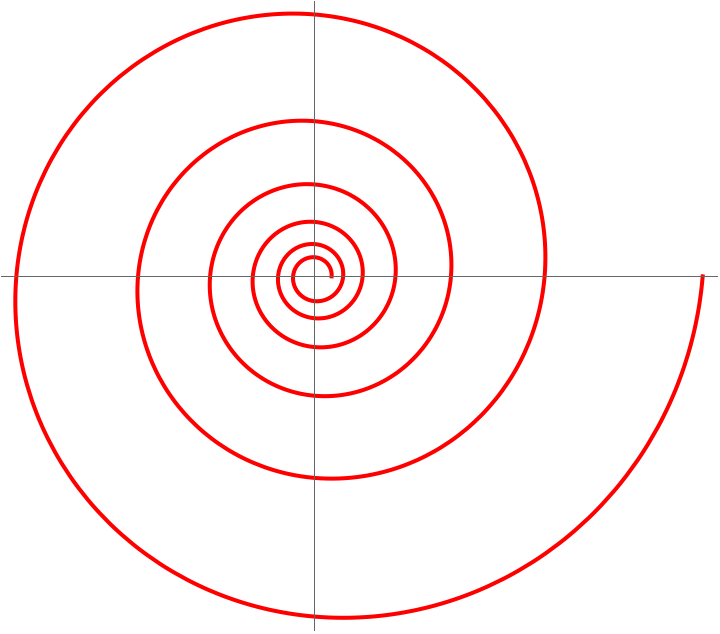
The Exponential spiral is based on the exponential function:
In[]:=
PolarPlot[Exp[t/12],{t,0,12π},PlotStyleRed,TicksNone]
Out[]=
We can look at the exponential Mandelbrot set:
In[]:=
ArrayPlot[Table[Length[Quiet@NestWhileList[Exp[#]+y+xI&,0,Abs[#]<10^12&,1,30]]-1,{x,-2.5,2.5,.005},{y,-1,4,.005}],ColorFunction"Rainbow"]
Out[]=
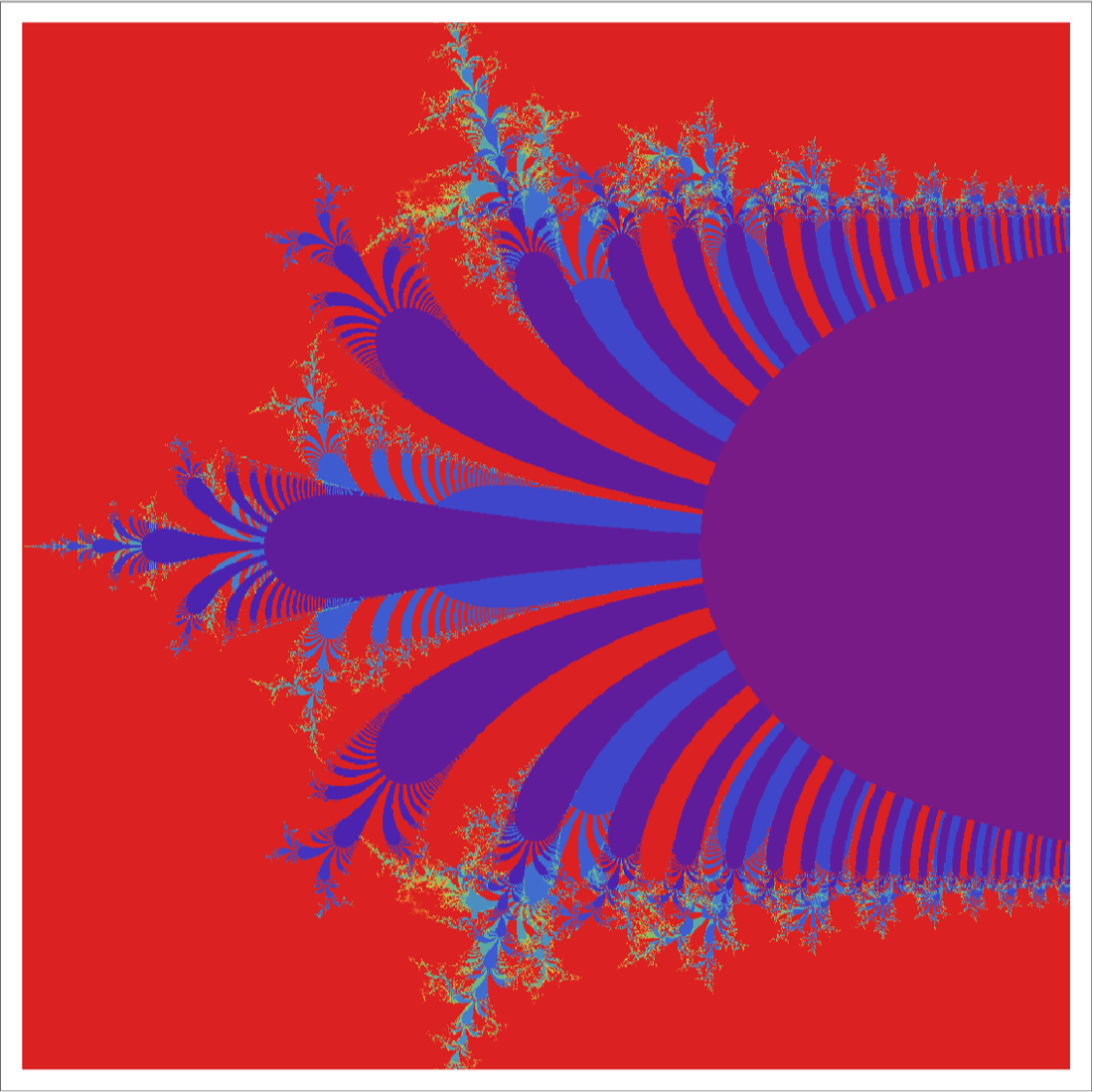
What’s going on at the top? This zoom takes a while:
Table[Length[Quiet@NestWhileList[Exp[#]+y+xI&,0,Abs[#]<10^15&,1,80]]-1,{x,-3,-1,.1},{y,0,2,.1}]
In[]:=
ArrayPlot[Table[Length[Quiet@NestWhileList[Exp[#]+y+xI&,0,Abs[#]<10^15&,1,80]]-1,{x,-3,-1,.001},{y,0,2,.001}],ColorFunction"Rainbow"]
Out[]=

A variant fractal
In[]:=
ArrayPlot[Transpose[Table[Length[Quiet@NestWhileList[Exp[#]&,x+yI,Abs[#]<100000&,1,10]],{x,-2,4,.01},{y,-3,3,.01}]],ColorFunction"Rainbow"]
Out[]=

Another variation
Another variation for the reciprocal:
The exponential curlicue fractal:
E is used for the curve of a hanging chain, the catenary curve:
The correct formula works just fine:
We may as well toss the logarithmic table experience into this.
CITE THIS NOTEBOOK
CITE THIS NOTEBOOK
Celebrating Euler's day: algorithms for derangements, branch cuts, and exponential fractals
by Ed Pegg
Wolfram Community, STAFF PICKS, February 4, 2026
https://community.wolfram.com/groups/-/m/t/3634481
by Ed Pegg
Wolfram Community, STAFF PICKS, February 4, 2026
https://community.wolfram.com/groups/-/m/t/3634481