Problem
Problem
ABCD is a convex quadrilateral.
◼
M is a point on segment AD, and N is a point on segment BC.
◼
P is the intersection of segment AN and segment MB.
◼
Q is the intersection of segment DN and segment CM.
◼
AM
AD
CN
CB
Prove that Area MQNP is equal to the sum of Area APB and Area DQC
Geometric Scene Construction
Geometric Scene Construction
Let’s use the synthetic feature of Wolfram language to build a proper geometric scene. Since the problem doesn’t say anything specific about how the bounding polygon should look like, we can give any coordinates to points A B C and D as long as it is convex.
I prefer GeometricScene to Graphics in this type of problem because the coordinates of the intermediate points like P and Q can be resolved automatically. Plus, the returned GeometricScene object can be easily converted to the Graphics objects with the built-in attributes.
Also, in stead of just building one particular scene, we would like to see if the relation awaiting a proof changes with different ratio parameter λ. We can create a function to sweep through some possible configurations, namely gs
In[]:=
gs[λ_]:=RandomInstanceGeometricScene{a{0.1,1},b{0,0},c{4,0},d{2,2},m,n,p,q},Style[Polygon[{a,b,c,d}],Transparent],m∈Style[Line[{a,d}],Transparent],n∈Style[Line[{b,c}],Transparent],Line[{a,p,n}],Line[{b,p,m}],Line[{c,q,m}],Line[{n,q,d}],Style[Polygon[{p,m,q,n}],Red],Style[Triangle[{a,p,b}],Blue],Style[Triangle[{c,d,q}],Blue],λ;
EuclideanDistance[a,m]
EuclideanDistance[a,d]
EuclideanDistance[c,n]
EuclideanDistance[c,b]
Notice that how easy it is to add styles to the simple graphics object for good and clean visualization.
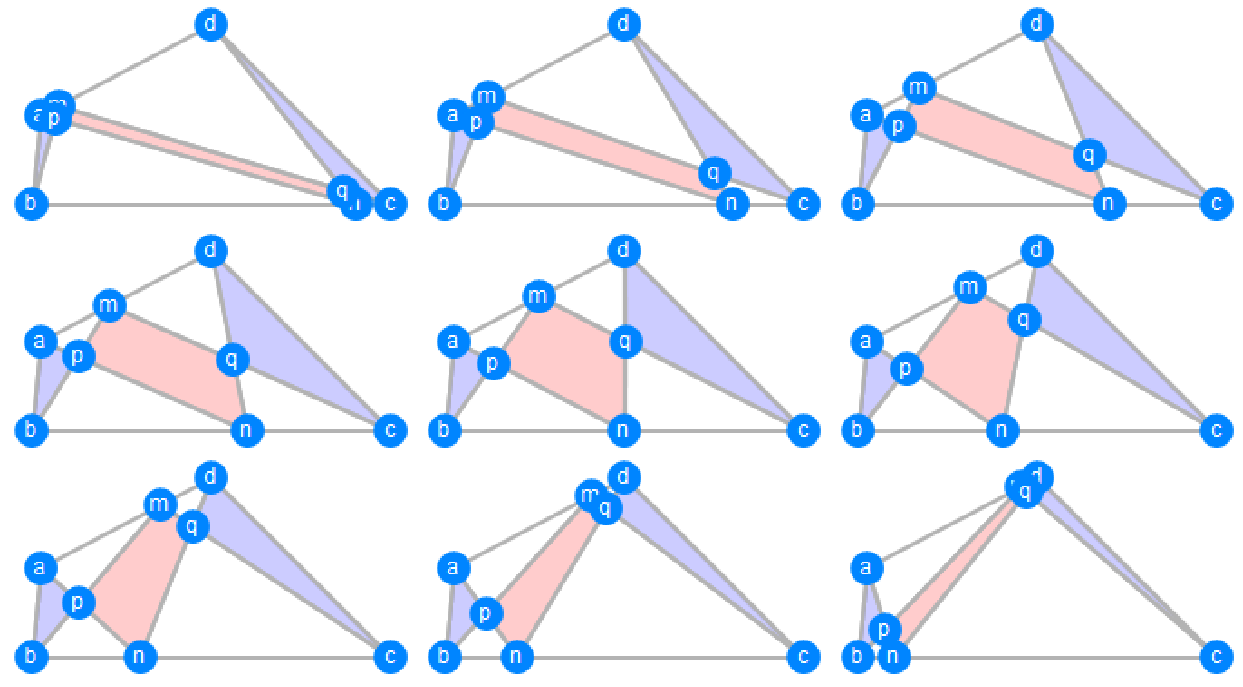
Let’s take a look at the result if we change λ from 0.1 to 1. Use either ParallelTable or ParallelMap to accelerate the computation. Save one particular sample to use later.
gsList=Table[gs[i],{i,0.1,0.9,0.1}];gs5=gsList〚5〛;
Use Grid function to demonstrate the setups in a neat 3 by 3 block.
In[]:=
Grid[Partition[gsList,3,3]]//Style[#,ImageSizeMultipliers{0.55,1}]&
Extract the coordinates of all labeled points in one scene
gs5["Points"]//TableForm
Out[]//TableForm=
a{0.1,1.} |
b{0.,0.} |
c{4.,0.} |
d{2.,2.} |
m{1.05,1.5} |
n{2.,0.} |
p{0.533674,0.763871} |
q{2.00472,1.00265} |
Similarly, we can use lamba expression and Map(/@) function to extract the coordinates in every scenes we have so far.
In[]:=
pts=#["Points"]&/@gsList;
The sum of area for triangle ABP and triangle DQC w.r.t. λ from 0.1 to 1 in each scene
NumberForm[(Area[Triangle[{a,p,b}]]+Area[Triangle[{c,d,q}]])/.pts,3]
Out[]//NumberForm=
{0.447,0.8,1.05,1.18,1.22,1.14,0.979,0.736,0.418}
The area of polygon MQNP w.r.t. λ from 0.1 to 1 w.r.t. λ from 0.1 to 1 in each scene
NumberForm[Area[Polygon[{m,p,n,q}]]/.pts,3]
Out[]//NumberForm=
{0.447,0.8,1.05,1.18,1.22,1.14,0.979,0.736,0.418}
Just compare the two list piece by piece we quickly realize the assertion in the problem is correct.
Proof
Proof
Because the problem does not include useful information about the angle or length of these polygons and triangles, in general we cannot use congruence theorems by extension or slicing some polygons. Thus we might have to work with the algebraic expression of area.
Observe the geometry we can tell that if the equation of the areas are the same, then the following must be true:

Use the coordinates we obtained from gs5, with Translate function, we generate a nice animation of the area transformation
In[]:=
ManipulateStyleColumn@gs5["Graphics"],With{tr=Translate[#,γ*(n-m)]&},Graphics,Thick,Line[{a,d}],,Triangle[{a,p,b}],,tr@Polygon[{m,q,n,p}],,Triangle[{d,q,c}],,EdgeForm[{Thick,Yellow}],Triangle[{p,b,n}],Triangle[{q,n,c}],tr@Triangle[{q,n,c}],tr@Triangle[{p,b,n}]/.gs5["Points"],ImageSizeMultipliers1,{γ,0.01,1},SaveDefinitionsTrue


Out[]=


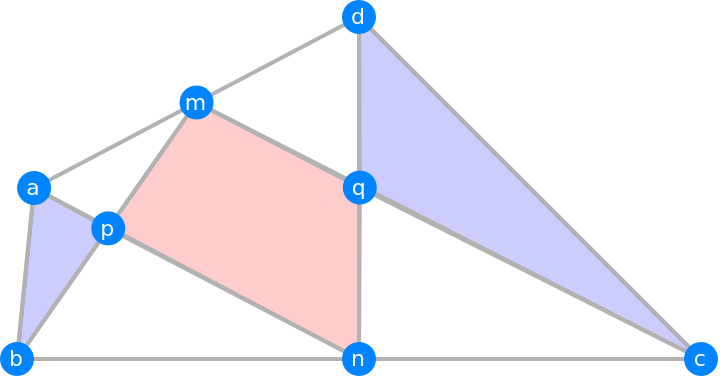
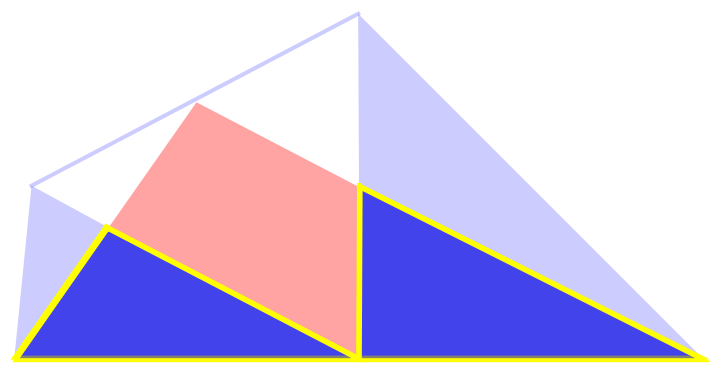
Therefore, we can compute the area of the three combined triangles:
◼
Area MBC = ×BC×
1
2
h
M
◼
Area ABN = ×BN×=×(1-λ)×BC×
1
2
h
A
1
2
h
A
◼
Area DNC = ×CN×=×λ×BC×
1
2
h
B
1
2
h
D
where is the altitude passing the vertex and sharing the same base. Notice that we also have affine relation and .Here is a simple illustration for arbitrary points P1 and P2 and their internal points given by length ratio λ.
h
point
point
h
A
h
M
h
D
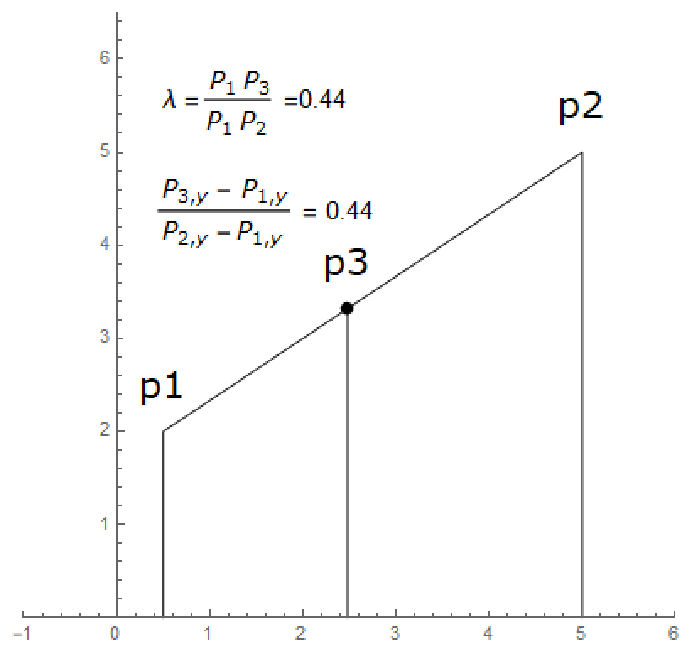
Now we can wrap up everything in the code below to check the equality in algebraic form
The sum of area in two expressions
We can conclude proof by the following result.
Other Geometry Problems
Other Geometry Problems