This is part of live presentation series called Mathematical Games in which we explore a variety of games and puzzles using Wolfram Language. In this episode, we explore games that involve filling space with similar parts.
demonstrations.wolfram.com
demonstrations.wolfram.com
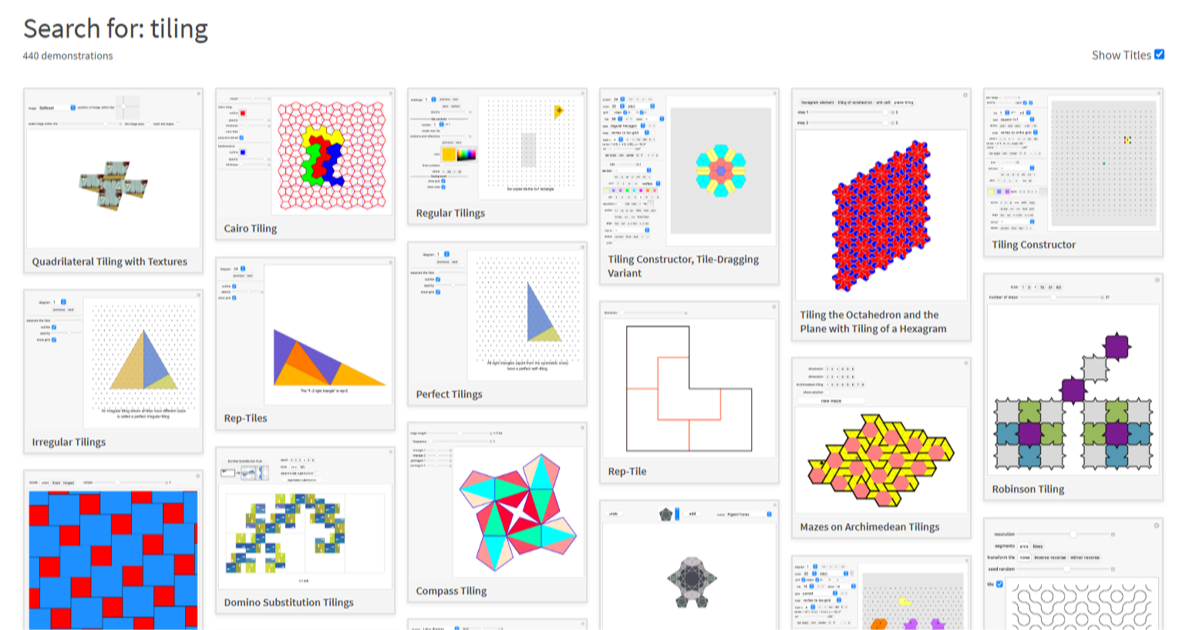
Many Demonstrations show tilings.
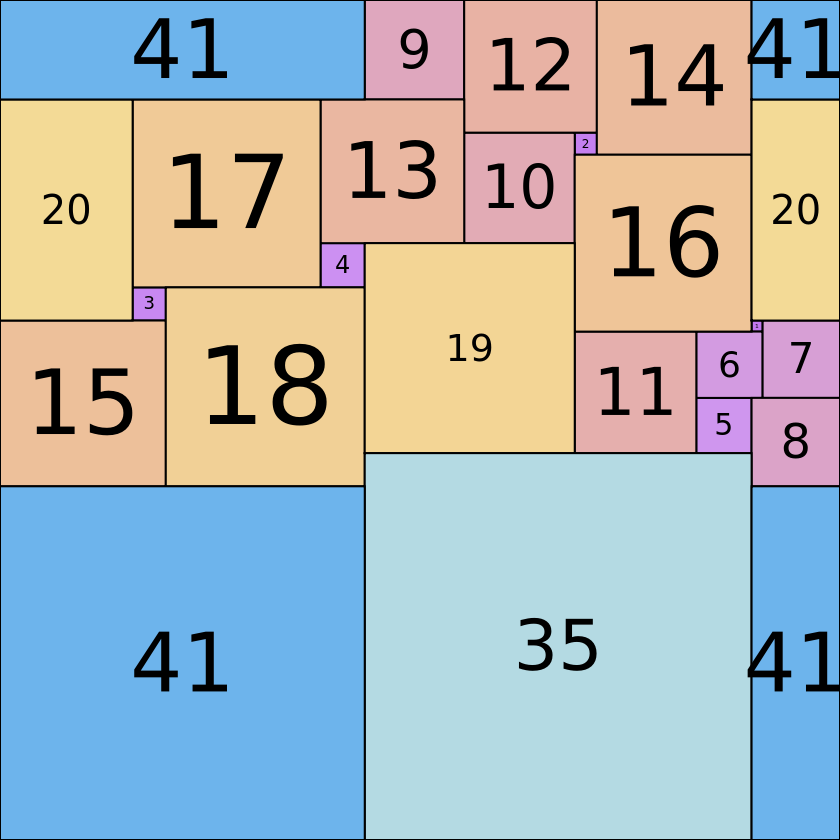
A Smaller Perfect Squared Square ... on a Torus
A Smaller Perfect Squared Square ... on a Torus
Martin Gardner ran a contest to make an order-70 square square out of squares 1 to 24. That turns out to be impossible, even on a torus.
On September 14th, Stuart Anderson found this toroidal perfect squared square solution using squares 1 to 20, 35 and 41.
On September 14th, Stuart Anderson found this toroidal perfect squared square solution using squares 1 to 20, 35 and 41.
Out[]=
New 12-square covering
New 12-square covering
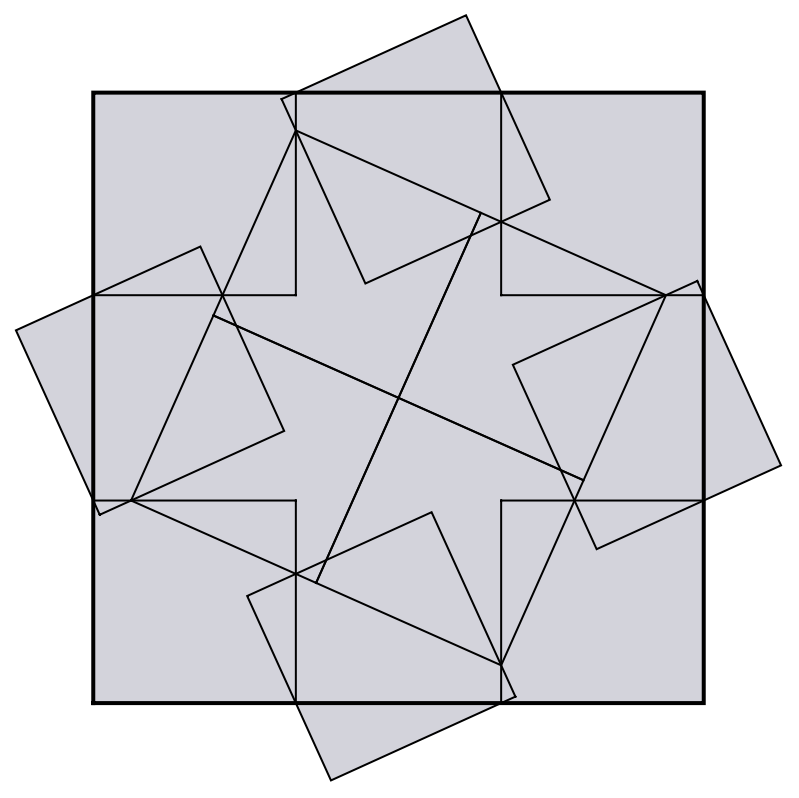
Ryan Chi, September 2026. 12 squares can cover a square with area 9.081961324844439...
In[]:=
q=Root[-7-41#-73#^2+89#^3+584#^4-120#^5+56#^6-40#^7-112#^8+176#^9-80#^10+16#^11&,3];N[4(1+q)^2,16]
Out[]=
9.081961324844439
Out[]=
Chomp 3×n solved
Chomp 3×n solved
In the game of Chomp, you have a big bar of chocolate, but the upper left corner is poison. Each person takes turns taking a chomp out of the bar. Whoever eats the poison square loses.
Erez Sheiner has proved all 3×n chomp positions have a unique winning move, settling Gale’s 52-year uniqueness conjecture.
https://arxiv.org/abs/2605.23837
https://arxiv.org/abs/2605.23837
Out[]=


Hadamard 668
Hadamard 668
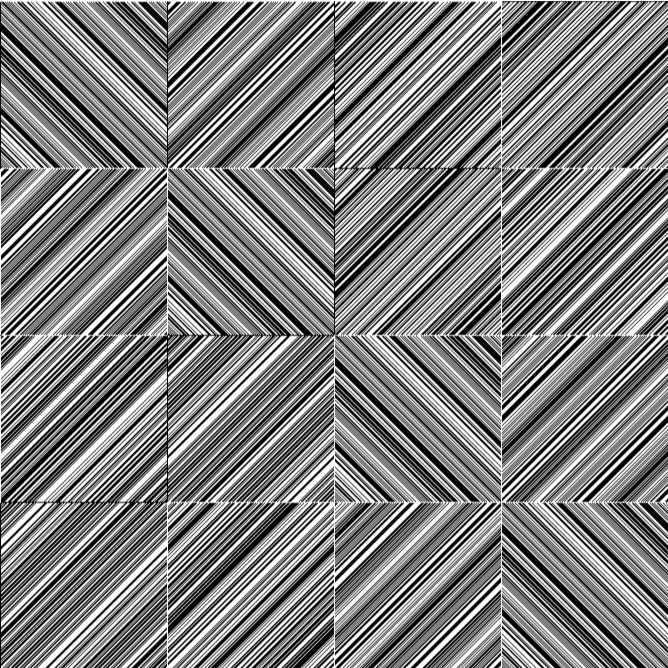
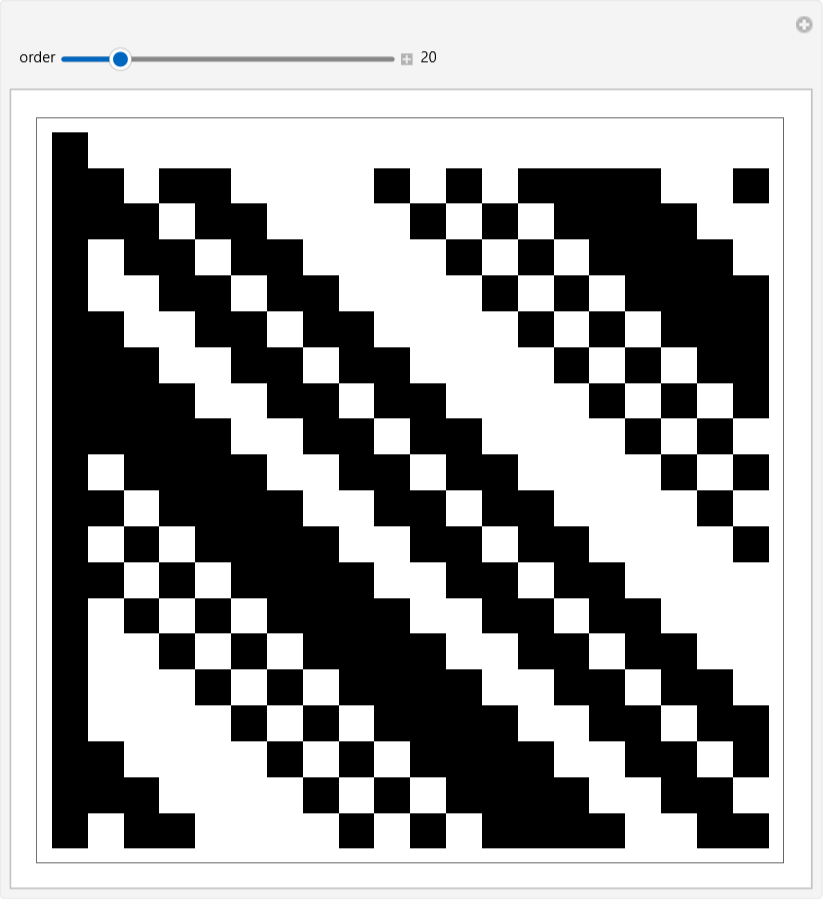
A Hadamard matrix is a square matrix with all entries equal to +1 or -1, with its rows mutually orthogonal. Half of the corresponding pairs of entries in any two rows have the same sign and half have the opposite sign. It is conjectured that a Hadamard matrix of order n exists for all integers divisible by 4. However, many orders are unsolved, including 668, 716 and 892....
A Hadamard matrix is a square matrix with all entries equal to +1 or -1, with its rows mutually orthogonal. Half of the corresponding pairs of entries in any two rows have the same sign and half have the opposite sign. It is conjectured that a Hadamard matrix of order n exists for all integers divisible by 4. However, many orders are unsolved, including 668, 716 and 892....
This notebook reconstructs the Hadamard matrix of order 668 announced in 2026 by Levent Alpöge, Philippe Voinov, and Saul Reynolds-Haertle, with assistance from Claude.
The matrix is reconstructed as four 167-element cyclic parts. Each part has one fixed distinguished coordinate, so only its other 166 signs are stored. The final permutation groups each distinguished coordinate with its 166 companions.
code
code
image
image
In[]:=
ResourceData["Demonstration: Small Hadamard Matrices"]
Out[]=
8-reptile Tetrahedra
8-reptile Tetrahedra
I had this slide in my previous talk, and I wanted to expand on it.
There are three tetrahedra that will make larger copies of themselves:
We can go to the next level.
A new Rational Tightest Square Packing for 50 squares
A new Rational Tightest Square Packing for 50 squares
Heesch in 2D
Heesch in 2D
A Heesch polygon can surround itself, but cannot tile space. Heinrich Heesch introduced the problem in 1968 and exhibited a convex pentagon with Heesch number 1. Heesch’s original pentagon can be decomposed into a square, an equilateral triangle, and a 30-60-90 triangle.
The tile can completely surround itself.
Craig S. Kaplan gives a particularly accessible introduction here: Heesch numbers, Part 1. One infinite class of Heesch-3 polygons I helped to identify are now called the Pegg Snakes. For many years the largest known finite Heesch number was 5, from work of Casey Mann. In 2020 Bojan Bašić found a figure with Heesch number 6, published in 2021. The general problem remains open. Useful starting points are MathWorld: Heesch Number, Bašić’s Heesch-6 paper, and Craig Kaplan’s Heesch-number data.
Craig S. Kaplan has carried out extensive computational work on Heesch numbers, including exhaustive searches of large families of polyforms using SAT methods. His 2021 paper and dataset are linked above. His earlier experiments with surrounding shapes also led to the puzzle game Good Fences, in which copies of a kernel must form a complete fence around it. Kaplan notes that the game grew directly out of his work with coronas. When David Smith began experimenting with the shape that became the Hat, it was not initially clear whether it tiled the plane at all. One plausible possibility was that it was a non-tiler with a surprisingly high Heesch number. Smith sent the shape to Craig Kaplan, and the subsequent investigation led instead to the first aperiodic monotile. Kaplan recounts the story in Scientific American and on the Hat project page.
More Heesch Polygons
More Heesch Polygons
Forty checked entries: one convex pentagon, eighteen polyominoes, twenty polyhexes, and one polyiamond. Each polyform has its original catalog cell list plus exact orientation and integer displacement records transcribed from its source PDF. The pentagon uses exact square-root coordinates reconstructed from the cited SVG. Selecting a corona count above the example’s Heesch number displays its final available corona.
Heesch in 3D
Heesch in 3D
For Heesch in 3D, one example uses the 3x3x3 cube, removing two faces cubes and adding a face cube. With the disparity, there are eventually too many holes to fill.
At https://heesch-atlas.netlify.app/ there are many examples of tiling objects with bumps and dimples. One can also extrude a planar Heesch polygon into a prism and extrude a planar corona with it.
At https://heesch-atlas.netlify.app/ there are many examples of tiling objects with bumps and dimples. One can also extrude a planar Heesch polygon into a prism and extrude a planar corona with it.
In three dimensions there is an additional obstruction unavailable in the planar problem: the Dehn invariant. Every polyhedron that tiles Euclidean 3-space has Dehn invariant 0. The converse is false: D=0 is necessary, not sufficient, for space filling. See MathWorld: Dehn Invariant.
Graphic
Graphic
3D Heesch Polycubes
3D Heesch Polycubes
One thing apparently not studied -- Heesch polycubes. Am I the first to point out this is Heesch? 3-stacks surrounded by 2-stacks, plus 4.
The space-filling truncated tetrahedron
The space-filling truncated tetrahedron
Start with the regular tetrahedron with vertices {1,1,1}, {1,-1,-1}, {-1,1,-1}, and {-1,-1,1}, and truncate every edge one quarter of the way from each endpoint. This is the space-filling truncated tetrahedron appearing in the beta-tin packing described by Damasceno, Engel, and Glotzer; see ACS Nano 6 (2012), 609-614.
Start Since the shape fills space, it has Dehn invariant 0. The regular tetrahedron has a non-zero Dehn invariant. If we add it to the beta-tin, we get a heptahedron that cannot fill space. Taking one third of the heptahedron gives the Heesch hemiobelisk. The hemiobelisk is one of the seven hexahedra.
A Corona for the Heesch Hemiobelisk
A Corona for the Heesch Hemiobelisk
Originally, I planned on just using the heptahedrons. I completely surrounded a beta-tin space-filling truncated tetrahedron. For all those on the outside, I converted them into heptahedra. Then I removed 1 of them to expose a triangular cell. To that, I added a tetrahedron, to make the central cell a heptahedron. Then I tried to completely surround it. I ran into some problems. Second, the yellow shape intersected with one of the outer heptahedra I needed. At that point, I had the idea of dividing the heptahedron into three parts.
In the figure below, each of the three inner cells has a single problem point.
A cleaner Heesch Hemiobelisk
A cleaner Heesch Hemiobelisk
It turns out that point p can be fixed. We can also clear away extra hemiobelisks.
Does the Heesch Hemiobelisk actually work?
Does the Heesch Hemiobelisk actually work?
We can build a contact matrix. 4=solid intersection, 3=face intersection, 2=edge intersection, 1=point intersection, 0 = no intersection.
None of the hemiobelisks have a volume intersection.
None of the hemiobelisks have a volume intersection.
The nearest uncovered point is at {18/13,18/13,16/13}, so we can cut a solid around the central cell at a depth of 1/13 and calculate the volume of the intersection. If all the surrounding shapes add up to the correct volume, then the complete surround is confirmed.
The intersection volume is correct. We can show that intersection at a depth of 1/13.
It does not yet prove that the exact three-dimensional Heesch number is 1. To make that stronger statement, every possible second corona would need to be found, and then it would need to be shown that none of these coronas could be completely surrounded. This construction establishes a genuine finite-Heesch phenomenon in 3D in the natural sense of a non-space-filling solid with a complete corona.
Is that the simplest example? Maybe. It is possible that one of the non-tiling rational tetrahedra is 1-Heesch. All of these have Dehn invariant 0.
What is the tightest corona for the Heesch hemiobelisk? I have no idea.
Another question. Is it possible for a space-filling polyhedron to have a finite Heesch polygon in a cross-section? I don’t know the answer to that, either.
Mosseri–Sadoc Tiles
Mosseri–Sadoc Tiles
The six Mosseri–Sadoc fundamental tetrahedra assemble several familiar icosahedral polyhedra and can be used to tile space. The first n tetrahedra are displayed.
Viewer
Viewer
Rep-Tiles
Rep-Tiles
A 2D shape that can tile itself with n smaller,equally sized copies of itself is called a rep-tile and is said to be rep-n.
A Strongly Aperiodic Monotile in Three Dimensions
A Strongly Aperiodic Monotile in Three Dimensions
By Ioannis Tsiokos, 16 Sep 2026. https://arxiv.org/pdf/2609.19214 https://www.quantamagazine.org/updates/transformation/#167384
A chair tiling can be forced in 3D with matching rules.
The 3D Golden 6 Substitution System
The 3D Golden 6 Substitution System
The 3D Golden 6 substitution system uses six tetrahedra, where each edge length is a power of the square root of the golden ratio. Numbers at the top give those powers, connecting vertices {{1,2}, {1,3}, {1,4}, {2,3}, {2,4}, {3,4}}. For example, the Bluish shape has edge lengths {0,0,1,1,0,2}.
Each tetrahedron has a substitution rule that decomposes it into smaller tetrahedra chosen from the same six types. The colors identify tetrahedron type and remain fixed throughout the recursion.
The 3D Golden 7 Substitution System
The 3D Golden 7 Substitution System
The 3D Golden 7 substitution system uses seven tetrahedra, where each edge length is a power of the square root of the golden ratio. Edge keys are exponents in the order 12, 13, 14, 23, 24, 34.
Each color is one tetrahedron type. The seven exact substitution rules contain 9, 7, 10, 9, 15, 8, and 9 pieces. The table gives piece counts by type and relative linear-scale exponent; within each color, the largest copy has scale 0.
Plastic K19 Pyramid
Plastic K19 Pyramid
The plastic K19 pyramid is a set of 19 points where all distances are integral powers of ρ.
All distances between points are integer powers. With all this, I thought some subset of tetrahedra would have the property that they could build each other.
But so far, I haven’t found a set.
But so far, I haven’t found a set.
Right Triangle Dissections
Right Triangle Dissections
How many different ways can you cut a 3-4-5 triangle into n pieces similar to a 3-4-5 triangle? Or a general right triangle. This is apparently a new sequence.
1, 1, 2, 10, 60, 363, 2346, 16581.
1, 1, 2, 10, 60, 363, 2346, 16581.
Constructions Functions
Constructions Functions
Two pieces
Two pieces
The altitude from the right angle gives the unique two-piece dissection.
In[]:=
u4Graphic[First[u4Two],200]
Subdividing either altitude piece gives the two three-piece layouts.
In[]:=
Grid[{u4Graphic[#,200]&/@u4Three},Spacings->{.5,0}]
The symmedians concur at K with barycentrics a^2:b^2:c^2. For the 3-4-5 triangle these are 25:9:16, so K=(18/25,24/25).
The layouts are sorted lexicographically by largest normalized area, then second largest, and so on. Equal areas have the same color throughout.
Solutions 3, 5 and 7 use the symmedians. Solutions 9 and 10 use the medians.
Solutions 3, 5 and 7 use the symmedians. Solutions 9 and 10 use the medians.
Consecutive entries in the area ordering are paired across the two halves of each rectangle.
Right Triangles 5 Parts
Right Triangles 5 Parts
Five-piece solutions
Five-piece solutions
The 60 solutions are ordered lexicographically by largest piece, then second largest, and so on.
Right Triangles 6 Parts
Right Triangles 6 Parts
The 363 solutions use the same area colors and ordering; consecutive solutions share each rectangle, with the first rectangle containing the initial blank.
General Non-right Triangle Dissections
General Non-right Triangle Dissections
Number of ways to cut a non-right triangle into n self-similar parts.
1, 0, 0, 4, 0, 36, 64, 468, 1672
Apparently, this is a new sequence. The symmedians get used again.
1, 0, 0, 4, 0, 36, 64, 468, 1672
Apparently, this is a new sequence. The symmedians get used again.
For six pieces, there are a variety of trapezoid constructions:
In[]:=
Grid[Partition[triangleGraphic[#, 115] & /@ dissections6, UpTo[9]]]
For seven pieces, there 64 ways to put together the 4-part dissections.
Sporadic triangle dissections
Sporadic triangle dissections
Once we know all the ways to dissect a general triangle, we can look for strange ways to divide a triangle. These are the roots that frequently pop up.
All dissections
All dissections
These are most of the known sporadic triangles. This still needs some work.
Unsolved
Unsolved
1. What are other Heesch 3D objects?
2. What are other ways to cut a triangle into similar parts?
2. What are other ways to cut a triangle into similar parts?
I didn’t list all of them, yet. In the equilateral dissections, we get the supergolden ratio, the tribonacci constant, the ninth Pisot number and the third Pisot number.
Each of these extends into a self-similar triangle dissection by adding two triangles.
Each of these extends into a self-similar triangle dissection by adding two triangles.
By varying a dissection even slightly, wildly different results are possible.
CITE THIS NOTEBOOK
CITE THIS NOTEBOOK
Mathematical Games: filling space with similar parts
by Ed Pegg
Wolfram Community, STAFF PICKS, September 24, 2026
https://community.wolfram.com/t/28170
by Ed Pegg
Wolfram Community, STAFF PICKS, September 24, 2026
https://community.wolfram.com/t/28170