Recently, the Online Encyclopedia of Integer Sequence ran a contest as it neared sequence 400,000. Official winners and honorable mentions.
A400000 The city-building sequence (Eric Fox). At each new integer position, choose the least nonnegative height h from which exactly h earlier rooftops are visible. A rooftop lying on a line of sight does not obstruct it. The sequence begins 0, 1, 1, 2, 1, 2, 1, 3 and is known to be infinite, unbounded, and to contain every nonnegative integer.
Out[]=
{0,1,1,2,1,2,1,3,1,2,1,3,1,2,1,10,1,2,2,3,1,3,1,4,1,2,4,1,2,2,1,10,1,2,2,3,1,3,1,4,1,2,4,1,2,2,1,11,1,2,2,3,2,3,1,4,1,2,4,1,2,2,1,10,1,2,2,3,1,3,1,4,1,2,4,1,2,2,1,11,1,2,2,3,2,3,1,4,1,2,4,1,2,2,1,10,1,2,2,3}
Rémy Sigrist’s visibility plot. Black marks show the sequence; blue, white, and red indicate fewer than, exactly, and more than h visible buildings. · Original illustration and credit · MathWorld: City-Building Sequence
Out[]=

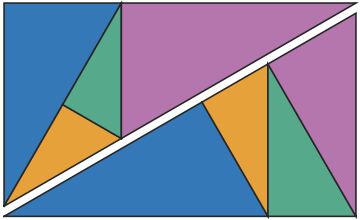
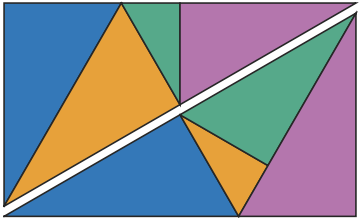
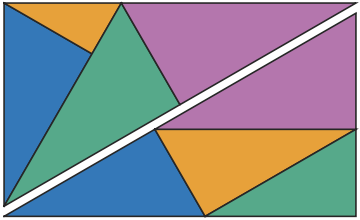
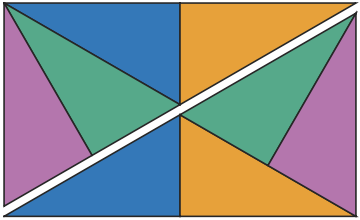
A399999 Ways to cut a 30-60-90 triangles into self-similar pieces (Ed Pegg Jr.). A drafter is a 30–60–90 triangle. The counts of dissections into 1 through 9 similar triangles are 1, 1, 3, 18, 121, 844, 6397, 53145, 460404. The eighteen four-piece dissections are paired below into nine rectangles. · Original eighteen-dissection illustration · MathWorld: 30–60–90 Triangle · MathWorld: Triangle Dissection
Out[]=
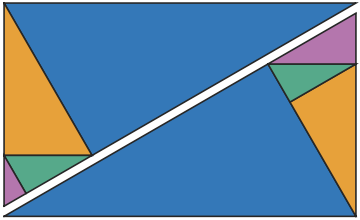
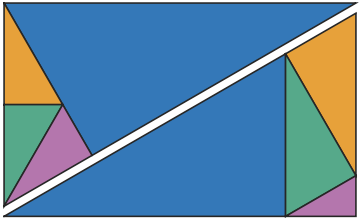
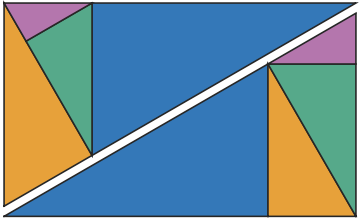
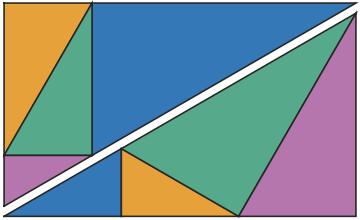
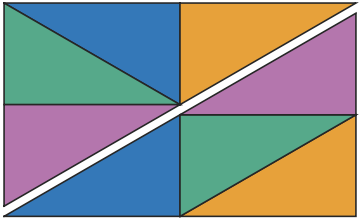
A400002 Hexagonal-lattice growth (Aidan Markey). Begin with two neighboring points of the six-neighbor triangular point lattice. At each simultaneous update, add an unoccupied point precisely when it has two occupied neighbors and those two neighbors are themselves adjacent. The total populations begin 2, 4, 8, 12, 18, 22, 26, 34, 42.
Out[]=
After 100 steps: 3770 points. The 68 points added on the final step are red. · Original stage-100 image · MathWorld: Hexagonal Lattice (background)
A399997 Many differences in a short interval (Wujie Gu). For n marks chosen from {0,1,...,Binomial[n,2]}, maximize the number of distinct positive pairwise differences. This differs from the complete sparse-ruler problem: missing distances are permitted, and the score is the number of distances attained, not the ruler’s span. · MathWorld: Sparse Ruler (background)
A connection to John Leech’s yardstick. The set {0,1,3,13,20,27,31,35,36} attains a(9) = 32, missing only distances 6, 21, 25, and 29. Adding the mark at 6 gives John Leech’s length-36 sparse yardstick, discussed by Martin Gardner. Gardner counts eight interior marks; including the endpoints gives ten. · Gardner, The Magic Numbers of Dr. Matrix (search the PDF for “yardstick”) Leech’s original reference: “On the Representation of 1, 2, ..., n by Differences,” Journal of the London Mathematical Society 31 (1956), 160–169.
Out[]=

Predicted continuation (by Ed Pegg), indexed by n = 3,...,24: {3,6,9,13,19,26,32,40,49,58,68,79,90,103,116,129,143,159,175,193,211,229} The values through n = 14 are listed in OEIS. The proposed continuation for n = 15 through 24 is supported by the following sets. Their difference counts are verified lower bounds; optimality is conjectural.
Out[]=
n | Differences | Marks |
15 | 90 | {0,1,11,21,22,35,48,61,74,90,93,97,99,102,105} |
16 | 103 | {0,2,3,8,12,18,37,50,63,76,89,96,103,117,119,120} |
17 | 116 | {0,2,3,9,20,22,23,29,81,86,91,96,120,124,128,132,136} |
18 | 129 | {0,1,2,7,14,21,28,50,65,80,95,110,118,126,134,142,151,152} |
19 | 143 | {0,1,2,3,12,21,30,56,73,90,107,124,132,140,148,156,164,170,171} |
20 | 159 | {0,1,2,3,8,16,24,32,57,74,91,108,125,142,151,160,169,178,188,189} |
21 | 175 | {0,1,2,3,13,23,33,62,72,91,110,129,157,166,175,184,193,202,208,209,210} |
22 | 193 | {0,1,2,3,13,23,33,62,72,91,110,129,148,176,185,194,203,212,221,227,228,229} |
23 | 211 | {0,1,2,3,13,23,33,62,72,91,110,129,148,167,195,204,213,222,231,240,246,247,248} |
24 | 229 | {0,1,2,3,13,23,33,62,72,91,110,129,148,167,186,214,223,232,241,250,259,265,266,267} |
A400005 Three colors of knights (Rémy Sigrist). Red, Green, and Blue take turns placing a knight on the least numbered available square of a square spiral. A placement may not be attacked by a knight of either other color. A400005 records the squares chosen by Red.
Out[]=
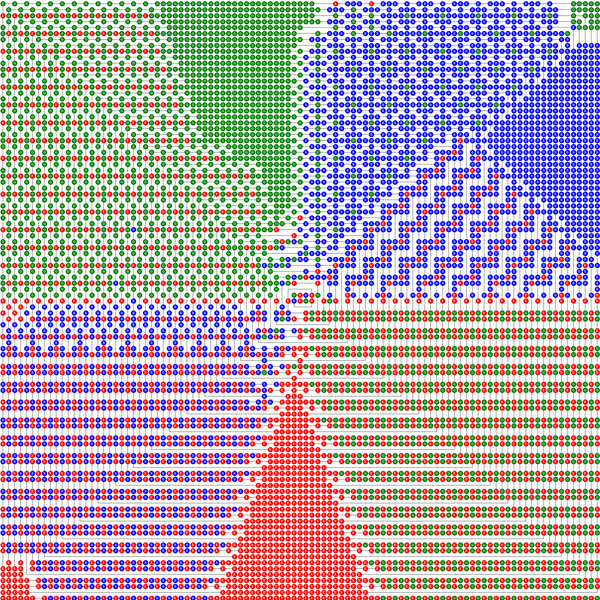
Rémy Sigrist’s three-color knight arrangement near the center of the spiral. · Original close-view illustration · MathWorld: Knight Graph (background)
Out[]=
{0,3,10,11,18,23,25,30,34,41,44,46,48,52,59,68,82,83,89,92,115,117,119,121,126,132,150,155,158,162}
A400004 Boxes with room to spare (Scott B. Farrar). Minimize ab+ac+bc over positive integer box sides with abc at least n. Thus the sequence is half the least surface area, allowing spare capacity. For n=7, a 2 by 2 by 2 box gives a(7)=12. The short enumeration below uses sorted side lengths and keeps the third side as small as feasible.
Out[]=
{3,5,7,8,11,11,12,12,15,16,16,16,20,20,20,20,21,21,24,24,26,26,26,26,27,27,27,31,31,31,32,32,33,33,33,33,38,38,38,38}
A399998 A self-referencing recurrence (Rok Cestnik). Starting with a(0)=0, use a(n+1)=a(n-a(a(n))^2)+1. Each term points to an earlier term and adds one; the values therefore describe depths in a rooted reference tree. Growth proportional to 2^(1/4) Sqrt[n] is conjectured. · MathWorld: Recurrence Equation (background)
In[]:=
Module[{values = {0}, index, back},
Do[back = index - values[[values[[index + 1]] + 1]]^2;
AppendTo[values, values[[back + 1]] + 1], {index, 0, 98}]; values]
Do[back = index - values[[values[[index + 1]] + 1]]^2;
AppendTo[values, values[[back + 1]] + 1], {index, 0, 98}]; values]
Out[]=
{0,1,1,2,2,3,2,4,3,3,4,3,5,3,4,5,3,6,4,5,5,4,7,3,6,6,5,7,4,7,4,6,8,4,8,7,6,9,5,8,5,7,7,6,9,8,7,5,6,10,5,8,8,7,10,6,9,6,8,11,6,10,9,8,11,7,11,7,9,12,10,11,10,10,7,9,12,9,10,10,9,12,10,12,9,10,13,10,12,9,10,8,11,13,10,11,14,10,13,10}
A400001 Triangles in a cubic grid (Felix Huber). Count nondegenerate triangles up to congruence using vertices in {0,...,n}^3. Here n specifies intervals, so the grid has (n+1)^3 points. A sorted triple of squared side lengths identifies the congruence class; the counts begin 0, 3, 40, 214. · MathWorld: Cubic Lattice (background)
In[]:=
Table[Module[{vertices = Tuples[Range[0, size], 3], triples},
triples = Sort[Total[#^2] & /@ (Subtract @@@ Subsets[#, {2}])] & /@
Subsets[vertices, {3}];
Length[DeleteDuplicates[Select[triples,
2 Total[Times @@@ Subsets[#, {2}]] > Total[#^2] &]]]], {size, 0, 2}]
triples = Sort[Total[#^2] & /@ (Subtract @@@ Subsets[#, {2}])] & /@
Subsets[vertices, {3}];
Length[DeleteDuplicates[Select[triples,
2 Total[Times @@@ Subsets[#, {2}]] > Total[#^2] &]]]], {size, 0, 2}]
Out[]=
{0,3,40}
A399995 Counting earlier pairs (Joshua B. Weinstein). Start at zero. Each next term counts pairs of distinct earlier positions whose values sum to the preceding term. Equal values at different positions still give different pairs. The apparent absence of values such as 5 and 9 remains conjectural.
In[]:=
Nest[Append[#, Count[Total /@ Subsets[#, {2}], Last[#]]] &, {0}, 99]
Out[]=
{0,0,1,2,2,4,3,4,6,6,8,7,6,10,11,6,12,13,10,15,8,14,18,14,20,16,19,13,13,15,17,21,26,18,22,22,24,27,22,26,30,28,37,20,26,36,27,27,29,29,31,30,40,36,35,38,31,33,44,43,37,47,33,46,44,48,46,48,50,51,43,45,38,35,46,55,45,43,49,61,49,63,52,56,59,58,59,61,57,64,63,66,57,66,59,67,68,54,51,65}
A399996 Polyominoes that can be halved (Dmitry Kamenetsky). Count free polyominoes with 2n cells that split along grid edges into two congruent n-cell polyominoes. Reflection is allowed when comparing the halves. The initial counts are 1, 4, 18, 97, 432, 1808. One shape may have several different halvings, but is counted only once. · MathWorld: Polyomino (background)
A400003 The surviving comma path (Michael S. Branicky and N. J. A. Sloane). This binary sequence records the branch choices along the unique infinite path in the base-10 comma child graph. The OEIS entry credits Chris Randall and Paul G. Roberts with the uniqueness result and a period of 314. The finite period is linked in the entry; a short local search alone would not establish that a branch survives forever. · MathWorld: Comma Sequence
Honorable Mentions
Honorable Mentions
A397182 Cutting the plane with long-legged A’s (N. J. A. Sloane). Each constrained A consists of two rays from an apex, joined by a crossbar whose endpoints are equally far from the apex. The maximum number of regions made by n such A’s is Floor[(15 n^2 - 6 n + 4)/4]. This formula is credited in the OEIS entry to Siddhartha Mahajan; the linked work with Paras Chopra includes a formalized proof and constructions.
In[]:=
Table[Floor[(15 count^2 - 6 count + 4)/4], {count, 0, 20}]
Out[]=
{1,3,13,30,55,87,127,174,229,291,361,438,523,615,715,822,937,1059,1189,1326,1471}
A399138 No three collinear in three dimensions (Aleksei Kudriashov). Maximize the number of selected points in an n by n by n grid with no three collinear over the real numbers. The reported exact values for n=1 through 6 are 1, 8, 16, 28, 40, 64. The entry links witnesses and certification material; modular noncollinearity is a different condition. Here’s the best known solution for order 8.
Out[]=

A399946 Graceful paths and repeated differences (Eliott Grillet). Take a permutation of {0,...,n-1} whose absolute consecutive differences are precisely {1,...,n-1}. Repeatedly replace the list by its absolute consecutive differences until one number remains. Maximize that final number over all such graceful permutations. This small experiment deliberately stops at n=8 because the permutation search grows factorially.
In[]:=
Table[Module[{paths},
paths = Select[Permutations[Range[0, order - 1]],
Sort[Abs[Rest[#] - Most[#]]] == Range[order - 1] &];
Max[First[Nest[Abs[Rest[#] - Most[#]] &, #, order - 1]] & /@ paths]],
{order, 1, 8}]
paths = Select[Permutations[Range[0, order - 1]],
Sort[Abs[Rest[#] - Most[#]]] == Range[order - 1] &];
Max[First[Nest[Abs[Rest[#] - Most[#]] &, #, order - 1]] & /@ paths]],
{order, 1, 8}]
Out[]=
{0,1,1,0,0,2,2,2}
A400939 A halving version of Recamán’s walk (Zlatko Damijanic). Start at 1. At step n, halve the previous term if it is even and the half has never appeared; otherwise add n. The addition branch may repeat a value. It is conjectured that every positive integer eventually occurs.
In[]:=
Module[{values = {1}, previous, step},
Do[previous = Last[values]; AppendTo[values,
If[EvenQ[previous] && !MemberQ[values, previous/2], previous/2, previous + step]],
{step, 2, 100}]; values]
Do[previous = Last[values]; AppendTo[values,
If[EvenQ[previous] && !MemberQ[values, previous/2], previous/2, previous + step]],
{step, 2, 100}]; values]
A396596 Divisor-power records (Hal M. Switkay). A number qualifies if its divisor-power sum sets a new record for at least one real exponent at most zero. This includes familiar record problems at exponent zero and minus one. Testing only a finite list of exponents can find examples, but does not enumerate the whole sequence.
A398965 A greedy Carpenter walk (Jens Ahlström). The Carpenter combines knight moves with two-square orthogonal jumps. On a square-spiral board numbered from 1, it always takes the lowest unvisited reachable square. The reported walk eventually gets trapped after 253925076 visited squares. The entry supplies programs and extensive data.
A399136 Small polycubes surrounding cavities (Stephen J. Pursey). How few occupied cubes can form a connected polycube enclosing a cavity of exactly n empty cubes? A single empty cube needs its six face-neighbors occupied; those six require at least five further cubes to connect them, giving the first value 11. · MathWorld: Polycube (background)
A394184 Primitive tessellations by lattice paths (Charles L. Hohn). Repeat a finite square-lattice path by translation to make an endless self-avoiding path, then repeat that path by translation to tile the lattice. Count primitive tessellations up to rotations, reflections, and translations. A path can support more than one tessellation, so this is not simply a count of path words.
CITE THIS NOTEBOOK
CITE THIS NOTEBOOK
Winners of the OEIS 400K milestone contest
by Ed Pegg
Wolfram Community, STAFF PICKS, October 26, 2026
https://community.wolfram.com/t/28423
by Ed Pegg
Wolfram Community, STAFF PICKS, October 26, 2026
https://community.wolfram.com/t/28423