Elementary Cellular Automata Rules with Different Initial Conditions
Elementary Cellular Automata Rules with Different Initial Conditions

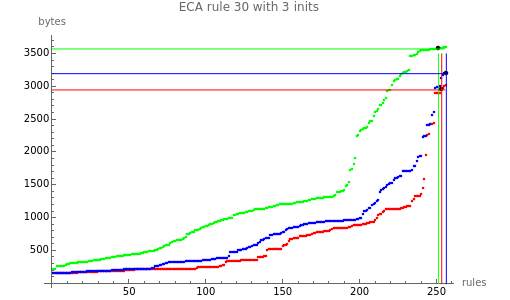
The graphic shows the complexity measures of the 256 elementary cellular automata (ECA) using three different initial conditions.
The choices for initial conditions are one central black cell (red), random (green), and unit step (blue). The unit step consists of a sequence of white cells followed by a sequence of black cells.
The complexity of each rule is calculated by the byte count of the double compression of the pattern produced in 100 steps; the patterns can be seen at the tabs. The rules are sorted by the complexity using the unit step initial condition.
The curves for the three initial condition are usually very similar. There are ECA rules that are more sensitive to the initial condition so one particular rule can have very different complexity according to different initial conditions.
The ECA four classes are distributed as follows: Low—Class I, Medium—Class II, and High—Classes III and IV.
Details
Details
Created at the New Kind of Science Summer School 2011.
References
References
[1] S. Wolfram, A New Kind of Science, Champaign, IL: Wolfram Media, Inc., 2002.
External Links
External Links
Permanent Citation
Permanent Citation
Daniel de Souza Carvalho
"Elementary Cellular Automata Rules with Different Initial Conditions"
http://demonstrations.wolfram.com/ElementaryCellularAutomataRulesWithDifferentInitialCondition/
Wolfram Demonstrations Project
Published: September 6, 2011