Abstract
Abstract
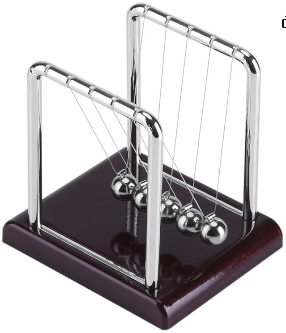
Shown above is a popular “executive toy” that demonstrates the conservation of momentum and energy. If a ball (particle) is released from the left and allowed to collide with the stationary particles, various interactions occur so that a single particle is ejected to the right with the same speed as the incident particle. It is obvious that mementum and energy are conserved. Of course, all the particles are assumed identical.
But do the two conservation laws demand that only one particle is ejected?? In this work we consider the possibility that two particles are ejected and then the possibility that three particles are ejected.
It is found that the assumption of two ejectees demands that one of them attains a velocity of 0, which is a contradiction since it cannot leave the interaction region.
However, there is no reason why three particles cannot be ejected, as indicated by the detailed calculations.
Details
Details
Assume that two particles are ejected
Assume that two particles are ejected
A single particle arrives from the left with velocity u
We assume that two particles are ejected with velocities v and w. All particle masses are identical.
Since momentum is conserved, we must have
In[]:=
u==v+w;
Since energy is conserved, it must also be the case that
In[]:=
2
u
2
v
2
w
There is no loss in generality by setting u = 1.
In[]:=
{%%,%}/.u->1
Out[]=
{1v+w,1+}
2
v
2
w
In[]:=
Solve[%,{v,w}]
Out[]=
{{v0,w1},{v1,w0}}
Hence one of the ejected particles has zero speed and therefore cannot be ejected.
Assume that three particles are ejected
Assume that three particles are ejected
A single particle arrives from the left with velocity u
We assume that three particles are ejected with velocities v, w, and x. All particle masses are identical.
Since momentum is conserved, we must have
In[]:=
u==v+w+x;
Since energy is conserved, it must also be the case that
In[]:=
2
u
2
v
2
w
2
x
There is no loss in generality by setting u = 1.
In[]:=
{%%,%}/.u->1
Out[]=
{1v+w+x,1++}
2
v
2
w
2
x
For now, we are only interested in the special case where v equals one-half, so we are left with the set of equations
In[]:=
eqs=%/.v->
1
2
Out[]=
1+w+x,1++
1
2
1
4
2
w
2
x
In[]:=
First@Solve[eqs,{w,x}]
Out[]=
w(1-(1+
1
4
5
),x1
4
5
)In[]:=
fullres=Prepend%,u->1,v->//Flatten
1
2
Out[]=
u1,v,w(1-(1+
1
2
1
4
5
),x1
4
5
)Momentum is conserved:
In[]:=
(u==v+w+x)/.fullres
Out[]=
True
Energy is conserved :
In[]:=
(==++)/.fullres
2
u
2
v
2
w
2
x
Out[]=
True
Comments
Comments
I suspect that very few of the world' s executives have observed a three-particle ejection as described above. On the other hand, to paraphrase Murray Gell-Mann, “Anything that can happen does happen, unless it is forbidden by a conservation law”.