Q16 for Grade 9-11
Out[]=

Visualization
Visualization
Add an arbitrary offset to show that my chord AB is not diameter. Just the shift the chord 0.3 unit above the horizontal diameter
In[]:=
h=-0.3;
WLOG, assume the larger circle is a unit circle and r is the inradius of the smaller circle. using the fact about internal tangent circles: the distance between the centers is the difference of their radii:
In[]:=
ptO[r_]:=
(1-r)^2-(r+h)^2
,-r-hIn[]:=
ptP[r_]:=
(1-r)^2-(r+h)^2
,-hIn[]:=
ptQ[r_]:=Normalize@ptO[r]
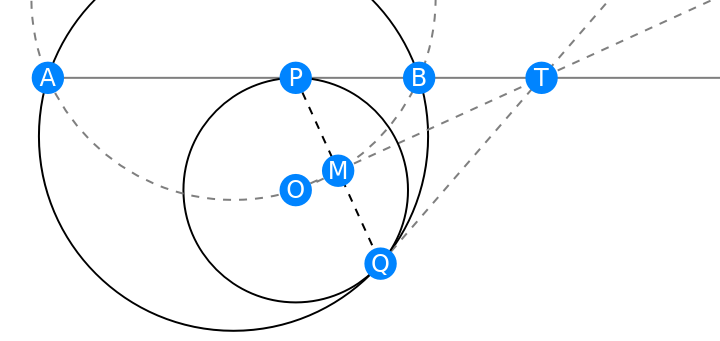
The idea of the proof is by setting the mid point of PQ first and then prove it is also on the arc AOB
In[]:=
ptM[r_]:=Midpoint[{ptP[r],ptQ[r]}]
The location of AB are from Pythagorean:
In[]:=
ptA=-
1-h^2
,-h;ptB=1-h^2
,-h;T is the intersection of OM and AM
In[]:=
ptT[r_]:=segmentIntersection[ptA,ptB,ptO[r],ptM[r]][[-1]]
Put everything above in one Manipulate function to create the animation
In[]:=
Manipulatet=r;GraphicsCircle[],{Gray,HalfLine[{ptA,ptB}]},{Gray,Dashed,HalfLine[ptQ[r],RotationMatrix[π/2].ptQ[r]]},{Gray,Dashed,HalfLine[{ptO[r],ptM[r]}]},Circle
(1-r)^2-(r+h)^2
,-r-h,r,{Dashed,Gray,CircleThrough[{ptA,ptO[r],ptB}]},{Dashed,Line[{ptP[r],ptQ[r]}]},label["A",ptA],label["B",ptB],label["O",ptO[r]],label["P",ptP[r]],label["Q",ptQ[r]],label["M",ptM[r]],label["T",ptT[r]],PlotRange{{-1.2,2.5},{-1.05,0.7}},{{r,0.3,"inradius = t"},0.2,0.64},SaveDefinitionsTrueOut[]=

Sketch of Proof
Sketch of Proof
To show AOMB on the same circle, let’s test power of point in the above diagram by constructing TQ both tangent to circle Ω and ω and T is on ray AB as well: .
TTA·TBTM·TO
2
Q
In[]:=
Dynamic@SquaredEuclideanDistance[ptT[t],ptQ[t]]
Out[]=
0.164347
In[]:=
Dynamic@(EuclideanDistance[ptT[t],ptB]*EuclideanDistance[ptT[t],ptA])
Out[]=
0.164347
In[]:=
Dynamic@(EuclideanDistance[ptT[t],ptM[t]]*EuclideanDistance[ptT[t],ptO[t]])
Out[]=
0.164347
The identity above is from
1.: Right triangle TQM is similar to Right triangle TQO by chord bisector theorem and property of tangent point of Q
2.: power of point T w.r.t. circle ABQ == circle Ω
The same value above indicate that AOMB is a concyclic quadrilateral because the condition of power of point is sufficient and necessary. Because we have already constructed M as mid point of PQ, arc AOB indeed bisects segment PQ.
1.
TTM·TO
2
Q
2.
TTA·TB
2
Q
The same value above indicate that AOMB is a concyclic quadrilateral because the condition of power of point is sufficient and necessary. Because we have already constructed M as mid point of PQ, arc AOB indeed bisects segment PQ.
Locus of Point O
Locus of Point O
Let’s take a look at the trajectory of O given fixed offset h1 and inradius r as variable.
In[]:=
Eliminatex
(1-r)^2-(r+h1)^2
,y-r-h1,rOut[]=
1+2h1++2y+2h1y
2
h1
2
x
In[]:=
Solve[%,y]
Out[]=
y
-1-2h1-+
2
h1
2
x
2(1+h1)
After eliminate r and we solve y in terms of x. This solution is an expression of hyperbola in the form of .
y=a+b
2
x
In[]:=
ResourceData["Demonstrations Project: Locus of the Center of a Circle Inscribed in a Circular Segment"]
Out[]=
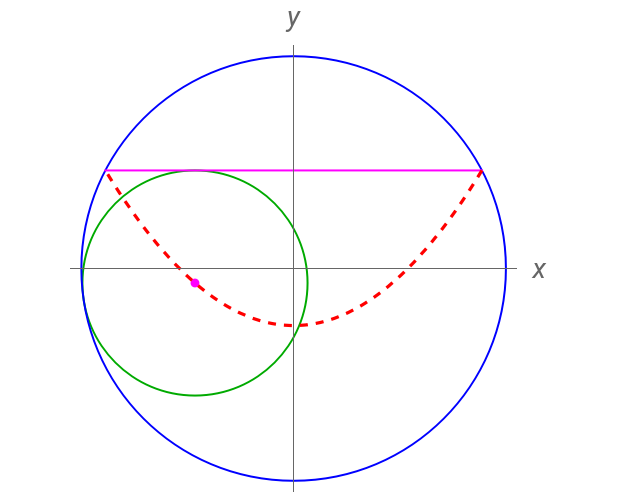
One should not be confused here: the trajectory of our moving O is parabola. But at any moment, we can construct a circle passing through AOB. This circle has nothing to do with the parabolic trajectory.
Utility Functions
Utility Functions
In[]:=
label[sym_String,pos_]:={PointSize[0.045],Hue[0.58,1,1],Point[pos],Text[Style[sym,White,12],pos]};
In[]:=
segmentIntersection[p1_List,p2_List,p3_List,p4_List]:=Block[{u,v},Module[{sol},sol=NSolve[u*(p2-p1)+p1v*(p4-p3)+p3,{u,v}];{u,v,u*(p2-p1)+p1}/.sol〚1〛]]