Previous articles in this series:
It’s Pi-day soon, so it’s good to bring out odd things about Pi. For example, here’s a high-power approximation:
In[]:=
NPi-
7
7
9
4
Out[]=
0.0000254234
There are other interesting constants, such at the golden ratio:
In[]:=
Solve[ϕ^2==ϕ+1]
Out[]=
ϕ(1-(1+
1
2
5
),ϕ1
2
5
)If coins have a golden ratio to each other, three golden coins will surround a unit coin against a wall. The penny and half dollar are close to this ratio.
In[]:=
ϕ=GoldenRatio;GraphicsLine[{{-Pi,0},{Pi,0}}],Circle[{0,1},1],Circle[{0,2+ϕ},ϕ],Circle2
ϕ
,ϕ,ϕ,Circle-2ϕ
,ϕ,ϕOut[]=
Another is the tribonacci constant, --t-1=0, seen in the snub cube. The snub dodecahedron needs a root of --t-ϕ=0.
3
t
2
t
3
t
2
t
In[]:=
scroot=Root[-1-#1-+&,1];{scv,scf}=;scp=ResourceFunction["SqrtSpace"][scroot,scv];sdroot=Root[-GoldenRatio-#1-+&,1];{sdv,sdf}=;sdp=ResourceFunction["SqrtSpace"][sdroot,sdv];GraphicsRow[{Graphics3D[{EdgeForm[Thick],Opacity[.9],Polygon[scp[[#]]]&/@scf},BoxedFalse,ViewAnglePi/9],Graphics3D[{EdgeForm[Thick],Opacity[.9],Polygon[sdp[[#]]]&/@sdf},BoxedFalse,ViewAnglePi/10]},ImageSize530]
2
#1
3
#1
2
#1
3
#1
Out[]=
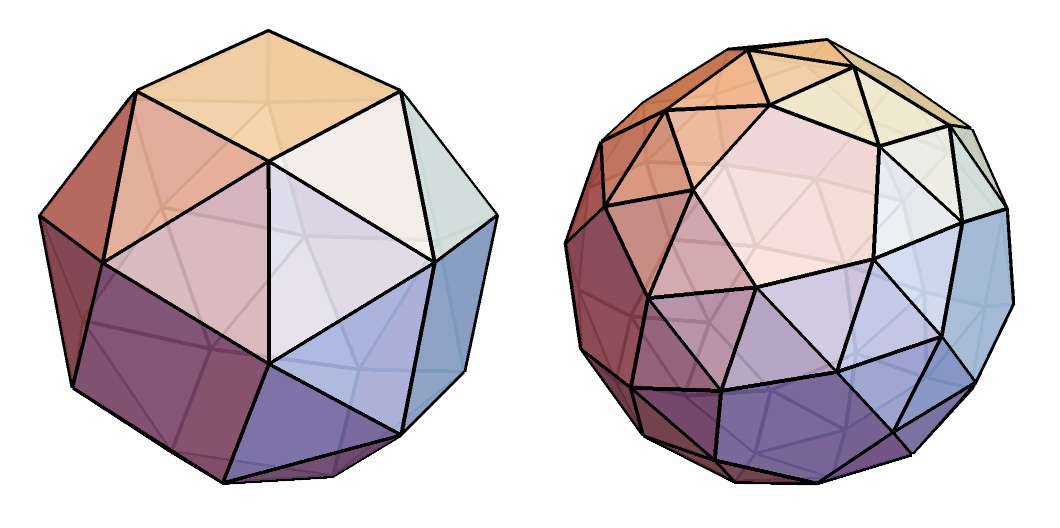
When set in terms of these roots, the complicated vertices are simple integers:
In[]:=
Union[Abs[Flatten[{scv,sdv}]]]
Out[]=
{0,1,2,3,4,5,6,7,8,9,10,11,12,13}
Five coins can surround a unit coin against a wall if they have a tribonacci-based ratio:
In[]:=
t2=1^2-2;GraphicsLine[{{-Pi,0},{Pi,0}}],Circle[{0,1},1],Circle[{0,2+t2},t2],Circle2,,t2,Circle-,,t2

t2
,t2,t2,Circle-2t2
,t2,t2,CircleOut[]=
Here’s a little trick done with e, π and .
19
In[]:=
N[(E^(Sqrt[19]Pi)+24)^(1/24),11]
Out[]=
1.7692923542
That seems curiously close to the root of =2(x+1):
3
x
In[]:=
N[Root[-2-2#1+&,1],11]
3
#1
Out[]=
1.7692923542
We can use that root for the optimal covering of a circle by twelve circles:
Out[]=
Melissen's 12 Disk Covering |
Here’s a similar trick done with e, π and .
163
In[]:=
N[(E^(Sqrt[163]Pi)+24)^(1/24),33]
Out[]=
5.31862821775018565910968015331802
That seems curiously close to the root of =2(3-2x+1):
3
x
2
x
In[]:=
N[Root[-2+4#1-6#1^2+&,1],33]
3
#1
Out[]=
5.31862821775018565910968015331802
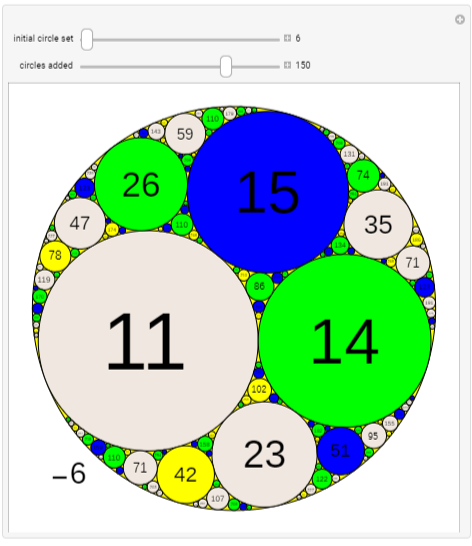
For an explanation, see my column Shattering the Plane. You might also like The Circles of Descartes.
CITE THIS NOTEBOOK
CITE THIS NOTEBOOK
Pi, the Golden Ratio and the Tribonacci Constant
by Ed Pegg
Wolfram Community, STAFF PICKS, March 13, 2024
https://community.wolfram.com/groups/-/m/t/3140342
by Ed Pegg
Wolfram Community, STAFF PICKS, March 13, 2024
https://community.wolfram.com/groups/-/m/t/3140342