An “AI-assisted” freshman-friendly journey through the universal engine of deduction, graph coloring, and the unreasonable effectiveness of Boolean logic.
The Registrar's Nightmare
Picture this: It is two weeks before finals at Alaska State University.
The university registrar is sitting in a bunker-like office surrounded by empty coffee cups. On their desk sits an angry memo from the Dean, a stack of change-of-major forms, and a spreadsheet containing hundreds of student course registrations.
The registrar’s task sounds deceptively innocent:
"Schedule the final exams for our six core freshman courses across three available morning slots: Monday, Wednesday, and Friday."
The courses are:
◼
Calculus I
◼
Computer Science 101
◼
General Physics
◼
Introductory Chemistry
◼
Organismal Biology
◼
College Writing (English)
Here is the catch: students take multiple classes at once. If a pre-med freshman is enrolled in both Calculus and Chemistry, those two exams cannot be held at the same time—unless the university wants riots in the quad.
To make matters worse, Professor Newton from the Physics department just emailed:
"I have a mandatory conference in Geneva on Friday. Under no circumstances will the Physics final be held on Friday morning."
The registrar sighs and opens a spreadsheet. For 6 courses and 3 time slots, there are 729 possible assignments. Checking 729 combinations by hand is tedious, but humanly doable over a weekend.
6
3
3^6 = 729 combinations
But what happens next semester when there are 100 courses and 5 exam slots? The number of possible schedules is:
100
5
69
10
To put that number in perspective: there are an estimated atoms in our entire Milky Way galaxy. If every computer on planet Earth checked one billion schedules per second since the dawn of the Big Bang 13.8 billion years ago, they wouldn't have checked even 0.0000001% of the search space.
68
10
Brute force is not just slow; it is mathematically dead on arrival.
Yet, your university registrar clicks a button, and the schedule pops out in less than five milliseconds.
How? Behind the scenes, the registrar isn't searching blindly. They are using one of the crown jewels of computer science: Boolean Satisfiability (SAT).
The Cook-Levin Miracle: The Universal Engine
In 1971, computer scientists Stephen Cook and Leonid Levin independently made a discovery that changed computing forever.
They were studying NP-complete problems—a family of notoriously stubborn computational puzzles where finding a solution feels like searching for a needle in a haystack, but checking a proposed solution is instant. Think of Sudoku: guessing the numbers is agonizing, but verifying a completed grid takes five seconds.
Cook and Levin proved that any problem whose solution can be efficiently verified can be translated into Boolean Satisfiability (SAT).
Out[]=
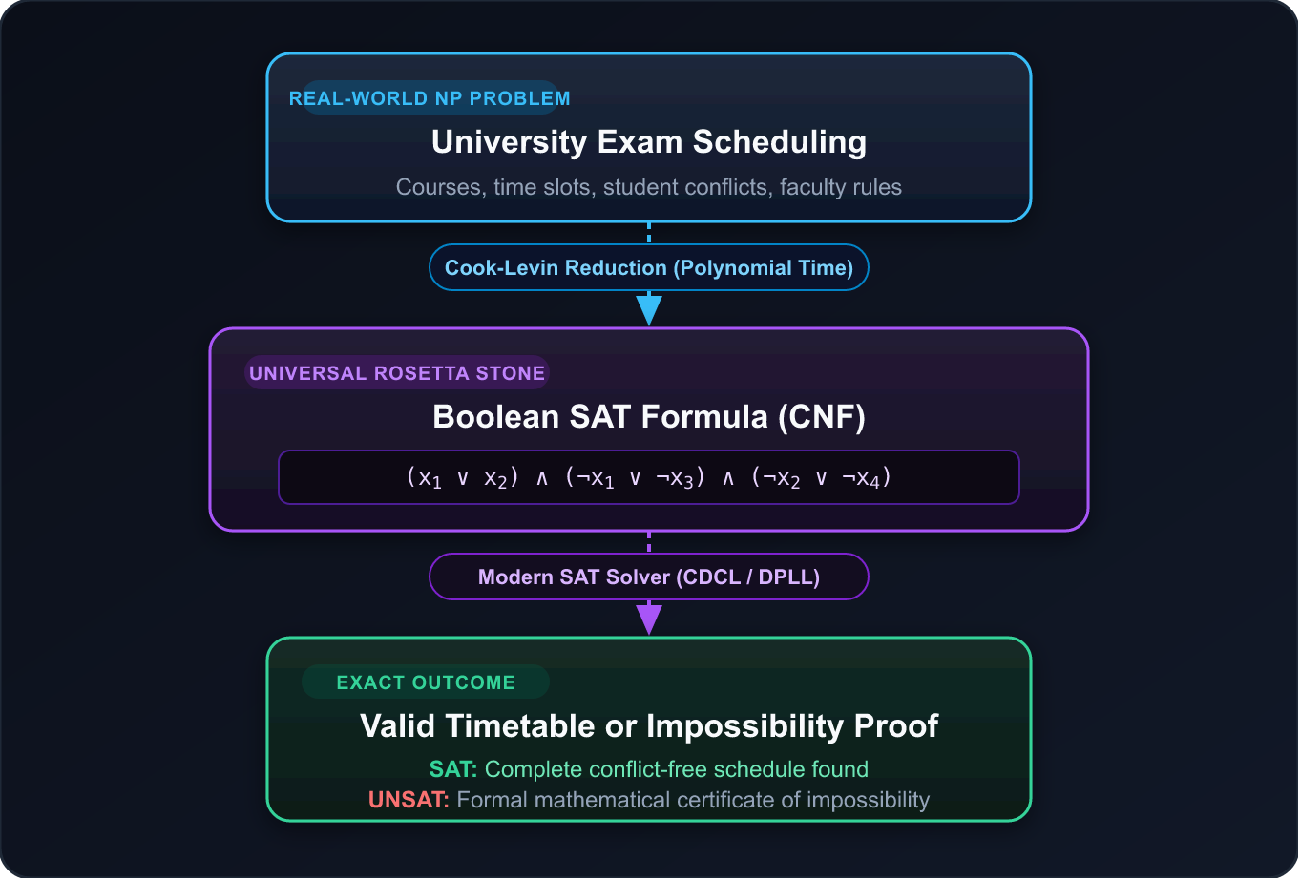
SAT is the Universal Rosetta Stone of computation. You don't need a custom algorithm for exam scheduling, another for airplane flight routes, another for compiler optimization, and another for hardware chip verification.
If you can translate your problem's rules into the simple language of True and False (And, Or, Not), a general-purpose SAT solver will do the heavy lifting for you.
The Grammar of Logic: How to Speak SAT
A SAT solver does not know what a "freshman", a "beaker", or a "final exam" is. It only understands three things:
1
.Variables that can be True or False.
2
.Clauses connected by Or ().
∨
3
.A grand formula joined by And (∧).
Let's convert the registrar's real-world headache into pure Boolean algebra.
The Variables
The Variables
We define a collection of Boolean propositions:
x
c,s
With 6 courses and 3 time slots (Slot 1 = Mon, Slot 2 = Wed, Slot 3 = Fri), we have Boolean variables:
6318
◼
x
Calc,1
x
Calc,2
x
Calc,3
◼
x
CS,1
x
CS,2
x
CS,3
◼
...and so on.
Rule 1 — Every Exam Must Happen ("At Least One")
Rule 1 — Every Exam Must Happen ("At Least One")
Calculus cannot simply vanish into thin air. It must be scheduled on Monday, Wednesday, or Friday:
(⋁⋁)
x
Calc,1
x
Calc,2
x
Calc,3
We write an "At-Least-One" clause for every course. For 6 courses, this gives 6 simple clauses.
Rule 2 — No Time Turners ("At Most One")
Rule 2 — No Time Turners ("At Most One")
Unless Hermione Granger is enrolled, a course cannot take place at two different times simultaneously. Calculus cannot be scheduled on both Monday and Wednesday:
¬(⋀)
x
Calc,1
x
Calc,2
Using De Morgan’s Laws, this turns into a clean OR clause:
(¬⋁¬)
x
Calc,1
x
Calc,2
Repeating this for every pair of slots ensures each course is assigned to at most one slot.
Rule 3 — The Conflict Graph ("No Clashes")
Rule 3 — The Conflict Graph ("No Clashes")
Now comes the heart of the problem. Which courses share students?
Imagine drawing a diagram where every course is a dot (node), and we draw a line (edge) between any two courses that share enrolled students. In mathematics, this is called a Conflict Graph:
◼
Many STEM students take Calculus + Computer Science.
◼
Physics students take Calculus + Physics.
◼
Pre-meds take Chemistry + Biology, and both take Calculus.
◼
Engineers take Physics + Chemistry.
◼
CS students must take English for their writing requirement.
◼
Biology majors also take English.
Out[]=
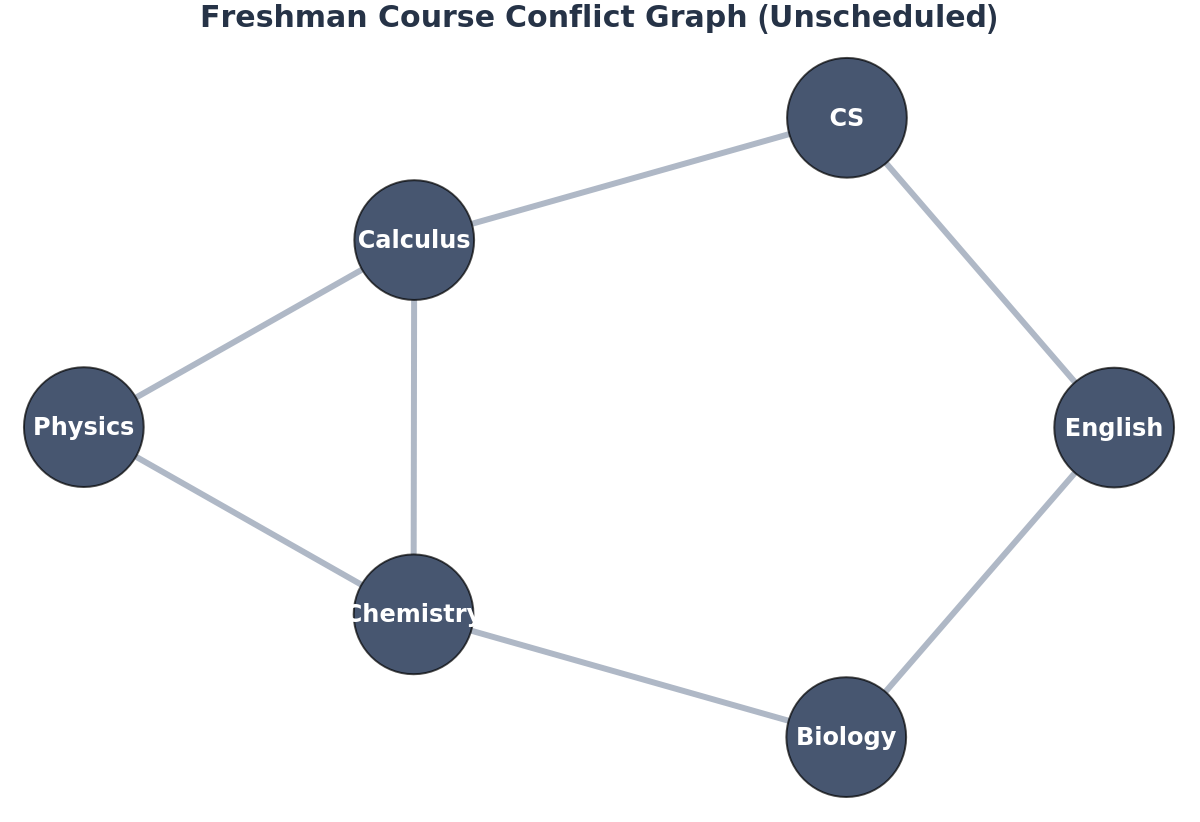
Whenever two courses share an edge—say, Calculus and Physics—they cannot share time slot :
s
¬(⋀)⟺(¬⋁¬)
x
Calc,s
x
Phys,s
x
Calc,s
x
Phys,s
If there are 7 conflict edges and 3 time slots, we generate conflict clauses.
7321
Rule 4 — Faculty Quirks
Rule 4 — Faculty Quirks
Professor Newton refuses to proctor Physics on Friday (slot 3). This translates to a single negative literal:
¬
x
Phys,3
That's it. We tie all these clauses together with a giant And. The solver's mission: find an assignment of True and False to all 18 variables that satisfies every single clause simultaneously.
Solving It in Wolfram Language
The Wolfram Language has industrial-strength Boolean logic engines built right into its core. We can build this model and solve it in just a few lines of code.
In[]:=
courses={"Calculus","Computer Science","Physics","Chemistry","Biology","English"};slots3={1,2,3};slotNames=<|1->"Monday 9:00 AM",2->"Wednesday 9:00 AM",3->"Friday 9:00 AM"|>;
In[]:=
conflictEdges={"Calculus"<->"Computer Science","Calculus"<->"Physics","Calculus"<->"Chemistry","Physics"<->"Chemistry","Computer Science"<->"English","Chemistry"<->"Biology","Biology"<->"English"};
Asking the Oracle: SatisfiableQ and SatisfiabilityInstances
Asking the Oracle: SatisfiableQ and SatisfiabilityInstances
Now, let's ask Wolfram Language if our schedule is possible, including Prof. Newton’s constraint of “no physics exam on Friday”:
Is there a solution?
Find a solution:
The Resulting Timetable
The Resulting Timetable
In less than 2 milliseconds, the solver returns a valid exam schedule.
Let's check the constraints:
◼
Are English and Chemistry adjacent in the conflict graph? No. (No shared students).
◼
Are Computer Science, Physics, and Biology adjacent to each other?
◼
CS conflicts with Calculus and English.
◼
Physics conflicts with Calculus and Chemistry.
◼
Biology conflicts with Chemistry and English.
◼
None of CS, Physics, or Biology conflict with one another! They can all happen on Wednesday morning without a single student having a double-booking!
◼
Is Physics on Friday? No. Professor Newton makes his Geneva flight.
Graph theorists will recognize what just happened: we 3-colored the conflict graph!
Every node is colored by its exam day (Blue = Monday, Orange = Wednesday, Green = Friday). Notice that no two nodes connected by an edge share the same color.
The Dean Strikes Back: The Secret Power of “Unsatisfiable”
Just as the registrar is packing up to head home, the phone rings. It's the Dean.
"Budget cuts. Facilities says we can only heat the exam hall for two days instead of three. You need to squeeze all six exams into Monday and Wednesday."
The output is False.
In everyday life, False feels like a failure. But in computer science, UNSAT (Unsatisfiable) is a superpower.
The solver didn't give up because it ran out of memory or got stuck in an infinite loop. It mathematically proved that no such schedule can exist in the laws of our universe.
◼
If you assign Calculus to Monday, Physics must be on Wednesday.
◼
But Chemistry conflicts with both Calculus and Physics. There is no third day for Chemistry to go!
A triangle requires at least 3 distinct colors. Trying to 2-color a triangle is mathematically impossible.
Armed with this proof, the registrar doesn't waste hours trying to rearrange puzzle pieces. They can walk into the Dean’s office with mathematical certainty: "Dean, here is the proof. If you want two days, you must cancel a course."
Under the Hood: Why Modern Solvers Don't Choke
If SAT is NP-complete, why did our solver return an answer in 0.001 seconds instead of running for a billion years?
Early algorithms from the 1960s (like Davis-Putnam) used naive backtracking: make a guess, follow it until you hit a wall, backtrack one step, and try another guess. On large problems, this hits an exponential wall.
Modern SAT solvers use an architecture called CDCL (Conflict-Driven Clause Learning). You can think of CDCL as the difference between a naive student taking a multiple-choice test and a master detective:
◼
Unit Propagation (The Obvious Deduction)
◼
Conflict Analysis: Learning from Failure
When a naive algorithm hits a contradiction (a conflict), it erases the last decision and tries something else.
A CDCL solver pauses. It inspects the graph of implications that caused the disaster, extracts the root cause of the conflict, and manufactures a brand-new rule:
The solver adds this learned clause to its rulebook. It then backtracks multiple levels up the decision tree, permanently pruning away millions of useless branches in one fell swoop.
Beyond Finals Week: The Invisible Engine of Modern Society
Exam scheduling is a friendly toy example, but the exact same machinery keeps the modern technological world from collapsing:
1
.Compiler Optimization & Register Allocation: When you compile a C++ or Rust program, the compiler juggles thousands of local variables. But your computer's CPU only has 16 physical registers. Which variables can share a register without corrupting memory? That is literally the exact same conflict graph coloring problem you just solved!
2
.Silicon Chip Verification (The $475M Bug): In 1994, a subtle division error in Intel's Pentium processor cost the company $475 million. Today, chip designers create a "miter circuit" comparing their optimized circuit with a specification, feeding both to a SAT solver. If SAT finds a solution, it's a bug! If it returns UNSAT, the chip is mathematically certified bug-free before burning it into silicon.
Fun Challenges to Explore
1
.Find All Solutions: Find out how many different valid exam schedules exist for our university.
2
.Room Capacity Constraints: What if our exam hall can only hold at most 2 exams at the same time? How would you express that using "At-Most-Two" Boolean clauses?
3
.Add More Departments: Introduce Art History, Economics, and Statistics with their own student overlap conflicts and see how high the chromatic number climbs!
SAT solving isn't just about True and False. It is proof that even when a problem feels overwhelmingly complex, translating it into the crisp, unapologetic grammar of logic can turn an impossible puzzle into an instantaneous solution.