This is part of live presentation series called Mathematical Games in which we explore a variety of games and puzzles using Wolfram Language. In this episode, we explore fractals.
demonstrations.wolfram.com
demonstrations.wolfram.com
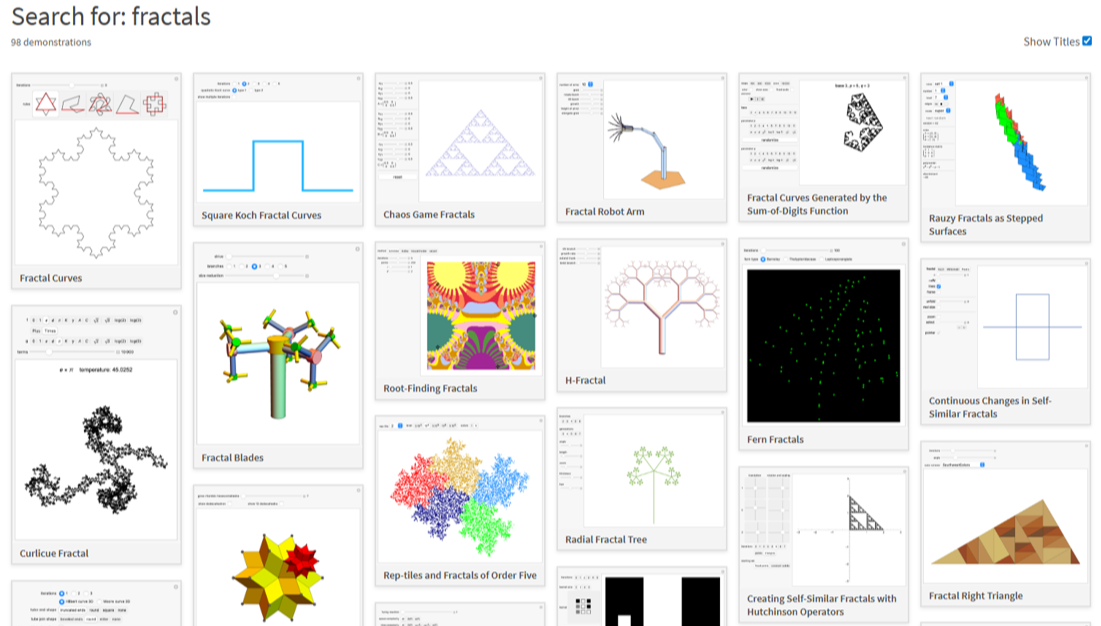
Many Demonstrations involve fractals
Fractals in Gardner
Fractals in Gardner
Some of the fractals covered by Martin Gardner include:
Penrose Tiles
Conway’s Surreal Numbers
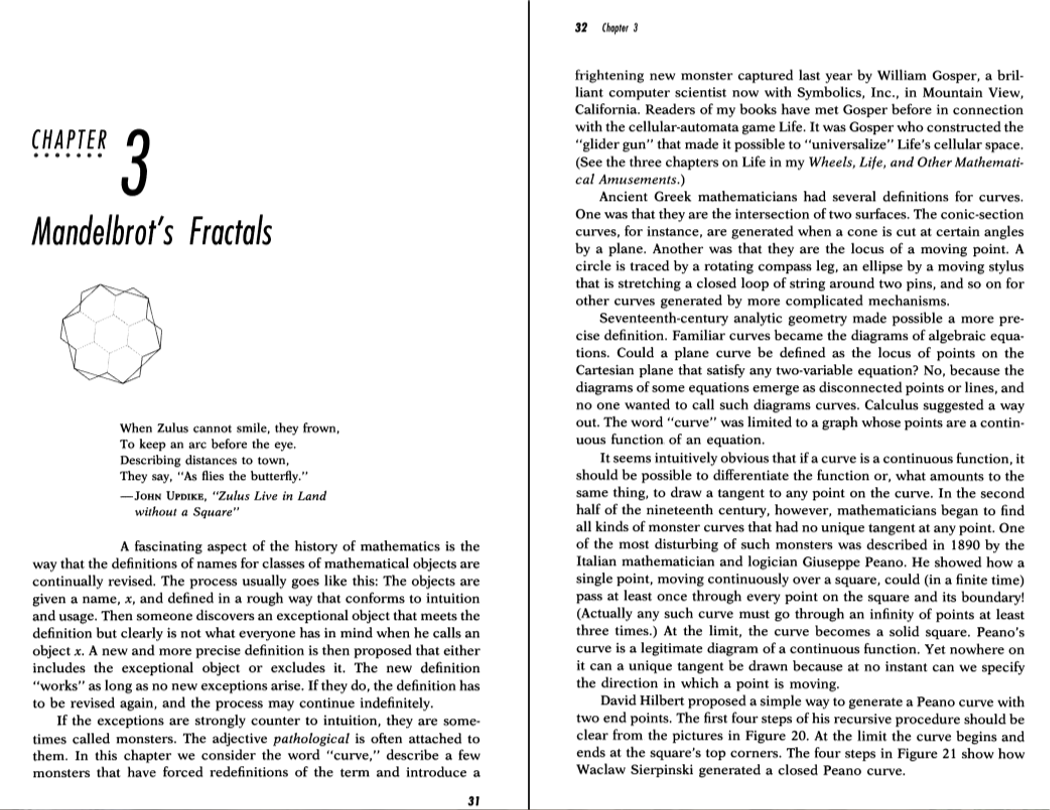
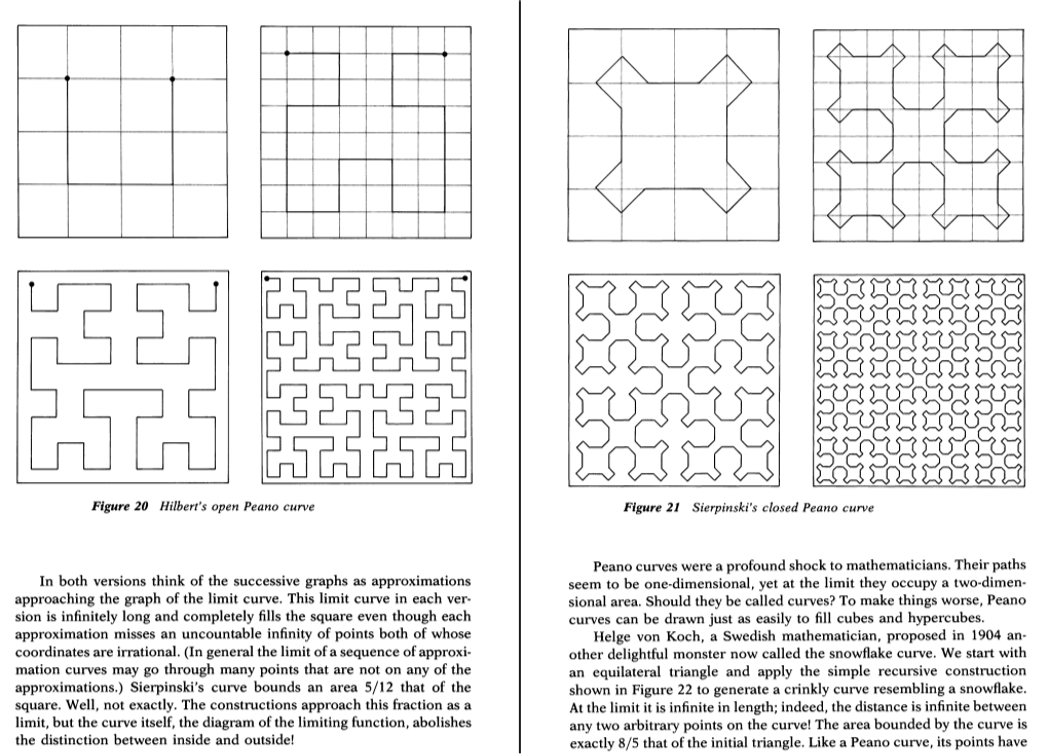
Mandelbrot’s Fractals
Fractal Music
Binary Gray Code
The Dragon Curve
Rep-Tiles
Penrose Tiles
Conway’s Surreal Numbers
Mandelbrot’s Fractals
Fractal Music
Binary Gray Code
The Dragon Curve
Rep-Tiles
Benoit Mandelbrot (20 November 1924 – 14 October 2010)
Benoit Mandelbrot (20 November 1924 – 14 October 2010)
I first corresponded with Benoit in 1990, when I asked him for permission to use the Mandelbrot set. He replied “You’re the first to ask. You don’t need my permission, it’s a mathematical object. That said, you have my permission.”
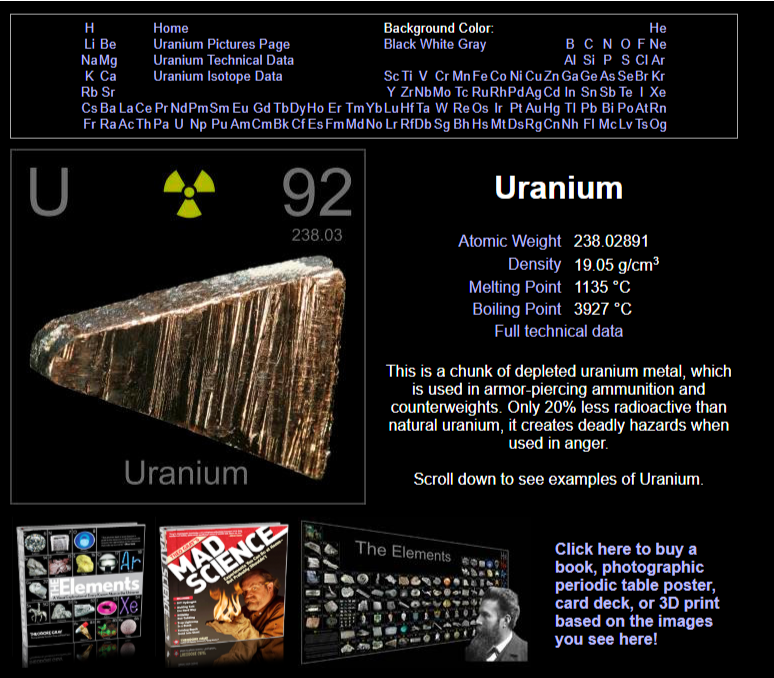
Later, via periodictable.com, he contacted us wanting to borrow one of our uranium samples, so we sent him one. We later learned he’d given a speech to the United Nations about nuclear security. Part of his talk was “I came here through the subway.” Then he put a large chunk of depleted uranium on the lectern -- in the United Nations building -- and gave his talk. Afterwards, he sent it back to us.
Binary numbers
Binary numbers
Just looking at binary numbers leads to a fractal.
In[]:=
ArrayPlot[Transpose[Table[IntegerDigits[n,2,6],{n,1,2^6-1}]]]
Out[]=

In[]:=
ArrayPlot[Transpose[Table[IntegerDigits[n,2,8],{n,1,2^8-1}]]]
Out[]=

In[]:=
ArrayPlot[Transpose[Table[IntegerDigits[n,3,4],{n,1,3^4-1}]]]
Out[]=

Needless to say, there are fractals all over the place.
How Long Is the Coast of Britain? (by Jaime Rangel-Mondragon)
How Long Is the Coast of Britain? (by Jaime Rangel-Mondragon)
Out[]=
This Demonstration examines the coastline paradox, studied by Benoit Mandelbrot (1924–2010) in his influential 1967 short paper "How Long Is the Coast of Britain?" [3]. The smaller the length of the measuring stick, the longer the length of the coast appears, so that in the limit the coast of the island of Great Britain is of infinite length! Starting from an empirical law obtained previously by Richardson, Mandelbrot introduced the idea of "fractals", concluding that it is meaningless to talk about the length of a coastline and proposing a generalization of the concept of fractal dimension to measure the degree of roughness involved in such measurements.


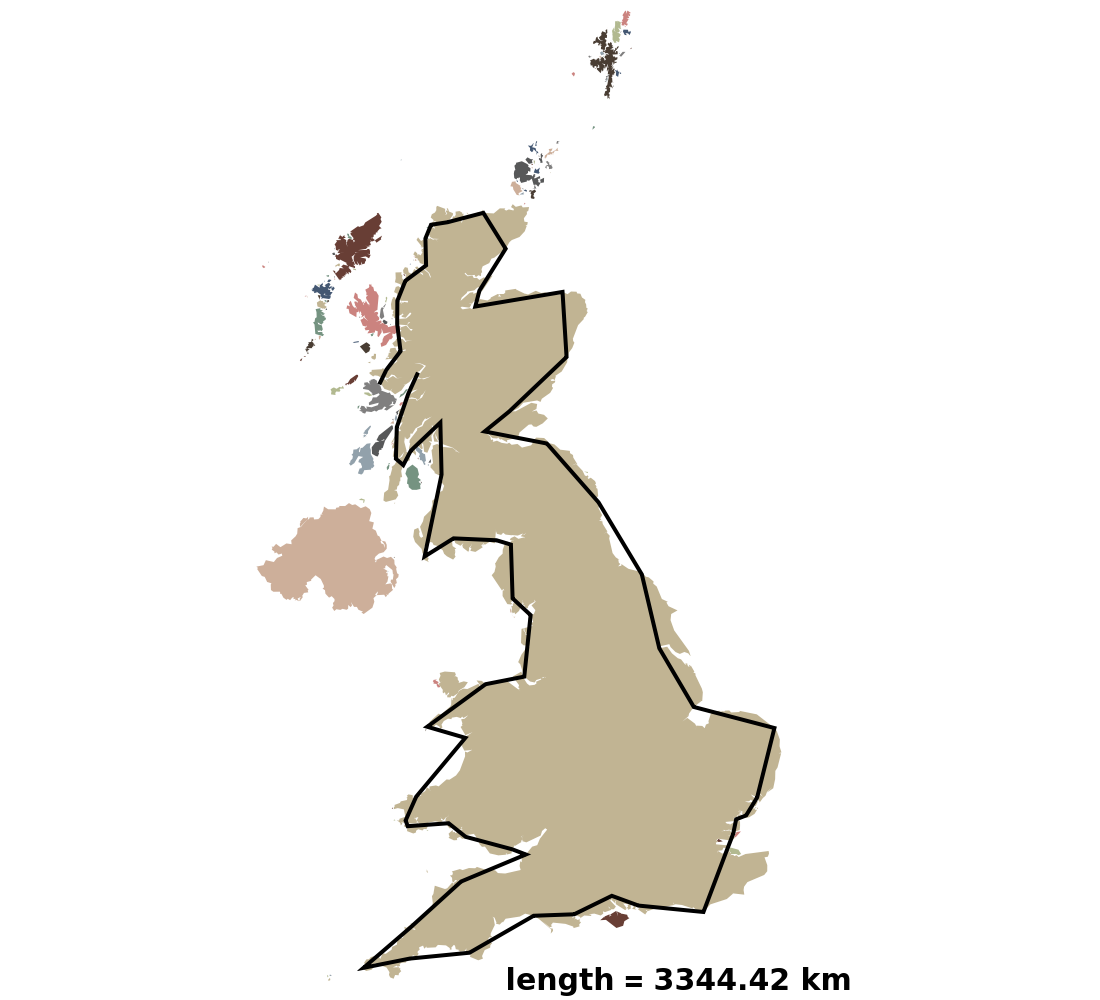
Later, Benoit tried to figure out “When is the Julia set connected?”
Quadratic Julia Sets (by Stephen Wolfram)
Quadratic Julia Sets (by Stephen Wolfram)
Generating Julia Sets (by Alijah Travascio-Green)
Generating Julia Sets (by Alijah Travascio-Green)
Julia Sets and the Mandelbrot Set (by Mark McClure)
Julia Sets and the Mandelbrot Set (by Mark McClure)
Magnified Views of the Mandelbrot Set (by S. M. Blinder)
Magnified Views of the Mandelbrot Set (by S. M. Blinder)
Droste Effect (by Arnoud Buzing)
Droste Effect (by Arnoud Buzing)
Fractal Maze (by Ed Pegg Jr)
Fractal Maze (by Ed Pegg Jr)
Peano Curve Explorer (by Robert Dickau)
Peano Curve Explorer (by Robert Dickau)
H-Fractal (by Sándor Kabai)
H-Fractal (by Sándor Kabai)
Triangle Fractal (by Sándor Kabai)
Triangle Fractal (by Sándor Kabai)
Turtle-Graphics (by Michael Trott)
Turtle-Graphics (by Michael Trott)
AnglePath (by Ed Pegg Jr)
AnglePath (by Ed Pegg Jr)
Inflating a Dragon (by Borut Levart, Sander Huisman)
Inflating a Dragon (by Borut Levart, Sander Huisman)
n-Flakes (by Eric W Weisstein, Michael Croucher)
n-Flakes (by Eric W Weisstein, Michael Croucher)
Fractal Right Triangle (by Ed Pegg Jr)
Fractal Right Triangle (by Ed Pegg Jr)
Substitution Tilings (by Ed Pegg Jr)
Substitution Tilings (by Ed Pegg Jr)
Vesa Timonen’s Plastic Pentagon
Vesa Timonen’s Plastic Pentagon
Setting these up isn’t trivial. I need to improve my code. Same color should give the same size.
Should look more like this:
By Karl Scherer, something similar
Ammann Chair, using the golden ratio
Various Fractal Substitutions
Various Fractal Substitutions
Order-3 non-fractal Irreptiles
Order-3 non-fractal Irreptiles
Here are all of the order-3 non-fractal irreptiles I know about:
1. Right triangles (infinite) and drafter3.
2. Four rectangles, which can be skewed to parallelograms.
3. An infinite set of quadrangles with two right angles and the tritan2.
4. The Vesa Timonen irregular pentagon.
5. Chairs by Mineyuki Uyematsu, Jun-ichi Miyoshi, Robert Ammann (and Karl Scherer) and Dale Walton.
Most fractals apply a step over and over.
A self-similar fractal exists for ρ. The numbers on green lines indicate a particular power of a complex root of ρ.
The plastic fractal triangle demonstrates an infinite series. Increase the iterations to improve the fractal.
Nautilus with Fractal triangle with the Supergolden Ratio
Nautilus with Fractal triangle with the Supergolden Ratio
PsiQuad is a self-defining fractal:
We can make a fractal using the chaos game, which randomly picks a next point from two options. The iteration produces two similar fractal triangles.
We can instead generate the wriggly edge to any desired fractal depth.
Both triangles together build a third similar triangle, making it a self-similar dissection, irreptile, or Rauzy fractal.
Both triangles together build a third similar triangle, making it a self-similar dissection, irreptile, or Rauzy fractal.
With the quadrilaterals.
With the shape we get a fractal nautilus:
A series of these covers itself.
Rep-Tiles (by Erich Friedman, George Freeman, Karl Scherer)
Rep-Tiles (by Erich Friedman, George Freeman, Karl Scherer)
Irreptiles (by Karl Scherer, Michael Reid, Rodolfo Kurchan, Ernesto Amezcua, George Freeman, and George Sicherman)
Irreptiles (by Karl Scherer, Michael Reid, Rodolfo Kurchan, Ernesto Amezcua, George Freeman, and George Sicherman)
Parametrization of a Fractal Curve (by Cedric Voisin)
Parametrization of a Fractal Curve (by Cedric Voisin)
Octahedron Fractal (by Ferenc Holló Szabó, Sándor Kabai)
Octahedron Fractal (by Ferenc Holló Szabó, Sándor Kabai)
Fractal Tetrahedron (by Sándor Kabai)
Fractal Tetrahedron (by Sándor Kabai)
Fractal Tetrahedron in an Octahedron (by Sándor Kabai)
Fractal Tetrahedron in an Octahedron (by Sándor Kabai)
Menger Sponge Slices (by Robert Dickau)
Menger Sponge Slices (by Robert Dickau)
Spheres in a Sierpinski Tetrahedron (by Sándor Kabai)
Spheres in a Sierpinski Tetrahedron (by Sándor Kabai)
Apollonian Gasket (by Michael Schreiber)
Apollonian Gasket (by Michael Schreiber)
Ford Circles with Variable Radii (by Ethan Zack, Jonathan Kogan)
Ford Circles with Variable Radii (by Ethan Zack, Jonathan Kogan)
What do Orthoscheme Tilings Look Like?
What do Orthoscheme Tilings Look Like?
I always meant to find out. A first step it to make sure the outer tetrahedron and smaller tetrahedra have the same orientation.
Now we can use a barycentric coordinate mapping:
From that, we get the orthoscheme tiling:
The other orthoscheme is similar:
Substitution System Defined by Splitting Each Cell into Nine (by Daniel de Souza Carvalho)
Substitution System Defined by Splitting Each Cell into Nine (by Daniel de Souza Carvalho)
Named Binary Cartesian 2D String Rewriting Systems (by Michael Schreiber)
Named Binary Cartesian 2D String Rewriting Systems (by Michael Schreiber)
Evolution of Rotating Substitution Systems in 3D (by Enrique Zeleny)
Evolution of Rotating Substitution Systems in 3D (by Enrique Zeleny)
CITE THIS NOTEBOOK
CITE THIS NOTEBOOK
Mathematical Games: Fractals Part 1 - applications, complex sets, and substitution rules
by Ed Pegg
Wolfram Community, STAFF PICKS, November 20, 2025
https://community.wolfram.com/groups/-/m/t/3578446
by Ed Pegg
Wolfram Community, STAFF PICKS, November 20, 2025
https://community.wolfram.com/groups/-/m/t/3578446