Abstract
Abstract
We explore the history of units and their transition from human based measures to a more substantive basis in the first half and relate our findings to the Wolfram Physics Project in the latter. Through human history units have come and gone and as our ability to measure things has increased, our definitions of units have been revised. Our bases in the modern SI system are the: meter(length), second(time), kilogram(mass), ampere(current), Kelvin(temperature), mole(amount) and the candela(luminous intensity). These currently accepted units have now since 2019 been directly based on constants of nature.(Candela aside.) In the second half of our investigation we will look to see how we may extend the current Wolfram Physics Project schema to incorporate such dimensions of reality. We find a speculative connection between the, “Planck flux,” as the number of nodes within our current multiway system (Ξ). Exploring this avenue allows us to compute values ~ 1 magnitude within initial Physics Project estimates and a maximally entangled observer in the causal graph would generate ζ = , the Planck Power.
P
P
Units: How we got here?
Units: How we got here?
The story of units is vast, often a matter of preference and the following is merely, “a slice,” so to speak of a much richer history worth exploring. This section will detail early human(literally) based measurement and then we will document a brief history of how each of the currently accepted base SI units came to be. First a quick example to illustrate how one may get to the same result using different units of measure.
Often it has been said, “the right tool for the job,” makes all the difference. In regards to units this is literally the case. Take for example: Perhaps one requires 2 cups of flour for a recipe. With the requisite flour available and a unit measuring cup, no big deal. However if one does not have the requisite cup, then one may default to adding 32 tablespoons of flour(1 cup=16 table spoons * 2 cups). If one has neither a cup nor tablespoon but a teaspoon, one would have to add 96 teaspoons of flour.(1 cup=48 teaspoons * 2.) If one is unfortunate to not have any, “standardized measure,” so to speak, then the age old method of, “eyeballing,” may be applied. As someone like the author with no culinary skill, this may often lead to disastrous results. This is but a single example many have encountered about a, “simple measure,” of volume.
Units: A very human basis.
Units: A very human basis.
Following up on our adage about the, “appropriate tool for the job,” we must ask ourselves, what does one do without the, “appropriate tool,” so to speak? Answer, we use what we have got. A simple answer but is the seed for how our modern system of units developed. Before the modern SI system units were a very personal thing.
The cubit(not the modern quantum computing kind) was an early unit of length[1], generally defined as the length of one’s forearm to the tip of their fingers. A much more accurate unit generally than, “eyeballing,” that will eventually change over time but for observers like us, a standard of measure. Traced back to early Egypt and Mesopotamia this early, “standard,” was still used in some localities such as Persia(Modern Iran) into the 20th century. A personal basis of measure is incredibly useful and many have successfully used the cubit to build and cultivate a farm and other such livelihoods. Other personal based units such as the hand or the foot are still in use today. (Hands to measure the height of a horse and feet in the Imperial system.)[2]
The reader can clearly see the arising issue here, we are all different and thus my cubit would likely be different from your cubit. Folks back then realized this and more standardized versions of these measures were implemented. Going back to our friend the cubit, a Royal version was often utilized: using the ruling individuals cubit as the standard, rods or other metrics of length were constructed. However we still run into the other problem with human based measures, we are computationally finite beings with limited lifespans. This means that when a ruler passes away and a new ruler comes to power, unless they are an identical twin, our unit will change once more.
Early methods to account for such variation led to the British rod; based on a randomized collection of 16 different men’s feet.[3] While we may credit those utilizing the power of a standard distribution, the problem here is still plainly evident. What sample are we taking? Are these folks all from a similar lineage of, “large footed folks,” so to speak or vice versa.
Standardization to set metrics, whatever they may be were most often driven by commerce. How much of this good am I receiving for my financial exchange? Places like India and China standardized units earlier than Europe, which lacked standardization until the 1800’s.[3] Following the pressure of commerce, standardization would become more necessary as within the industrial revolution much more precise measurement would be required to engineer the machines being produced, i.e. the power looms for cloth manufacturing.
Standardization: The Development of the Metric system and Modern SI.
Standardization: The Development of the Metric system and Modern SI.
The Metric system and SI(International System of Units) are not precisely the same thing, as SI is an international agreed upon subset of the Metric system composed of seven base units: the meter, second, kilogram, ampere, Kelvin, mole and candela. Both systems use mod 10 for prefixes to express exponential powers, allowing one to express very large or very small magnitudes. (Deca, hecto, kilo, etc to express tens, hundreds or thousands and deci, centi and milli to express tenths, hundredths and thousandths.)[3]
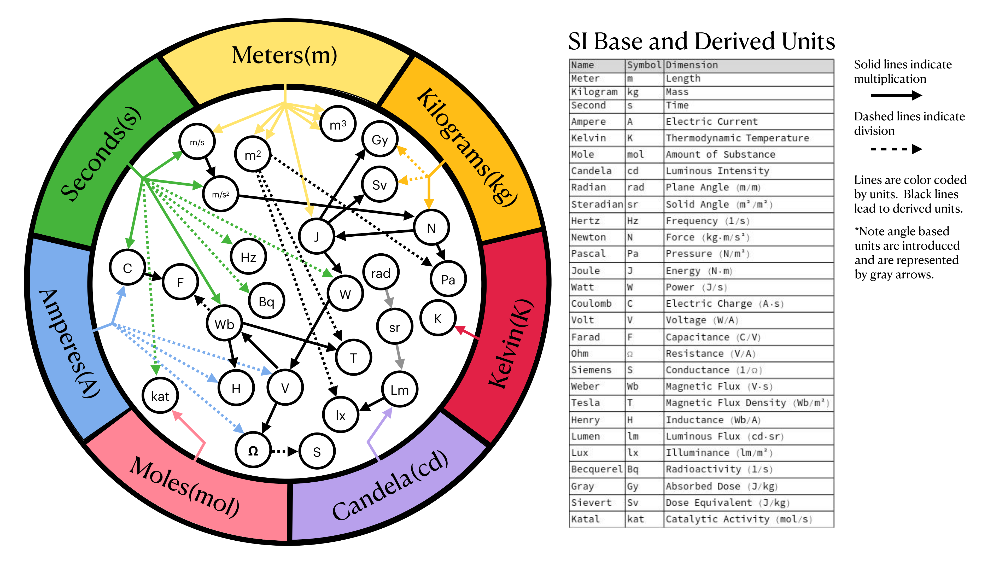
This is the current relationship between the 7 different SI base units and their derived values. It may seem like a hodgepodge, so to speak, and was done on purpose. This form while seemingly going all over the place helps to highlight that once we have established base relationships, we may continue to relate dimensional quantities in a coherent way.
The Meter(Length)
The Meter(Length)
Originally defined as the distance from the north pole to the equator by a route through Paris divided by 10 million.[3](To the reader this may appear as an arbitrary definition and it is but the important thing is a standard is chosen, we will explain the importance of this later through coherence.) To be fair this was based upon estimates of the circumference of the Earth and perhaps a less arbitrary standard that that of a cubit or the rod, that used the summation of men’s feet.
Officially in 1960 during the 11th General Conference on Weight and Measures the formal definition of the meter became the, “length equal to 1,650,763.73 wavelengths in vacuum of the radiation corresponding to the transition between the levels 2p10 and 5d5 of the krypton-86 atom.”[3] So the wavelength of energy emitted by an excited krypton-86 atom multiplied by the definitional given number of wavelengths.
In 1983 we nailed down the speed of light to its current(not to be confused with current that we shall discuss later) value of 299,792,458 meters per second.[3][4]
◼
Now defined as 1/(Magnitude of c) 1/299,792,458 meters or officially by the second method below.
◼
Voted on November 16, 2018 in Versailles, France and adopted in SI on May 20, 2019.
Out[]=
(c(speed of light))×xseconds1meter
Out[]=
The official definition and other units based on constants of nature are defined in similar ways taking the numerical values and then inverting the constant relationships to derive said units as done here:[26]
Out[]=
9192631770
299792458
(Cs)
133
hfs
Out[]=
1meter
The Second(Time)
The Second(Time)
Originally defined as 1/60 of a minute, a minute is 1/60 of an hour and 24 hours in a day.(AKA: an Earthly convenience.)[6] The concept of minutes and seconds was first used in Astronomy to help survey the cosmos.[7] The Babylonian and Greeks used this idea to dissect the sky for celestial observations building upon the Sumerians notion of dividing a circle into 360 degrees. About 5,000 years ago Egyptians are credited with use of sundials to note the progression of time. Water clocks, those utilizing tanks of water with steady drip rates, were used in Egypt and China to more reliably measure time. Candle’s(not the candela per se)have been used through history to track time but run into the same standardization problem. The hourglass is a more, “modern,” accounting method arising in the past millennia.[7]
Mechanical clocks came about in Europe during the 14th century and improved over the following centuries with spring based technology in the 1700’s. The pendulum clock developed by Christiaan Huygens in 1657 encouraged the Royal Society of London to purpose this as a timekeeping standard. Interestingly enough this method of timekeeping utilized a unit of length, the distance of the pendulum to swing back and forth.[7]
Like the meter the second continued to be defined more and more precisely though the development of atomic clocks with increasing precision. It should be noted that even here we have a working relationship between length and time.
◼
Now defined in SI as the inverse or ((Frequency of caesium 133)/Hz)/(Frequency of caesium 133) by the General Conference on Weights and Measures.[7]
Out[]=
1
Hz(hertz)
(Cs)
133
hfs
(Cs)
133
hfs
Out[]=
1second
Some of this may seem redundant but this is in effect what we are doing when inverting the constants no? It is the relative proportionality once we have definitions, ones which the dimensionless magnitudes between similarly defined things have meaning.
The Kilogram(Mass)
The Kilogram(Mass)
Originally codified as the “grave,” which was defined as the mass of 1 cubic decimeter of water(1 liter) at the point where water would begin to freeze.[8](Coincidently this related the mass of the kilogram to the meter.) This was done at the behest of French King Louis XVI to help prevent fraud by a commission who suggested, what later became a decimal based metric system. The, “grave,” lasted until the French Revolution and then the ”gramme” or “gram,” was adopted as the absolute mass of a cubic centimeter of water at 4 degrees Celsius. June 22, 1799 France adopted the, “kilogram of the archives,” a 1,000 gram platinum cylinder as the standard. Standardization continued and on May 20, 1875 a consortium of 17 different countries including the U.S. signed the Treaty of the Meter or the, “Meter Convention.” This recognized the International Prototype Kilogram(IPK) as the Kilogram, a man made platinum-iridium cylinder.
With the advent of the Kibble Balance by Bryan Kibble at the United Kingdom's National Physical Laboratory in 1975 a new era of precision was unlocked.[9] This Kibble Balance allowed us to, “weigh,” objects by the local gravitational effect and offset that by the amount of power in watts required to make the scale balance where: the mass in grams is equal to the current times the magnetic field strength times the length of wire in the coil. This precision was limited by one knowledge of the magnetic field strength and length of the spring coil. However Physicists leveraged two constants of nature the Josephson =2e/h) that relates voltage to frequency and the von Klitzing =h/e^2)that describes the way discrete values exist in electrical resistance.[10]
constant(
K
J
constant(
R
K
◼
Now defined based on the 2019 redefinition of SI by Planck’s constant h using the below method.[11]
Out[]=
xkg(kilograms)((reciprocal square meter))second
h(Planck constant)
h/(sJ)(Planck constant per second joule)
-2
m
Out[]=
Or equivalently:
Out[]=
(Js(joule second))(Hz(hertz))
2
(m/s(meter per second))
Out[]=
1kg(kilogram)
The Ampere(Current)
The Ampere(Current)
Originally defined as the force generated by a constant current between two straight parallel wires placed 1 meter apart in a Newtons/meter, in 1881)[=2e/h) that relates voltage to frequence and the von Klitzing ) that describes the way discrete values exist in electrical resistance
vacuum.(2
-7
x10
12
] The discovery by Hans Christian Ørsted that electricity and magnetism were two sides of the same coin, so to speak; and that putting a compass near a electrical current would deflect the needle from magnetic north, helped to usher in the paradigm of electromagnetism. Inspired by Ørsted’s work André-Marie Ampère a French Mathematician and Physicist, sought to figure out what was going on between electricity and magnetism. He found that running current through a wire would generate a magnetic field around said wire and thus having two wires next to each other would attract or repel depending on the direction of the charged currents.[12
]During the 1800’s a number of different unit systems for electromagnetic related phenomena were utilized. This made things quite confusing for Scientists whom in 1861 had four simultaneous systems in place. The International Electrical Congress(IEC) met in Chicago in 1893 to decide on a standard for EM related affairs; they choose two units: the ohm and Ampere, representing resistance and current respectively.(Subsequently adopted at the groups meeting in London in 1908.)[12
] Originally known as the, “international ampere,” it was determined by a silver voltameter, a device with positive and negative terminals suspended in a solution of silver nitrate. As current passed through the device silver would accumulate on the cathode and researchers could weigh the device before and after. Thus the original or, “international ampere,” was defined as: “the current that would deposit precisely 0.001118 grams of silver per second from a silver nitrate solution.”[12
] This allowed for more precise calibration of future technology such as the Kibble balance.(See kilogram.) The ampere was formally accepted as the fourth SI unit into the General Conference on Weights and Measures(CGPM) in 1921.[12
] Between 1933-1935 CGPM and the International Committee on Weights and Measure(CIPM) considered basing the ampere on, “more fundamental units,” such as CGS.(Centimeter, gram, second.) This was not official until later as WWII happened and in 1948 CIPM adopted the new definition which was basically Ampere’s original definition.[13
]The ampere is interesting as it was in part determined by two other more well measured constants of nature: the Josephson constant(
K
J
constantSubscript[R,K]=h
2
e
◼
Now defined by e(elementary charge in motion per unit of time.[26] This allows Scientists to utilize Ohm’s law(I=V/R; Current=Voltage/Resistance) by using the new definitions to relate elementary charge and Planck’s constant to verify current and voltage values.(Note: Ohm’s law is, “empirical,” i.e. it is based on experimental observation.[31] If there was a deviation the downstream effects, so to speak could be immense.)
Out[]=
1C/s | 1A(ampere) | 1A(ampere) | |
1000mA(milliamperes) | 1000mA(milliamperes) | ||
0.001kA(kiloamperes) | 1 1000 | ||
| 1 10 | ||
| 2997924580statA(statamperes) | ||
| 1 10 | ||
| 2997924580esus | ||
150.97488474atomic units | 150.974884745atomic units |
Or equivalently 1 volt divided by 1 ohm:
Out[]=
1V/Ω | 1A(ampere) | |
1000mA(milliamperes) | ||
0.001kA(kiloamperes) | ||
| ||
| ||
| ||
| ||
150.97488474atomic units |
The Kelvin(Temperature)
The Kelvin(Temperature)
Temperature is a fickle thing that a number of folks through history have grappled with, often utilizing systems involving a zero at the freezing point of water.(For a deeper dive into the History of Thermodynamics see Stephen Wolfram’s: [25]) Early attempts to quantify temperature can be traced back to the third century B.C. where Philo of Byzantium designed a hollow sphere filled with air and water connected to an open air pitcher as a rudimentary thermometer. Galileo & likely Santorio(1593) updated said thermoscope to an inverted glass tube placed in a bowl containing water/wine. During the 1600’s the Grand Duke of Tuscany noticed pressure also effected said thermoscopes, an effect that helped to later develop the ideal gas law.[14]
Temperature developed more formally around 1702 with Guillaume Amontons’ predicting a minimum temperature of -240 degrees Celsius. Anders Celsius in the 1700’s originally developed his still used scale inversely to how we have it today, 0 was boiling point of water and 100 was melting point of ice. Carl Linnaeus inverted Celsius’s scale to the more well known modern version.[16]
Technological advances led to more precise systems being created and in turn allowing us to better understand our natural world. As with electromagnetism a number of scales were purposed by different individuals. Ole Christensen Rømer constructed a scale using the boiling and freezing point of salt water and divided this into a even 60 degree scale. Issac Newton purposed 0 degrees be the freezing point of water and 12 degrees the temperature of a healthy human. Fahrenheit and Celsius were progenitors and are still used across the globe today but for scientific purposes the Kelvin was adopted. Originally it was Lord Kelvin, “On an Absolute Thermometric Scale,” to first calculate a minimum temperature of -273 degrees Celsius. 1954 the General Conference on Weights and Measures adopted the Kelvin as the base unit for temperature setting a reference point of 273.16 K as the triple point of water.(The point at which water exists as a solid, liquid and gas in thermal equilibrium.[14]
◼
Now defined by Boltzmann’s constant 1.380649*10 Joules/Kelvin using the total energy relation T.
-23
E=
k
B
Out[]=
xJ(joules)
k(Boltzmann constant)
By definition we yield the magnitude of Boltzmann's constant:
Out[]=
The Mole(Amount)
The Mole(Amount)
Amedeo Avogadro(1776-1856) a Lawyer turned Chemist asserted that simple gasses were mad of molecules and also theorized the concept of, “atoms,” so to speak using the term, “elementary molecules.” Originally in honor of Avogadro in the early 1900’s the mole was based on the number of atoms in one gram of of oxygen. In 1971 when introduced into SI it was renamed, “Avogadro’s constant.” Later it was defined by the number of molecules in 12 grams of carbon-12. Problem: It is based on the reference of mass, the kilogram, which at the time was a platinum-iridium cylinder locked away in Paris.[17]
More modern methods have utilized x-ray diffraction-interferometry to measure the distance between lattice based structures such as silicon. With a high enough purity and knowledge about the mass of the element in question we can calculate how many atoms of a substance are present.[26]
More modern methods have utilized x-ray diffraction-interferometry to measure the distance between lattice based structures such as silicon. With a high enough purity and knowledge about the mass of the element in question we can calculate how many atoms of a substance are present.[26]
◼
Now uses modern definition of kilogram based on Planck’s constant and modern equipment.(See Kibble Balance in Kilogram section) There has been criticism of the mole because it is simply a count we have parameterized through using oxygen and carbon-12 and later redefined it so that it deviates in later significant digits. No doubt it has been a useful unit for Chemistry but one may ask: as it is dimensionless why are we using it when we can count?
Or equivalently 1 Avogadro constant of entities:
The Candela(Luminous intensity)
The Candela(Luminous intensity)
The 1/683 is the attempt to capture what an, "average," observer like us would capture through our eyes.
Methodology in Wolfram Physics
Methodology in Wolfram Physics
We chronicle the process of how we came to our speculative yet seemingly, “in good agreement,” with Physics Project estimates of elementary units. Our investigation like many others took a number of twists and turns, so to speak and on the day of mid-project meetings two key pieces of information were obtained. During lunch Xerxes stressed the idea of energy and momentum having a strong meaning within our graph structure and the assignment by Professor Wolfram of additional reading. This built upon guidance from Program Mentors of focusing on length, time and energy.[23]
Upon doing assigned, “homework,” so to speak, this passage was come across. Coincidently we had considered using, the Planck intensity as method of estimating potential activity within our graph network (Ξ). [22]
An alternative interpretation for determining (Ξ).
An alternative interpretation for determining (Ξ).
There is a Philosophical argument that could be made that if our hypergraph structure is the literal underlying, “medium for flux,” that we may take this dimensional count as it appears. This is quite reckless and we should caution the reader, again this is a speculative result.
However taking this numerical count of flux seriously and plugging it into our framework for (Ξ) yields an elementary length of the magnitude:
However taking this numerical count of flux seriously and plugging it into our framework for (Ξ) yields an elementary length of the magnitude:
This result is ~ 1 magnitude off from the initial Physics Project estimates. The seemingly remarkable thing is that the original estimates where calculated in a very different way. Original estimates use a logarithmic plot
The original calculation uses the Hubble time(Age of universe) to help estimate (Ξ). Further calculations and transcendental equations are employed to generate a logarithmic plot to estimate (Ξ). (For full details please see: [23])
Following our given convention we find the following results for the elementary time and energy:
Again we must stress the only reason this path was followed was the, “seeming,” ability to replicate the original Physics Project estimates by another methodology. However as has been highlighted earlier if we are to interpret energy and momentum as, “excess fluxes” of causal edges in time and space,” perhaps there is some notion of the dimension of flux.(Thank you Wolfram Alpha!)
Following the same schema we return elementary values for the following dimensions of measure:
Coherent Units
Coherent Units
[29]
Some may have heard the saying, “Once you have F=ma, we can derive all of Physics.” While the reader should have their doubts about any all encompassing claim the general notion is a powerful one. If we are searching for the underlying, “machine code,” and ultimately the rule for our universe, we must latch onto some physical thing. Early work on the Physics Project had postulated that we may interpret energy as a count of edges in some hypergraph. This intuition still seems as the best method of going about this as we have the ability to count.
Let’s take a moment an break down the reason why we are discussing this topic.
Take for example a clothes dryer. Baring any thermodynamics and just focusing on the spinning drum: one could imagine giving it a nudge and causing it to accelerate just a bit. We have thus applied a force and caused it’s mass to accelerate.
Now a casual nudge to the drum of our clothes dryer will not to much as we need it to cycle and thus rotate a distance. Therefore we require a force great enough for our drum to rotate say a full revolution.
We actually would like our clothes to dry(again neglecting the thermodynamic component) so we would like it to spin more than a single revolution. So we require that energy to continue over a period of time. The period of energy that we will need to dry our clothes will correspond to the amount of power we require.
This exercise was to prime ones notion of the importance of the relationships between our dimensions of measure represented by corresponding units. In particular energy is a prime example of how simply dividing or multiplying by time or length will generate additional units.
The methodology behind this is to identify features of, “Physics as we know it,” to verify the underlying, “rule of the world.” We should be able to count edges to determine the associated energy and explore our multiway system to identify other, “standard phenomena.”
One such method as inspired by Project Mentors Hatem and Nick would be to simulate the formation of a minimal black hole. This would likely require extremely high resolution mapping of all the underlying edges within the causal graph, that may or may not be feasible at this time. The idea is that if we know a physical limit via general relativity and had the ability to simulate it within our hypergraph landscape, we should be able to nail down the elementary energy via counting edges.
The Maximum Entanglement Speed
The Maximum Entanglement Speed
We should come at our investigation from as many, “angles of attack,” as possible. Take this relationship given in 8.20 Units and Scales.[22]
The maximum entanglement speed would be the inverse of the elementary time giving us the following:
It appears that the maximum entanglement speed when expressed, “in terms of the energy associated with edges in the causal graph,” is the Planck power. This is not because we just, “happened,” to guess Ξ correctly; this is because we have coherent units related to each other. As the Planck energy divided by Planck time will always yield the Planck power. No matter what we choose to scale them by as long it is the same magnitude for both, we shall derive the same relationship.
For reference this would output the mass energy of Sagittarius A Star in 21 seconds:
For reference this would output the mass energy of Sagittarius A Star in 21 seconds:
Space and Timelike Hypersurfaces
Space and Timelike Hypersurfaces
[27]
Let us take this dimension of Planck flux and multiply it by its equivalent energy.
Now let us do the same for momentum.
We return the Planck intensity and Planck pressure. These are maximal states for a given Planck volume. If we were to actually achieve this energy or momentum within such a volume we would create a black hole. These correspond to the limits of energy and momentum within a minimal system, in this case the Planck scale. Within Wolfram Physics this could be seen at the maximal number of causal edges crossing a spacelike hypersurface in regards to momentum and maximal number of edges crossing a timelike hypersurface for energy.
One potential route of investigation would be to look at the Bessel Function as it is often associated with forms of dispersion. It is similar to how a drum head may vibrate when percussed as can be seen here:[30]
This is an area of future investigation and we mention it here as it was one of the first things that came to mind. Another way one may try to conceptualize this is that we can rewrite our unit of flux from inverse time and area to frequency area.
While this may be trivial, at least for observers like us this may be useful.
However the question still remains: if this is an interpretation of a minimal physical unit such as the Planck volume(through space and timelike hypersurfaces), why does it correspond so well to our estimated position in the multiway system. The simplest answer is, it is a mere coincidence and has no true correlation. Occam’s razor would suggest that the simplest answer is the most likely.
Philosophical Interpretations
Philosophical Interpretations
Perhaps this would net out to not change? If that were the case one might interpret that as no further expansion of the network was occurring. If this were true that would mean there would be no more expansion in our universe. Perhaps we are in some, “maximally expanded state.” Entertaining this idea then brings up the issue of cosmological observations. Space seems to be expanding, how can we account for this observation? We would need to attribute it to some other physical mechanism. Perhaps dark matter and energy may help us account for these effects. One could imagine if we were in some maximally extended state that rewritings of our multiway system may account for these observed phenomena.
The question still remains: What’s going on?
Concluding Remarks
Concluding Remarks
Units have a rich and tangled history with observers like us. We have developed a system of seemingly arbitrary basis for our world. Remarkably once we chose a basis for these dimensions of measure, the relationships between them allow us to peer deeper into nature. The meter and second however arbitrary, once set will ultimately yield the speed of light c. As will other units for mass, current/charge and temperature via coherence.
Within the scope and methodology of Wolfram Physics we, “stumbled,” so to speak across a highly speculative relationship. This speculation if taken literally appears to reproduce initial estimates of the Physics Project ~ 1 magnitude. While this is likely a coincidence it does raise the question, what if it was not a coincidence? Aside from this coincidence the original methodology of edge counting within our multiway system seems like the best way of accounting for energy. Energy and its relationship with time and space appear to be the most promising path forward for rooting our system in reality. Whatever the elementary time, space and energy end up being in our universe their relationships should help guide our path forward.
Acknowledgements
Acknowledgements
I would like to thank my Mom and Dad for always believing in me, even when it was hard. My Mentor’s Nicholas Frieler and Hatem Elshatlawy for their passionate guidance and wisdom. The Wolfram Institute for providing a wealth of free information to the world: Dugan Hammock, Carlos Zapata, Nik Murzin and James Wiles. Jonathan Gorard who helped inspire me to do live science. To Xerxes Arsiwalla who’s lunchtime tip helped make any potential discoveries possible. Professor Stephen Wolfram for putting on this program, giving Wolfram Alpha to the world and putting up with my nonsense. Jennifer Scharf for consistently holding my words to account. Caleigh Fisher for enlightening me to topics I was previously unaware. Bill Manuel for imparting the, “taking observers seriously,” approach within me. And to my Friends at the Physics Monastery. Vanessa for teaching me through the complexity of everything, nature is simple. K.C. O’Keefe for stressing the requirement of rigor. To Thad Roberts for taking me under his wing, sitting down and catching me up on years of education I did not have. And to Rick DeWitt for sharing his knowledge and intuition, that without, any potential discovery here would not be possible.
References
References
1
.2
.“The “Hand” Measurement for Horses.” Archive.org, 2025, https://web.archive.org/web/20110822161506/www.omafra.gov.on.ca/english/livestock/horses/facts/info_hands.htm
3
.4
.5
.Office, Stationery. Removal and Disposal of Vehicles (Amendment) (Scotland) Regulations 1999. 1999. https://www.bipm.org/documents/20126/41489670/SI-App2-metre.pdf/0e011055-9736-d293-5e56-b8b1b267fd68?version=1.8&t=1637238031486&download=false
6
.“Second: Introduction.” NIST, 9 Apr. 2019, www.nist.gov/si-redefinition/second-introduction
7
.“Second: The Past.” NIST, 9 Apr. 2019, www.nist.gov/si-redefinition/second-past.
8
.“Kilogram: The Past.” NIST, 14 May 2018, www.nist.gov/si-redefinition/kilogram-past
9
.Materese, Robin. “Kilogram: The Kibble Balance.” NIST, 29 May 2019, www.nist.gov/si-redefinition/kilogram-kibble-balance
10
.NIST. “Kilogram: Mass and Planck’s Constant.” NIST, 14 May 2018, www.nist.gov/si-redefinition/kilogram-mass-and-plancks-constant
11
.“The Latest: Landmark Change to Kilogram Approved.” AP News, 16 Nov. 2018, https://apnews.com/article/e6991383703e4ad5a9570d97b0e57822
12
.Materese, Robin. “Ampere: History.” NIST, 15 May 2018, www.nist.gov/si-redefinition/ampere-history
13
.robin.materese@nist.gov. “Ampere: Introduction.” NIST, 15 May 2018, www.nist.gov/si-redefinition/ampere-introduction
14
.“Kelvin: History.” NIST, 14 May 2018, www.nist.gov/si-redefinition/kelvin-history
15
.“Memoirs of the Literary and Philosophical Society of Manchester.” Google Books, 2025, https://books.google.com/books?id=3qdJAAAAYAAJ&pg=PA595#v=onepage&q&f=false
16
.“Kelvin: Introduction.” NIST, 14 May 2018, www.nist.gov/si-redefinition/kelvin-introduction
17
.“Redefining the Mole.” NIST, 23 Oct. 2018, www.nist.gov/si-redefinition/redefining-mole.
18
.Johansson, Ingvar. “Metrological Thinking Needs the Notions Ofparametricquantities, Units and Dimensions.” Metrologia, vol. 47, no. 3, 12 Apr. 2010, pp. 219–230, https://doi.org/10.1088/0026-1394/47/3/012
19
.Barański, Andrzej. “The Atomic Mass Unit, the Avogadro Constant, and the Mole: A Way to Understanding.” Journal of Chemical Education, vol. 89, no. 1, 1 Nov. 2011, pp. 97–102, https://doi.org/10.1021/ed2001957
20
.“Candela.” NIST, 16 May 2019, www.nist.gov/si-redefinition/candela
21
.“History of the Magnitude Scale.” Cas.sdss.org, https://cas.sdss.org/DR6/en/proj/advanced/color/maghistory.asp
22
.“Units and Scales: Wolfram Physics Project Technical Background.” Wolframphysics.org, 2025, www.wolframphysics.org/technical-introduction/potential-relation-to-physics/units-and-scales/
23
.“Matter, Energy and Gravitation: Wolfram Physics Project Technical Background.” Wolframphysics.org, 2025, www.wolframphysics.org/technical-introduction/potential-relation-to-physics/matter-energy-and-gravitation/ Accessed 31 Oct. 2025.
24
."Wayback Machine.” Archive.org, 2025, https://web.archive.org/web/20111107023429/https://www.unc.edu/~mgood/research/RestEnergy.pdf
25
.“How Did We Get Here? The Tangled History of the Second Law of Thermodynamics.” Writings.stephenwolfram.com, 31 Jan. 2023, https://writings.stephenwolfram.com/2023/01/how-did-we-get-here-the-tangled-history-of-the-second-law-of-thermodynamics/
26
."The International System of Units (SI)." Bureau International des Poids et Mesures, 9th edition, 2019, https://www.bipm.org/documents/d/guest/si-brochure-9-en-pdf
27
.Weisstein, Eric W. “Hypersurface.” Mathworld.wolfram.com, https://mathworld.wolfram.com/Hypersurface.html
28
.Code Assistance provided by Wolfram Notebook Assistant and ChatGPT 4o.
29
.Wikipedia Contributors. “Coherence (Units of Measurement).” Wikipedia, Wikimedia Foundation, 23 Oct. 2025. https://en.wikipedia.org/wiki/Coherence_(units_of_measurement)
30
.Wikipedia Contributors. “Bessel Function.” Wikipedia, Wikimedia Foundation, 7 Dec. 2019, https://en.wikipedia.org/wiki/Bessel_function
31
.---. “Ampere: The Present.” NIST, 15 May 2018, www.nist.gov/si-redefinition/ampere-present
CITE THIS NOTEBOOK
CITE THIS NOTEBOOK
Units: How we got here and methodology for implementation in the Wolfram Physics
by Matthew Fox
Wolfram Community, STAFF PICKS, July 9, 2025
https://community.wolfram.com/groups/-/m/t/3497693
by Matthew Fox
Wolfram Community, STAFF PICKS, July 9, 2025
https://community.wolfram.com/groups/-/m/t/3497693