This is the first part of post series that serve as a concise guide to harnessing the possibilities of the Wolfram plugin for mathematics, physics and Wolfram Language coding, with a special focus on effective problem-solving prompting techniques, exemplified with 100+ plugin-using ChatGPT chat sessions.
Check out other parts of this guide here:
Guide 1: https://community.wolfram.com/groups/-/m/t/3070428
Guide 3: https://community.wolfram.com/groups/-/m/t/3077476
Guide 4: https://community.wolfram.com/groups/-/m/t/3077667
Guide 5: https://community.wolfram.com/groups/-/m/t/3078038
Guide 1: https://community.wolfram.com/groups/-/m/t/3070428
Guide 3: https://community.wolfram.com/groups/-/m/t/3077476
Guide 4: https://community.wolfram.com/groups/-/m/t/3077667
Guide 5: https://community.wolfram.com/groups/-/m/t/3078038
Contents
Contents
The Importance of Prompt Engineering Some Recently Discussed Prompt Techniques (All from the Literature) Prompt Examples (All from the Literature)
Cell coloring conventions
Cell coloring conventions
The Importance of Prompt Engineering
The Importance of Prompt Engineering
Some Recently Discussed Prompt Techniques (All from the Literature)
Some Recently Discussed Prompt Techniques (All from the Literature)
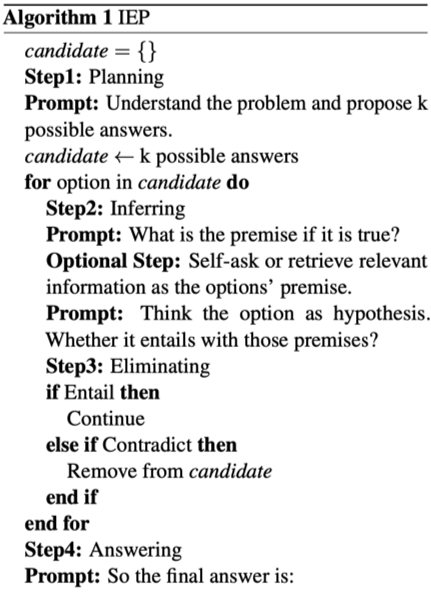
Inferential exclusion prompting (IEP)
Inferential exclusion prompting (IEP)
Eliminating Reasoning via Inferring with Planning: A New Framework to Guide LLMs’ Non-linear Thinking (https://arxiv.org/abs/2310.12342)
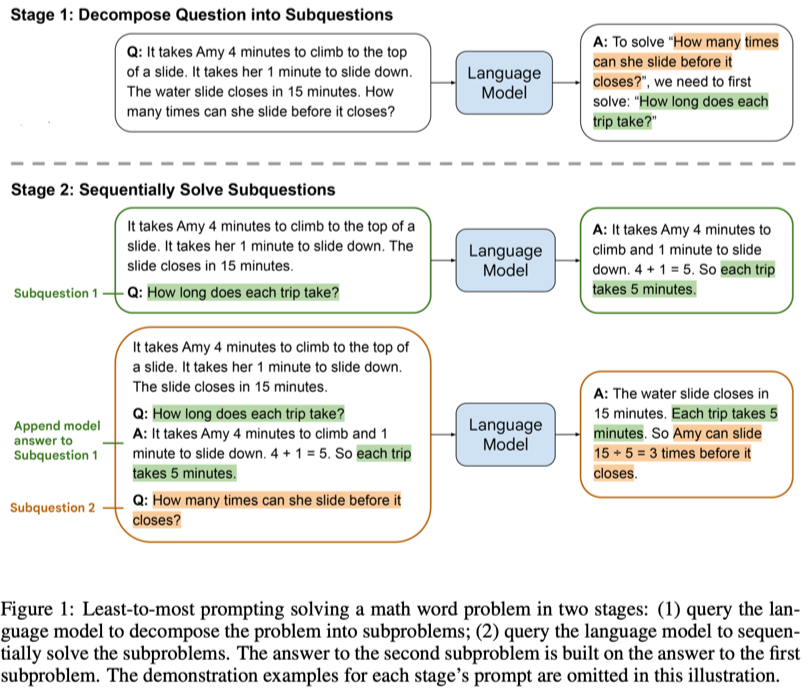
Least-to-Most prompting
Least-to-Most prompting
Least-to-Most Prompting Enables Complex Reasoning in Large Language Models (https://arxiv.org/abs/2205.10625)
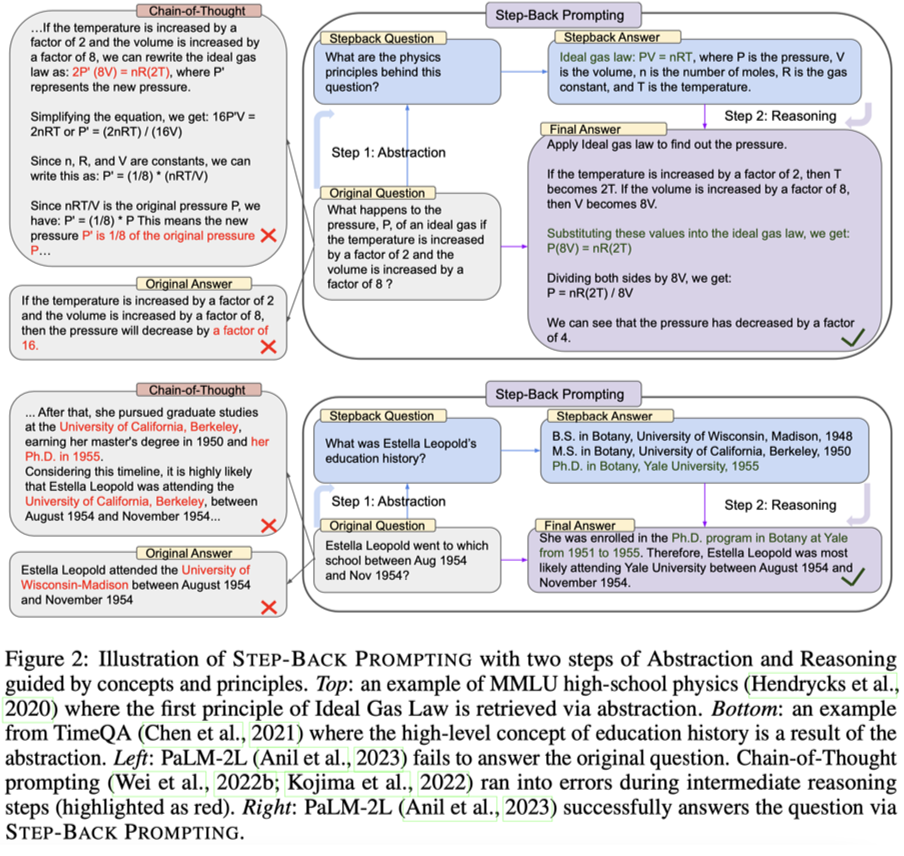
Step-back prompting
Step-back prompting
Tell the LLM to literally ‘step’ back and reflect/remember how the concrete problem could be embedded in a larger class of problems.
Encourage the LLM to put the problem in a larger context and remember related problems.
Take a Step Back: Evoking Reasoning via Abstraction in Large Language Models (https://arxiv.org/abs/2310.06117)
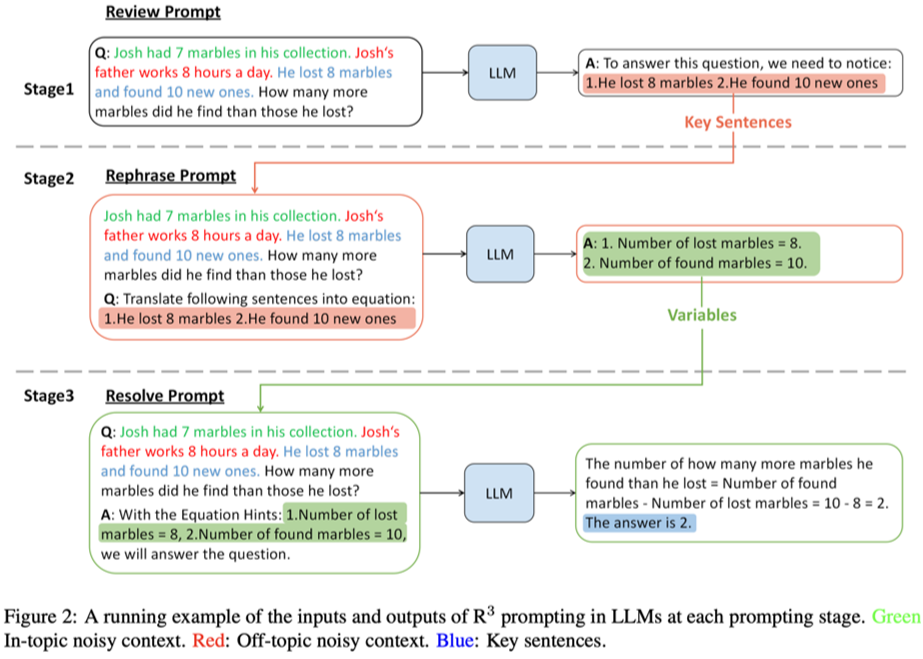
Review-Rephrase-Resolve (3R)
Review-Rephrase-Resolve
()
3
R
Tell the LLM to review a problem and rephrase it before solving.
3
R
Progressive hints
Progressive hints
Progressive-Hint Prompting Improves Reasoning in Large Language Models (https://arxiv.org/abs/2304.09797)
Self-ask
Self-ask
ThoughtSource: A central hub for large language model reasoning data (https://arxiv.org/abs/2301.11596)
Measuring and Narrowing the Compositionality Gap in Language Models (https://arxiv.org/abs/2210.03350)
Tell the LLM to generate follow-up questions and then answer them.
Self-asking and self-understanding
Self-asking and self-understanding
Metacognitive Prompting Improves Understanding in Large Language Models (https://arxiv.org/abs/2308.05342)
Self-consistency
Self-consistency
Tell the LLM to do multiple CoT and check consistency.
Self-consistency Improves Chain of Thought Reasoning in Language Models (https://arxiv.org/abs/2203.11171)
Self-check
Self-check
SelfCheckGPT: Zero-Resource Black-Box Hallucination Detection for Generative Large Language Models (https://arxiv.org/abs/2303.08896)
Enhancing Large Language Models in Coding Through Multi-Perspective Self-Consistency (https://arxiv.org/abs/2309.17272)
PS: The Wolfram plugin is perfect and powerful for a LLM to get external feedback.
Pure self-correction is quite limited:
Large Language Models Cannot Self-Correct Reasoning Yet (https://arxiv.org/abs/2310.01798)
Large Language Models Cannot Self-Correct Reasoning Yet (https://arxiv.org/abs/2310.01798)
Self-refinement and self-critiquing
Self-refinement and self-critiquing
It is an ongoing discussion whether this is a valuable approach.
Can Large Language Models Really Improve by Self-critiquing Their Own Plans? (https://arxiv.org/abs/2310.08118)
Foresee and Reflect (FaR)
Foresee and Reflect (FaR)
How FaR Are Large Language Models From Agents with Theory-of-Mind? (https://arxiv.org/abs/2310.03051)
Monte Carlo tree search
Monte Carlo tree search
Monte Carlo Thought Search: Large Language Model Querying for Complex Scientific Reasoning in Catalyst Design (https://arxiv.org/abs/2310.14420)
EmotionPrompt
EmotionPrompt
Tell the LLM why you want the LLM to solve this problem.
Large Language Models Understand and Can Be Enhanced by Emotional Stimuli (https://arxiv.org/abs/2307.11760)
Branch-Solve-Merge (BSM)
Branch-Solve-Merge (BSM)
Branch-Solve-Merge Improves Large Language Model Evaluation and Generation (https://arxiv.org/abs/2310.15123)
Multi-agent
Multi-agent
Towards CausalGPT: A Multi-Agent Approach for Faithful Knowledge Reasoning via Promoting Causal Consistency in LLMs (https://arxiv.org/abs/2308.11914)
Exploring the Intersection of Large Language Models and Agent-Based Modeling via Prompt Engineering (https://arxiv.org/abs/2308.07411)
Language Agent Tree Search Unifies Reasoning Acting and Planning in Language Models (https://arxiv.org/abs/2310.04406)
Prompt Examples (All from the Literature)
Prompt Examples (All from the Literature)
None of the prompt examples from this section are especially important. The goal of the prompt collection of this subsection is to give a good impression of the breadth and variety of instructions and details that one could (and often should) put in a prompt, as well as to demonstrate the variety of tasks that can be accomplished with the above-discussed prompting techniques.
High-school physics competitions
High-school physics competitions
Innovative approaches to high school physics competitions: Harnessing the power of AI and open science (https://arxiv.org/abs/2309.02986)
Problem solving
Problem solving
Math teacher
Math teacher
“A Tale of Two Prompts”: Investigating the Impact of Guidance and Interaction Strategies for LLM Use on Learner Performance and Perception (https://arxiv.org/abs/2310.13712)
Vehicle accident analysis
Vehicle accident analysis
Large Language Models in Analyzing Crash Narratives—A Comparative Study of ChatGPT, BARD and GPT-4 (https://arxiv.org/abs/2308.13563)
Special relativity consistency
Special relativity consistency
Assessing GPT-4’s role as a co-collaborator in scientific research: a case study analyzing Einstein’s special theory of relativity (DOI:10.1007/s44163-023-00075-3)
Multi-choice questions
Multi-choice questions
Summarization
Summarization
Prevalence and prevention of large language model use in crowd work (https://arxiv.org/abs/2310.15683)
Summarization II
Summarization II
From Sparse to Dense: GPT-4 Summarization with Chain of Density Prompting (https://arxiv.org/abs/2309.04269)
Summarization III
Summarization III
Summarization VI
Summarization VI
Can GPT models Follow Human Summarization Guidelines? Evaluating ChatGPT and GPT-4 for Dialogue Summarization (https://arxiv.org/abs/2310.16810)
Translation
Translation
Beyond Static Datasets: A Deep Interaction Approach to LLM Evaluation (https://arxiv.org/abs/2309.04369)
Gender reversal
Gender reversal
Will the Prince Get True Love’s Kiss? On the Model Sensitivity to Gender Perturbation over Fairytale Texts (https://arxiv.org/abs/2310.10865)
Communication games
Communication games
Exploring Large Language Models for Communication Games: An Empirical Study on Werewolf (https://arxiv.org/abs/2309.04658)
Geometric transformations
Geometric transformations
Long-form answers
Long-form answers
Strategic Behavior of Large Language Models: Game Structure vs. Contextual Framing (https://arxiv.org/abs/2309.05898)
Evaluator
Evaluator
Investigating Answerability of LLMs for Long-Form Question Answering (https://arxiv.org/abs/2309.08210)
“The Importance of Prompt Engineering” section continues in the following post.
“The Importance of Prompt Engineering” section continues in the following post.
CITE THIS NOTEBOOK
CITE THIS NOTEBOOK
Guide 2: The Wolfram Plugin for ChatGPT
by Michael Trott
Wolfram Community, STAFF PICKS, December 1, 2023
https://community.wolfram.com/groups/-/m/t/3075538
by Michael Trott
Wolfram Community, STAFF PICKS, December 1, 2023
https://community.wolfram.com/groups/-/m/t/3075538