Langmuir Hinshelwood Mechanism
Authors: Benjamin J. McCoy, Housam BINOUS and Ahmed Bellagi
Langmuir Hinshelwood Mechanism
Authors: Benjamin J. McCoy, Housam BINOUS and Ahmed Bellagi
Authors: Benjamin J. McCoy, Housam BINOUS and Ahmed Bellagi
The strategy is to solve the rate equations with a mass balance on the total number of adsorption sites, .
One reaction is chosen as the rate limiting step, and the other reactions are at equilibrium.
S
tot
One reaction is chosen as the rate limiting step, and the other reactions are at equilibrium.
Reaction A ⇌ B
Rate expressions when adsorption or desorption are rate limiting steps
Rate expressions when adsorption or desorption are rate limiting steps
adsorption is rate limiting step
A + S ⇌ As (rate limiting step, equilibrium constant KA and rate constants are k1 and k2)
As ⇌ Bs (equilibrium constant K and rate constants are k5 and k6)
Bs ⇌ B+S (equilibrium constant 1/KB and rate constants are k3 and k4)
A ⇌ B (equilibrium constant KAB=K KA/KB)
Concentration of reactants are A and B. Concentration of adsorbed reactants are As and Bs.
Concentration of empty adsorption sites is S=Stot-As-Bs where the concentration of all sites (empty and occupied) is Stot.
Rate expression when adsorption of A is rate limiting step
A + S ⇌ As (rate limiting step, equilibrium constant KA and rate constants are k1 and k2)
As ⇌ Bs (equilibrium constant K and rate constants are k5 and k6)
Bs ⇌ B+S (equilibrium constant 1/KB and rate constants are k3 and k4)
A ⇌ B (equilibrium constant KAB=K KA/KB)
Concentration of reactants are A and B. Concentration of adsorbed reactants are As and Bs.
Concentration of empty adsorption sites is S=Stot-As-Bs where the concentration of all sites (empty and occupied) is Stot.
Rate expression when adsorption of A is rate limiting step
In[]:=
Solve[{r==As-As,Bs-Bs==0,Bs-As0,s+As+Bs},{r,s,As,Bs}]//Simplify
k
1
k
2
k
3
k
4
k
6
k
5
S
tot
Out[]=
r+B(+),s+B(+),As+B(+),Bs+B(+)
(A-B)
k
1
k
4
k
5
k
2
k
3
k
6
S
tot
k
4
k
5
k
3
k
5
k
6
k
4
k
5
S
tot
k
4
k
5
k
3
k
5
k
6
B
k
3
k
6
S
tot
k
4
k
5
k
3
k
5
k
6
B
k
3
k
5
S
tot
k
4
k
5
k
3
k
5
k
6
In[]:=
(A-B)
k
1
k
4
k
5
k
2
k
3
k
6
S
tot
k
4
k
5
k
3
k
5
k
6
k
2
k
1
K
A
k
4
k
3
K
B
k
5
K
B
k
6
K
AB
K
A
Out[]=
-(B-A)
k
1
K
AB
S
tot
B+(1+B)
K
A
K
AB
K
B
In[]:=
rate=(-B/+A)
k
1
K
AB
S
tot
1+B(1+/())
K
B
K
A
K
AB
K
B
Out[]=
k
1
B
K
AB
S
tot
1+B1+
K
A
K
AB
K
B
K
B
In[]:=
rate=A-
k
1
B
K
AB
S
tot
1+B1+
1
K
K
B
Out[]=
k
1
B
K
AB
S
tot
1+B1+
1
K
K
B
desorption is rate limiting step
A+S ⇌ As (equilibrium constant KA and rate constants are k1 and k2)
As ⇌ Bs (equilibrium constant K and rate constants are k5 and k6)
Bs ⇌ B+S (rate limiting step, equilibrium constant 1/KB and rate constants are k3 and k4)
A ⇌ B (equilibrium constant KAB=K KA/KB)
Concentration of reactants are A and B. Concentration of adsorbed reactants are As and Bs.
Concentration of empty adsorption sites is S=Stot-As-Bs where the concentration of all sites (empty and occupied) is Stot.
Rate expression when desorption of B is rate limiting step
A+S ⇌ As (equilibrium constant KA and rate constants are k1 and k2)
As ⇌ Bs (equilibrium constant K and rate constants are k5 and k6)
Bs ⇌ B+S (rate limiting step, equilibrium constant 1/KB and rate constants are k3 and k4)
A ⇌ B (equilibrium constant KAB=K KA/KB)
Concentration of reactants are A and B. Concentration of adsorbed reactants are As and Bs.
Concentration of empty adsorption sites is S=Stot-As-Bs where the concentration of all sites (empty and occupied) is Stot.
Rate expression when desorption of B is rate limiting step
In[]:=
Solve[{0==As-As,-Bs+Bsr,Bs-As0,s+As+Bs},{r,s,As,Bs}]//Simplify
k
1
k
2
k
3
k
4
k
6
k
5
S
tot
Out[]=
r+A(+),s+A(+),As+A(+),Bs+A(+)
(A-B)
k
1
k
4
k
5
k
2
k
3
k
6
S
tot
k
2
k
6
k
1
k
5
k
6
k
2
k
6
S
tot
k
2
k
6
k
1
k
5
k
6
A
k
1
k
6
S
tot
k
2
k
6
k
1
k
5
k
6
A
k
1
k
5
S
tot
k
2
k
6
k
1
k
5
k
6
In[]:=
(A-B)
k
1
k
4
k
5
k
2
k
3
k
6
S
tot
k
2
k
6
k
1
k
5
k
6
k
2
k
1
K
A
k
4
k
3
K
B
k
5
K
B
k
6
K
AB
K
A
Out[]=
-(B-A)
k
3
K
AB
S
tot
1+A+A
K
A
K
AB
K
B
In[]:=
rate=(-B/+A)
k
3
K
AB
K
AB
S
tot
1+A(1+/)
K
A
K
AB
K
B
K
A
Out[]=
k
3
B
K
AB
K
AB
S
tot
1+A1+
K
A
K
AB
K
B
K
A
In[]:=
k
3
B
K
AB
K
AB
S
tot
1+A1+
K
A
K
AB
K
B
K
A
K
AB
K
B
K
A
K
AB
k
3
k
4
K
A
Out[]=
KA-
k
4
K
A
B
K
AB
S
tot
1+A(1+K)
K
A
Irreversible Reaction A + B C
Rate expressions when reactants adsorb on same or different type of adsorption site with and without product adsorption
Rate expressions when reactants adsorb on same or different type of adsorption site with and without product adsorption
One site model. Reactants A and B adsorb on same type of site. Product C does not adsorb.
A+S ⇌ As (equilibrium constant KA and rate constants are k1 and k2)
B+S ⇌ Bs (equilibrium constant KB and rate constants are k3 and k4)
As+Bs C+S+S (rate limiting step, rate constant is kp)
Concentration of reactants are A and B. Concentration of adsorbed reactants are As and Bs.
Concentration of empty adsorption sites is S=Stot-As-Bs where the concentration of all sites (empty and occupied) is Stot.
Rate expression when reactants adsorb on same type of site and product does not adsorb
A+S ⇌ As (equilibrium constant KA and rate constants are k1 and k2)
B+S ⇌ Bs (equilibrium constant KB and rate constants are k3 and k4)
As+Bs C+S+S (rate limiting step, rate constant is kp)
Concentration of reactants are A and B. Concentration of adsorbed reactants are As and Bs.
Concentration of empty adsorption sites is S=Stot-As-Bs where the concentration of all sites (empty and occupied) is Stot.
Rate expression when reactants adsorb on same type of site and product does not adsorb
In[]:=
Solve[{A(-As-Bs)-As==0,B(-As-Bs)-Bs==0,dPkpAsBs},{dP,As,Bs}]//Simplify
k
1
S
tot
k
2
k
3
S
tot
k
4
Out[]=
dP,As,Bs
ABkp
k
1
k
2
k
3
k
4
2
S
tot
2
(A+(B+))
k
1
k
4
k
2
k
3
k
4
A
k
1
k
4
S
tot
A+(B+)
k
1
k
4
k
2
k
3
k
4
B
k
2
k
3
S
tot
A+(B+)
k
1
k
4
k
2
k
3
k
4
In[]:=
ABkp
k
1
k
2
k
3
k
4
2
S
tot
2
(B+(A+))
k
2
k
3
k
1
k
2
k
4
k
1
k
2
K
A
k
3
k
4
K
B
Out[]=
ABkp
K
A
K
B
2
S
tot
2
(1+A+B)
K
A
K
B
One site model. Reactants A and B adsorb on same type of site with product C adsorption.
A+S ⇌ As (equilibrium constant KA and rate constants are k1 and k2)
B+S ⇌ Bs (equilibrium constant KB and rate constants are k3 and k4)
As+Bs Cs+S (rate limiting step, rate constant is kp)
Cs ⇌ C+S (equilibrium constant KC and rate constants are k5 and k6)
Concentration of reactants and product are A, B and C. Concentration of adsorbed reactants and adsorbed product are As, Bs and Cs.
Concentration of empty adsorption sites is S=Stot-As-Bs-Cs where the concentration of all sites (empty and occupied) is Stot.
Rate expression when reactants and product adsorb on same type of site
A+S ⇌ As (equilibrium constant KA and rate constants are k1 and k2)
B+S ⇌ Bs (equilibrium constant KB and rate constants are k3 and k4)
As+Bs Cs+S (rate limiting step, rate constant is kp)
Cs ⇌ C+S (equilibrium constant KC and rate constants are k5 and k6)
Concentration of reactants and product are A, B and C. Concentration of adsorbed reactants and adsorbed product are As, Bs and Cs.
Concentration of empty adsorption sites is S=Stot-As-Bs-Cs where the concentration of all sites (empty and occupied) is Stot.
Rate expression when reactants and product adsorb on same type of site
In[]:=
Solve[{A(-As-Bs-Cs)-As==0,B(-As-Bs-Cs)-Bs==0,C(-As-Bs-Cs)-Cs0,dPkpAsBs},{dP,As,Bs,Cs}]//Simplify
k
1
S
tot
k
2
k
3
S
tot
k
4
k
6
S
tot
k
5
Out[]=
dP,As,Bs,Cs
ABkp
k
1
k
2
k
3
k
4
2
k
5
2
S
tot
2
(A+(B+(+C)))
k
1
k
4
k
5
k
2
k
3
k
5
k
4
k
5
k
6
A
k
1
k
4
k
5
S
tot
A+(B+(+C))
k
1
k
4
k
5
k
2
k
3
k
5
k
4
k
5
k
6
B
k
2
k
3
k
5
S
tot
A+(B+(+C))
k
1
k
4
k
5
k
2
k
3
k
5
k
4
k
5
k
6
C
k
2
k
4
k
6
S
tot
A+(B+(+C))
k
1
k
4
k
5
k
2
k
3
k
5
k
4
k
5
k
6
In[]:=
ABkp
k
1
k
2
k
3
k
4
2
k
5
2
S
tot
2
(B+(A+(+C)))
k
2
k
3
k
5
k
4
k
1
k
5
k
2
k
5
k
6
k
1
k
2
K
A
k
3
k
4
K
B
k
6
k
5
K
C
Out[]=
ABkp
K
A
K
B
2
S
tot
2
(1+A+B+C)
K
A
K
B
K
C
Two different sites S1 and S2 without product adsorption.
A+S1 ⇌ As (equilibrium constant KA and rate constants are k1 and k2)
B+S2 ⇌ Bs (equilibrium constant KB and rate constants are k3 and k4)
As+Bs C+S1+S2 (rate limiting step, rate constant is kp)
Concentration of reactants are A and B. Concentration of adsorbed reactants are As and Bs.
Concentration of empty adsorption sites is S1=S1tot-As and S2=S2tot-Bs where the concentration of all sites (empty and occupied) of type 1 and 2 are S1tot and S2tot.
Rate expression when reactants adsorb on different sites without product adsorption
A+S1 ⇌ As (equilibrium constant KA and rate constants are k1 and k2)
B+S2 ⇌ Bs (equilibrium constant KB and rate constants are k3 and k4)
As+Bs C+S1+S2 (rate limiting step, rate constant is kp)
Concentration of reactants are A and B. Concentration of adsorbed reactants are As and Bs.
Concentration of empty adsorption sites is S1=S1tot-As and S2=S2tot-Bs where the concentration of all sites (empty and occupied) of type 1 and 2 are S1tot and S2tot.
Rate expression when reactants adsorb on different sites without product adsorption
In[]:=
Solve[{A(-As)-As==0,B(-Bs)-Bs==0,dPkpAsBs},{dP,As,Bs}]//Simplify
k
1
S1
tot
k
2
k
3
S2
tot
k
4
Out[]=
dP,As,Bs
ABkp
k
1
k
3
S1
tot
S2
tot
(A+)(B+)
k
1
k
2
k
3
k
4
A
k
1
S1
tot
A+
k
1
k
2
B
k
3
S2
tot
B+
k
3
k
4
In[]:=
ABkp
k
1
k
3
S1
tot
S2
tot
(A+)(B+)
k
1
k
2
k
3
k
4
k
1
k
2
K
A
k
3
k
4
K
B
Out[]=
ABkp
K
A
K
B
S1
tot
S2
tot
(1+A)(1+B)
K
A
K
B
In[]:=
ABkp
K
A
K
B
S1
tot
S2
tot
1+A+B+AB
K
A
K
B
K
A
K
B
Out[]=
ABkp
K
A
K
B
S1
tot
S2
tot
(1+A)(1+B)
K
A
K
B
Two different site S1 and S2 with product adsorption on site S1
A+S1 ⇌ As (equilibrium constant KA and rate constants are k1 and k2)
B+S2 ⇌ Bs (equilibrium constant KB and rate constants are k3 and k4)
As+Bs Cs+S2 (rate limiting step, rate constant is kp)
Cs ⇌ C+S1 (equilibrium constant KC and rate constants are k5 and k6)
Concentration of reactants and product are A, B and C. Concentration of adsorbed reactants and adsorbed product are As, Bs and Cs.
Concentration of empty adsorption sites are S1=S1tot-As-Cs and S2=S2tot-Bs where the concentration of all sites (empty and occupied) of type 1 and 2 are S1tot and S2tot.
Rate expression when reactants adsorb on different sites with product adsorption
A+S1 ⇌ As (equilibrium constant KA and rate constants are k1 and k2)
B+S2 ⇌ Bs (equilibrium constant KB and rate constants are k3 and k4)
As+Bs Cs+S2 (rate limiting step, rate constant is kp)
Cs ⇌ C+S1 (equilibrium constant KC and rate constants are k5 and k6)
Concentration of reactants and product are A, B and C. Concentration of adsorbed reactants and adsorbed product are As, Bs and Cs.
Concentration of empty adsorption sites are S1=S1tot-As-Cs and S2=S2tot-Bs where the concentration of all sites (empty and occupied) of type 1 and 2 are S1tot and S2tot.
Rate expression when reactants adsorb on different sites with product adsorption
Reaction A + H2 AH2 (for example: hydrogenation reactions)
Rate expression when H2 follows dissociative adsorption
Rate expression when H2 follows dissociative adsorption
Dissociative adsorption with product adsorption
A+S ⇌ As (equilibrium constant KA and rate constants are k1 and k2)
H2+2S ⇌ 2Hs (dissociative adsorption) (equilibrium constant KH2 and rate constants are k3 and k4)
As+2Hs AH2s+2S (rate limiting step, rate constant is kp)
AH2s ⇌ AH2+S (equilibrium constant KAH2 and rate constants are k5 and k6)
Concentration of reactants and product are A, H2 and AH2. Concentration of adsorbed reactants and adsorbed product are As, Hs and AH2s.
Concentration of empty adsorption sites is S=Stot-As-Hs-AH2s where the concentration of all sites (empty and occupied) is Stot.
Rate expression when there is dissociative adsorption of H2 and product adsorption
A+S ⇌ As (equilibrium constant KA and rate constants are k1 and k2)
H2+2S ⇌ 2Hs (dissociative adsorption) (equilibrium constant KH2 and rate constants are k3 and k4)
As+2Hs AH2s+2S (rate limiting step, rate constant is kp)
AH2s ⇌ AH2+S (equilibrium constant KAH2 and rate constants are k5 and k6)
Concentration of reactants and product are A, H2 and AH2. Concentration of adsorbed reactants and adsorbed product are As, Hs and AH2s.
Concentration of empty adsorption sites is S=Stot-As-Hs-AH2s where the concentration of all sites (empty and occupied) is Stot.
Rate expression when there is dissociative adsorption of H2 and product adsorption
Dissociative adsorption without product adsorption
A+S ⇌ As (equilibrium constant KA and rate constants are k1 and k2)
H2+2S ⇌ 2Hs (equilibrium constant KH2 and rate constants are k3 and k4)
As+2Hs AH2+3S (adsorption of AH2 is neglected because it is weak) (rate limiting step, rate constant is kp)
Concentration of reactants are A and H2. Concentration of adsorbed reactants are As and Hs.
Concentration of empty adsorption sites is S=Stot-As-Hs where the concentration of all sites (empty and occupied) is Stot.
Rate expression when there is dissociative adsorption without product adsorption
A+S ⇌ As (equilibrium constant KA and rate constants are k1 and k2)
H2+2S ⇌ 2Hs (equilibrium constant KH2 and rate constants are k3 and k4)
As+2Hs AH2+3S (adsorption of AH2 is neglected because it is weak) (rate limiting step, rate constant is kp)
Concentration of reactants are A and H2. Concentration of adsorbed reactants are As and Hs.
Concentration of empty adsorption sites is S=Stot-As-Hs where the concentration of all sites (empty and occupied) is Stot.
Rate expression when there is dissociative adsorption without product adsorption
Reaction A + B ⇌ C or A + B C
Rate expressions ⇌or reversible and irreversible reactions involving three components
Rate expressions ⇌or reversible and irreversible reactions involving three components
Eley-Rideal Mechanism (reactants A and B are such A is adsorbed and B stays in the gas phase).
One site model single site reaction
A+S ⇌ As (equilibrium constant KA and rate constants are k1 and k2)
As+B Cs (rate limiting step, rate constant is kp) (equilibrium constant KAB)
Cs ⇌ C+S (equilibrium constant 1/KC and rate constants are k5 and k6)
Equilibrium constants are not independent: KC C=KA KAB A B
Concentration of reactants and product are A, B and C. Concentration of adsorbed reactant and product are As and Cs.
Concentration of empty adsorption sites is S=Stot-As-Cs where the concentration of all sites (empty and occupied) is Stot.
Rate expression ⇌or the Eley-Rideal mechanism
One site model single site reaction
A+S ⇌ As (equilibrium constant KA and rate constants are k1 and k2)
As+B Cs (rate limiting step, rate constant is kp) (equilibrium constant KAB)
Cs ⇌ C+S (equilibrium constant 1/KC and rate constants are k5 and k6)
Equilibrium constants are not independent: KC C=KA KAB A B
Concentration of reactants and product are A, B and C. Concentration of adsorbed reactant and product are As and Cs.
Concentration of empty adsorption sites is S=Stot-As-Cs where the concentration of all sites (empty and occupied) is Stot.
Rate expression ⇌or the Eley-Rideal mechanism
One site model with dual site reaction and inert component : D
A+S ⇌ As (equilibrium constant KA and rate constants are k1 and k2)
B+S ⇌ Bs (equilibrium constant KB and rate constants are k3 and k4)
D+S ⇌ Ds (equilibrium constant KD and rate constants are k7 and k8)
As+Bs Cs+S (rate limiting step, rate constant is kp) (equilibrium constant KAB)
Cs ⇌ C+S (equilibrium constant 1/KC and rate constants are k5 and k6)
Equilibrium constants are not independent: KC C=KA KB KAB A B
Concentration of reactants, inert and product are A, B, D and C. Concentration of adsorbed reactants, inert and product are As, Bs, Ds and Cs.
Concentration of empty adsorption sites is S=Stot-As-Bs-Cs-Ds where the concentration of all sites (empty and occupied) is Stot.
Rate expression when there is an inert component D competing ⇌or adsorption sites
A+S ⇌ As (equilibrium constant KA and rate constants are k1 and k2)
B+S ⇌ Bs (equilibrium constant KB and rate constants are k3 and k4)
D+S ⇌ Ds (equilibrium constant KD and rate constants are k7 and k8)
As+Bs Cs+S (rate limiting step, rate constant is kp) (equilibrium constant KAB)
Cs ⇌ C+S (equilibrium constant 1/KC and rate constants are k5 and k6)
Equilibrium constants are not independent: KC C=KA KB KAB A B
Concentration of reactants, inert and product are A, B, D and C. Concentration of adsorbed reactants, inert and product are As, Bs, Ds and Cs.
Concentration of empty adsorption sites is S=Stot-As-Bs-Cs-Ds where the concentration of all sites (empty and occupied) is Stot.
Rate expression when there is an inert component D competing ⇌or adsorption sites
One type of site only with reversible reaction
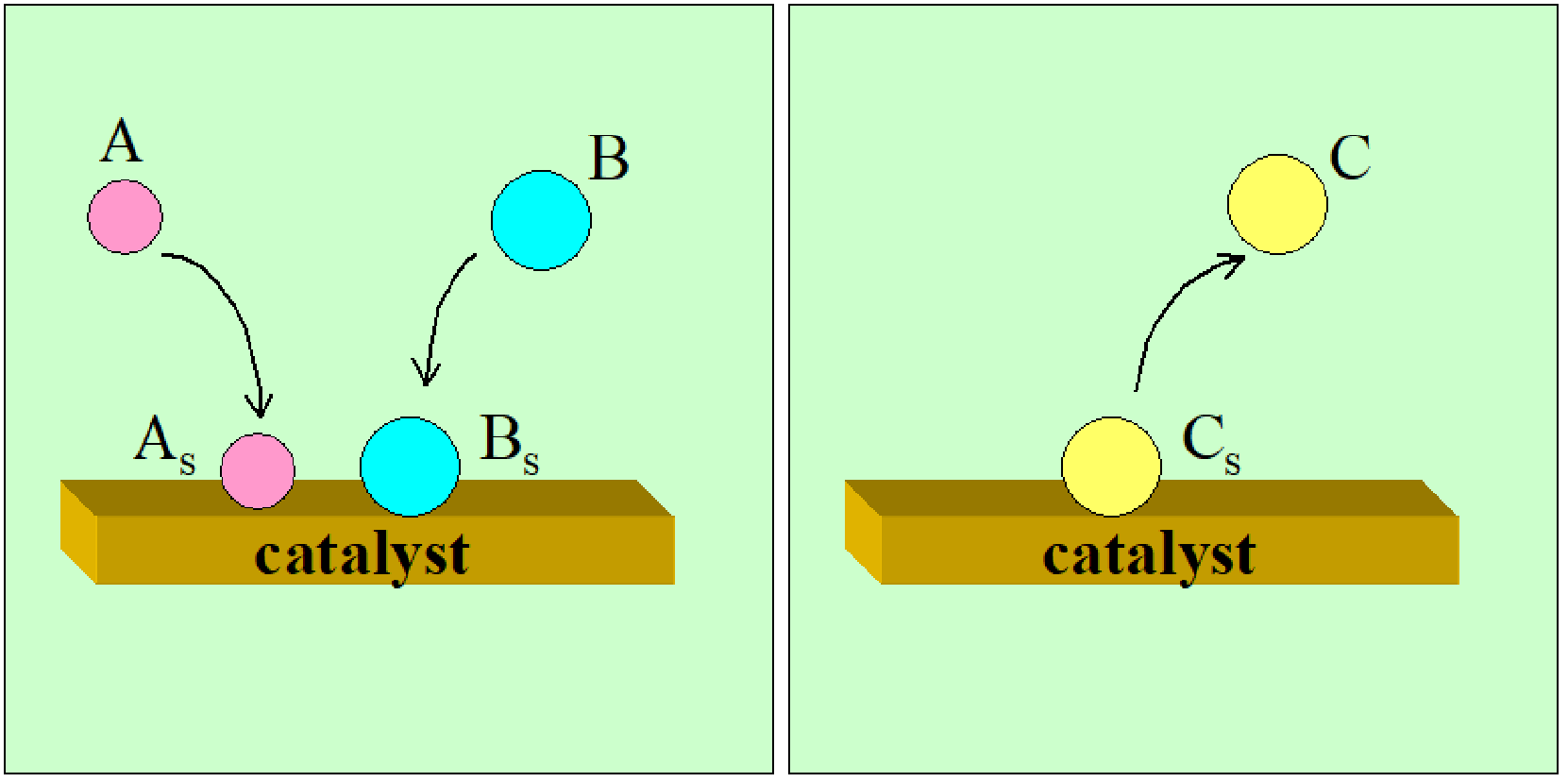
A+S ⇌ As (equilibrium constant KA and rate constants are k1 and k2)
B+S ⇌ Bs (equilibrium constant KB and rate constants are k3 and k4)
As+Bs ⇌ Cs+S (rate limiting step, rate constants are kp and kp') (equilibrium constant KAB=kp/kp’)
Cs ⇌ C+S (equilibrium constant 1/KC and rate constants are k5 and k6)
Equilibrium constants are not independent: KC C=KA KB KAB A B
A+B⇌C (equilibrium constant Keq is equal to KAB KA KB/KC )
Concentration of reactants and product are A, B and C. Concentration of adsorbed reactants and product are As, Bs and Cs.
Concentration of empty adsorption sites is S=Stot-As-Bs-Cs where the concentration of all sites (empty and occupied) is Stot.
Rate expression ⇌or a reversible reaction involving three components
A+S ⇌ As (equilibrium constant KA and rate constants are k1 and k2)
B+S ⇌ Bs (equilibrium constant KB and rate constants are k3 and k4)
As+Bs ⇌ Cs+S (rate limiting step, rate constants are kp and kp') (equilibrium constant KAB=kp/kp’)
Cs ⇌ C+S (equilibrium constant 1/KC and rate constants are k5 and k6)
Equilibrium constants are not independent: KC C=KA KB KAB A B
A+B⇌C (equilibrium constant Keq is equal to KAB KA KB/KC )
Concentration of reactants and product are A, B and C. Concentration of adsorbed reactants and product are As, Bs and Cs.
Concentration of empty adsorption sites is S=Stot-As-Bs-Cs where the concentration of all sites (empty and occupied) is Stot.
Rate expression ⇌or a reversible reaction involving three components