

Working through the American Association of Physics Teacher's 2011 F=ma exam
Working through the American Association of Physics Teacher's 2011 F=ma exam
PeterCullenBurbery
Abstract
I want to solve the problems in the SI.
In[]:=
$UnitSystem="Metric"
Out[]=
Metric
Problem #1
Problem #1
In[]:=
Out[]=
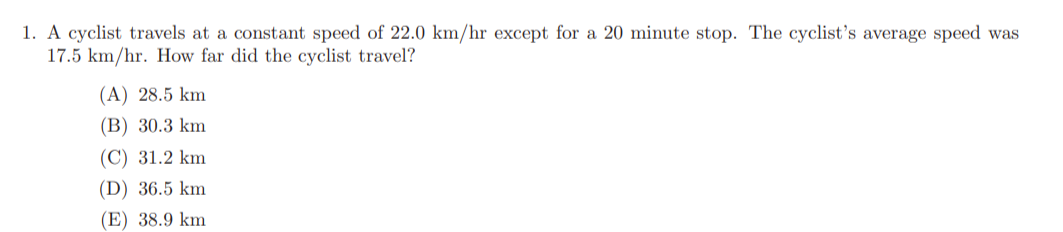
We have the average velocity which we name .
v
In[]:=
v
We have the time stopped which is 20 minutes. We will s for this quantity variable.
In[]:=
s=;
We have the cyclists speed which we name c.
In[]:=
c=;
We can use the equation to find the distance.
d=t
v
We can solve for the time now.
In[]:=
Solve==,t
v
ct
s+t

Out[]=
t
In[]:=
d=(s+t)/.FirstSolve==,t
v
v
ct
s+t
Out[]=
The answer is 28.5185km.
In[]:=
StringTemplate["The cyclist biked <* QuantityForm[#,\"Abbreviation\"] *>."][d]
Out[]=
The cyclist biked 28.5185 km.
The closest answer is A).
Problem #5
Problem #5
In[]:=
Out[]=
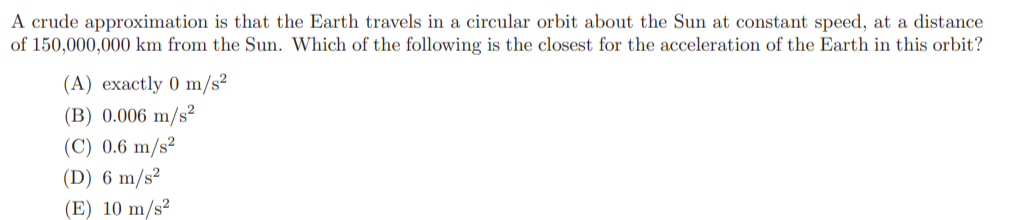
We use . We also use .
F=m·
2
v
r
F=
G··
m
1
m
2
2
r
We will use the approximate value for the distance from Earth to the Sun.
In[]:=
d=
Out[]=
I'm curious what the right SI prefix is to express this large distance. Sometimes UnitSimplify will work.
In[]:=
UnitSimplify[d]
Out[]=
In[]:=
UnitConvert[d,"Megameters"]
Out[]=
In[]:=
UnitConvert[d,"Gigameters"]
Out[]=
Define d in terms of gigameters as d=150Gm.
In[]:=
d=150;
In[]:=
Solve==,v
2
v
d
2
d
Out[]=
v,v
Add the assumption velocity is not negative.
In[]:=
Solve==,v,
2
v
d
2
d
>0
Out[]=
v
Now compute the acceleration. I use l for acceleration because a is a vowel and l is in the word acceleration.
In[]:=
l=/.FirstSolve==,v,
2
v
d
2
v
d
2
d
>0
Out[]=
In[]:=
UnitSimplify[l]
Out[]=
In[]:=
Round[UnitSimplify[l],0.001]
Out[]=
It looks like the closest answer is B, .
0.006m
-2
s
In[]:=
StringTemplate["The closest acceleration is <* QuantityForm[Round[#,0.001],\"LongForm\"] *>."][l]
Out[]=
The closest acceleration is 0.006 meters per second squared.
Alternative method with FormulaData and the dimensional analysis framework built into Mathematica
Alternative method with FormulaData and the dimensional analysis framework built into Mathematica
First I need the force the Earth is attracted to the Sun by.
In[]:=
FormulaData["NewtonsLawOfUniversalGravitation"]
Out[]=
F
m
1
m
2
2
r
Plug in the numbers:
I can use subscripted strings like instead of entering the full details for the QuantityVariable. I can also enter r directory as QuantityVariable["r"] instead of QuantityVariable["r","Distance"] which is helpful because sometimes I'm not sure if the second argument, in this case "Distance" should be "Length" or "Radius" or "Distance". I first thought it was "Radius" and then had to change it. I would like to emphasize the first argument is not which is what I originally input.
"m"
1
""
m
1
In[]:=
FormulaData"NewtonsLawOfUniversalGravitation",QuantityVariable[]->,QuantityVariable[]->,QuantityVariable["r"]->d
"m"
1
"m"
2
Out[]=
F
In[]:=
LastFormulaData"NewtonsLawOfUniversalGravitation",QuantityVariable[]->,QuantityVariable[]->,QuantityVariable["r"]->d
"m"
1
"m"
2
The force is 35.2265 ZN.
I get the same answer.
Problem #6
Problem #6
I will work through problem 6.
I have an equation I can solve.
I think E is the correct answer.
Problem #7
Problem #7
Find the formula for rotational kinetic energy by looking up formulas for rotation:
The first one is the right one:
The correct answer is 4, which is D).