Across languages, the translations of one word sound different and are spelt differently. Through finding trends in the changes across languages we can see what the most common changes that occur, throughout other languages, for the word are. These trends show us what the word will most likely be called in other countries and regions. This change can be calculated and can further be used to see how some words might be more similar or distant from each other depending on many factors.
Introduction
Introduction
Words of different languages have different pronunciations and structures. Sometimes the words change to form entirely new words, and other times only a small part of them changes. The changes or lack of changes occur due to the exposure of the language of one place to the language of another place. The exposure might be due to the country being a previous colony, or people speaking one language might live extremely close to people speaking another language. Whatever the reason might be, the interactions amongst communities contribute to their being an exchange of words. This exchange of words leads to their being similar words for some things. An isolated community might face the opposite situation. Their words and word structure might not be similar to other communities as they haven’t had many interactions or time for their to be an exchange of words.
To create a function that shows common trends for words across languages, we’d have to firstly get the words and then extract their letter to see the changes that occur.
To create a function that shows common trends for words across languages, we’d have to firstly get the words and then extract their letter to see the changes that occur.
Finding the words
Finding the words
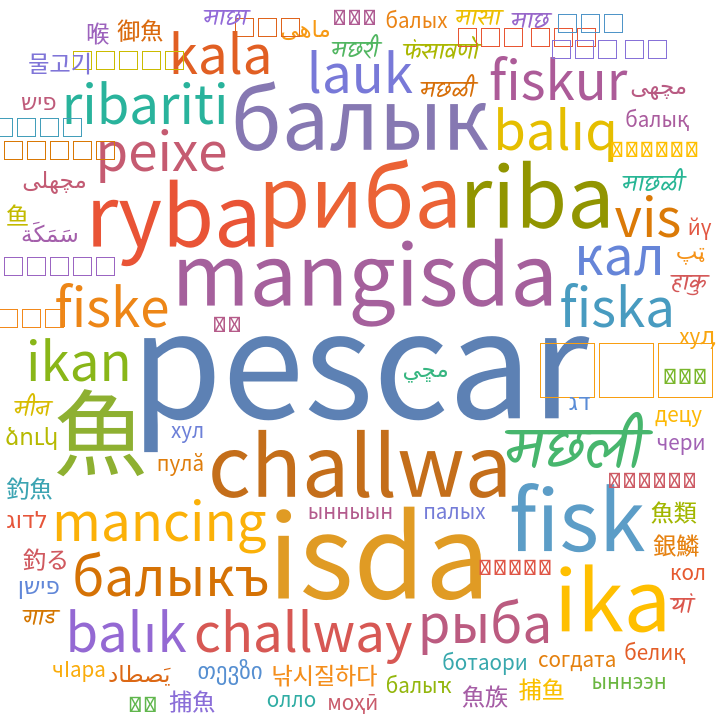
Firstly analyze the words, we would have to get all the translations we are going to analyze, of the word . So, to start, I used the WordTranslation function to convert the word into the selected languages, so that I can get the words in different languages . Then I converted it into a function that let' s the user enter a word, that way we can find the trends across different words . Lets take the example of the word "fish" .
I had decided to narrow it down to 11 languages as, due of the amount of languages that exist, calculating data on all of them would take more time .
I had decided to narrow it down to 11 languages as, due of the amount of languages that exist, calculating data on all of them would take more time .
In[]:=
WordCloud[WordTranslation["fish","English"-> All]]
Out[]=
In[]:=
WordTranslation["fish","English"->{"Chinese","French","Hindi","Italian","Arabic","Russian","Japanese", "German","Swahili","Korean","English"}]
Out[]=
魚,捕魚,{poisson,pêcher},मछली,मछली पकड़ना,{pesce,pescare},سَمَكَة,يَصطاد,рыба,рыбачить,喉,魚,御魚,釣る,銀鱗,魚族,魚類,{Fisch,fischen},{samaki,-vua samaki},물고기,낚시질하다,{fish}
So, this way we had the different translations of the word we required . Word Translation gave multiple different word translations, and I required only one translation to use further . So, I extracted the first words in the list of translations . The output however had to be just a string and not a list . So, to get the required output I used the Part function as opposed to the commonly used take function .
In[]:=
Take[WordTranslation["fish", "German"],1]
Out[]=
{Fisch}
In[]:=
Part[WordTranslation["fish","English"-> "German"],1]
Out[]=
Fisch
Now, after I got the first word, some words were in the alphabets of different languages . So, to compare them to each other they had to be converted to the same alphabets . Through the help of the Transliterate function I was able to get the pronunciation for the words that didn' t use the English Alphabets .
In[]:=
Part[WordTranslation["fish","English"-> "Chinese"],1]
Out[]=
魚
In[]:=
Part[Transliterate[WordTranslation["fish","English"-> "Chinese"]],1]
Out[]=
yu
This way, I had the the translations of many different words, from the different languages as I required, in the English alphabet which made the comparison easier .
In[]:=
Part[Transliterate[WordTranslation["fish","English"-> "German"]],1]
Out[]=
Fisch
In[]:=
Part[Transliterate[WordTranslation["fish","English"-> "Hindi"]],1]
Out[]=
machali
In[]:=
Part[Transliterate[WordTranslation["fish","English"-> "Chinese"]],1]
Out[]=
yu
Extracting the changed parts
Extracting the changed parts
Now, the next part was to remove the non changed parts of the obtained words . To remove these words I had to first break the word input into characters . These characters were then removed from the word translations that were obtained . This will get us the extracted letters that change across other languages when compared to the same word in English .
In[]:=
Characters["Fish"]
Out[]=
{F,i,s,h}
In[]:=
StringDelete[Part[Transliterate[WordTranslation["fish","English"-> "German"]],1],{"F","i","s","h"}]
Out[]=
c
Then we use this to form a function that forms a list of all the languages, and then join the list of characters that comes out . I decided to use only a few selected languages to narrow down the project, as the translations of all languages would take time . The number of languages can be increased to see the trends across more languages .
Trends[s_String]:=Join
Trends["fish"]
Out[]=
{p,o,o,n,c,m,a,c,a,l,r,y,b,a,y,u,p,e,c,e,a,m,a,k,a,t,o,u,a,m,a,k,m,u,l,g,o,g,p,e,z}
Finding probabilities
Finding probabilities
To find what the most commonly used letter is, we have to find the frequency of the letter in the list of the characters of the words . To get the frequency of the letters, I used the Counts function on the list and found the number of times a letter is used for the word in other languages .
In[]:=
Counts@Trends["Fish"]
Out[]=
p3,o4,n1,c3,m4,a8,l2,r1,y2,b1,u3,e3,k2,t1,g2,z1
Then I decided to arrange it in the order of the English alphabets for easier use .
In[]:=
Sort[Trends["fish"]]
Out[]=
{a,a,a,a,a,a,a,a,b,c,c,c,e,e,e,g,g,k,k,l,l,m,m,m,m,n,o,o,o,o,p,p,p,r,t,u,u,u,y,y,z}
In[]:=
Counts@Sort[Trends["fish"]]
Out[]=
a8,b1,c3,e3,g2,k2,l2,m4,n1,o4,p3,r1,t1,u3,y2,z1
Graphing the results
Graphing the results
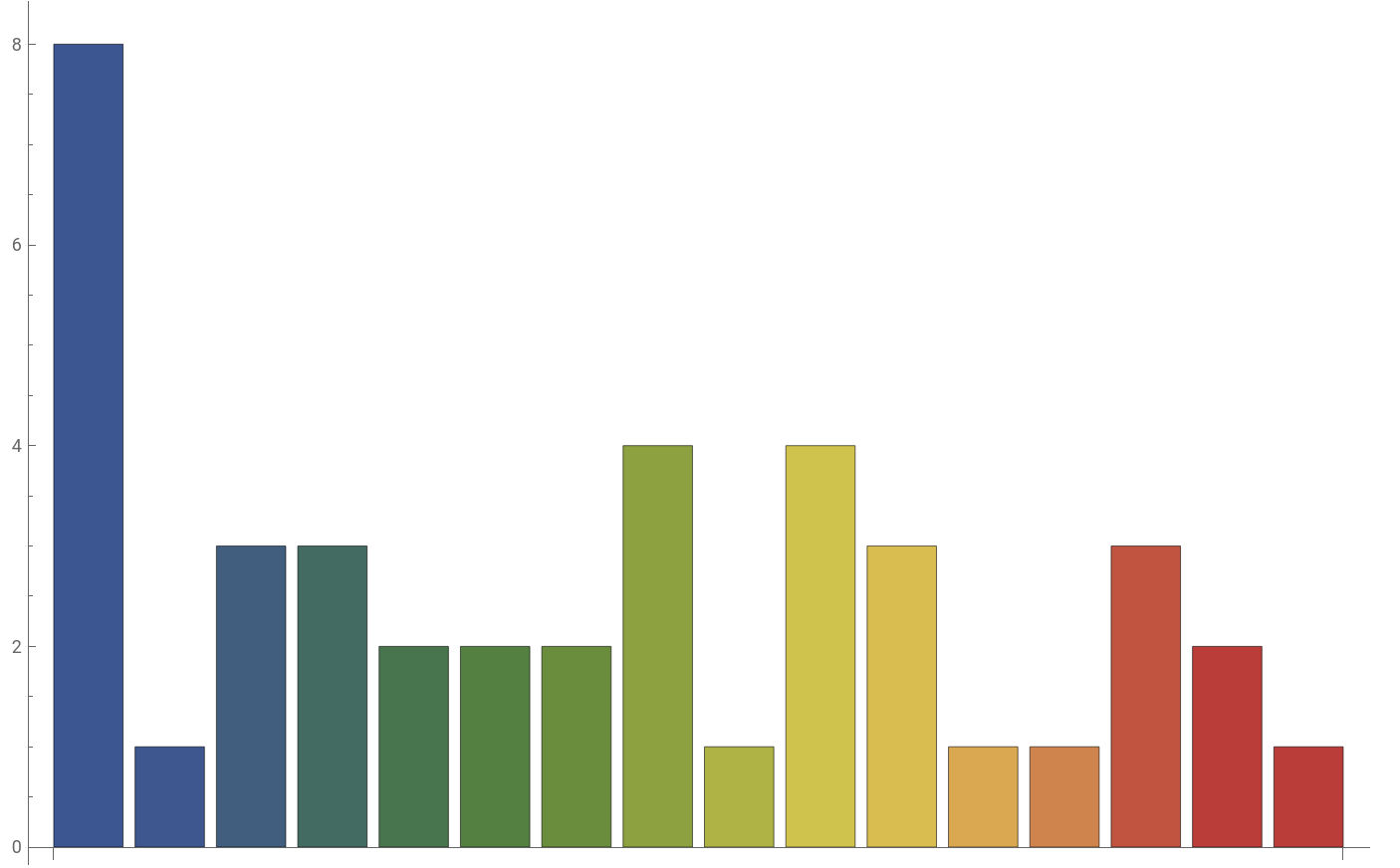
Now, we had the information as to how many times a letter occurs in the word of other languages . This obtained information shows that for the word "fish", the letter "a" is common in other languages a lot but, it doesn't exist in the English languages . This information also shows the how many times other letters occur in the word in other languages . I then made a Bar chart so that the results are easier to analyze .
In[]:=
BarChart[Counts@Sort[Trends["fish"]],ChartStyle->{"DarkRainbow"}]Counts@Sort[Trends["fish"]]
Out[]=
Out[]=
a8,b1,c3,e3,g2,k2,l2,m4,n1,o4,p3,r1,t1,u3,y2,z1
Conclusion
Conclusion
In the graph above, formed from the example of the word "fish" we get the most common trend in the change of the letters . This shows us that some letters are more commonly used for that word in other languages as compared to English . As for the word "fish" the most common change is the presence of alphabet "a" which is present in other languages in the word for fish, but not in the English word for fish . By finding the letters and then extracting the changed letters in other languages with reference to English, we get the most commonly used letters in those languages . Thus, finding the trends in changes of letters in words across languages .