Plane Seismic Waves
Plane Seismic Waves


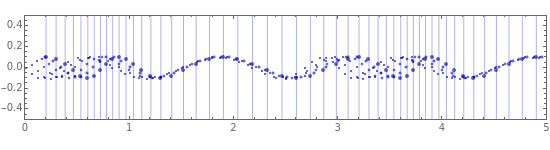
This Demonstration shows the propagation of elastic waves, commonly known as seismic waves. Two types of seismic waves are shown here: pressure waves (P-waves) and shear waves (S-waves). The P-wave is longitudinal, and so oscillates along the direction of the wave propagation, while the S-wave shakes perpendicular to the travel direction.
By combining these two types, you can simulate other types, such as Rayleigh waves. In such cases, the particles move in a circle or ellipse. The movement can be observed in detail by increasing the length of the trail.
Details
Details
In the event of a real earthquake, the P-wave always precedes the S-wave, because the speed of P-waves is
v
p
K+μ
4
3
ρ
while the speed of an S-wave is
v
s
μ
ρ
where is the bulk modulus, μ is the shear modulus, and ρ is the density.
K
External Links
External Links
Permanent Citation
Permanent Citation
Yu-Sung Chang
"Plane Seismic Waves"
http://demonstrations.wolfram.com/PlaneSeismicWaves/
Wolfram Demonstrations Project
Published: March 7, 2011