In this article, group schemes arising from finite algebraic structures are investigated in order to provide an analogy between these groups and traditional Lie groups. Routines for handling ring homomorphisms and Hopf algebras necessary for conducting algebraic group theory computationally are implemented in Wolfram Language. The Zariski tangent space at the identity of a group scheme is considered as an analog to the Lie algebra.
Introduction
Introduction
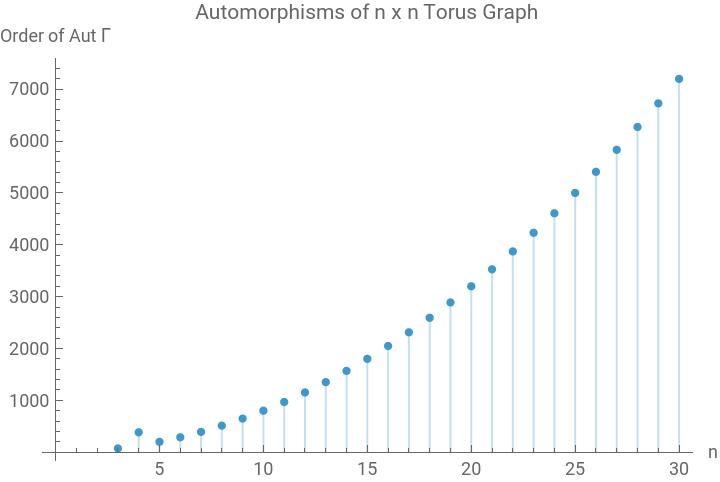
While abstract groups with no additional structure are well-suited for the analysis of discrete symmetry problems, such as graph automorphism or polytope symmetry, they are poorly-suited for the description of continuous symmetry. For example, the rotational symmetry group of a sphere consists of uncountably many elements. This motivates the internalization of groups in an ambient geometric category, such as , , or , which yield topological groups, Lie groups, and group schemes, respectively. The extra structure allows for additional techniques in the analysis of such groups: for example, many properties of Lie groups are determined by their corresponding Lie algebra on the tangent space of the identity element.Automorphism groups of graphs are traditionally considered to form abstract groups, due to the status of graphs as discrete objects. However, when considering graphs arising from discretization of smooth geometry, as the discretization is refined, the number of graph automorphisms diverges to infinity. The accurate description of the limiting behavior of these graphs is a central problem in discrete geometry. Considering the fact that the graphs involved are provided an analogy with continuous geometry, it is natural to attempt to form a similar analogy for their symmetry groups. The idea of considering continuous transformation groups as the limit of finite groups is hence well-motivated.


Out[]=
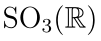
However, the problem is complicated by the rigidity of group structure compared to loose graphs or manifolds. For example, the finite subgroups of the symmetry group of the sphere are classified into the infinite families of cyclic and dihedral groups, which are not dense, and the tetrahedral, octahedral, and icosahedral symmetry groups[1]. It is hence impossible to form a filtration of as an injective limit of finite subgroups. This prompts the investigation of groups that ‘approximate’ subgroups of important linear-algebraic groups, i.e. behave like them enough to provide insight into graph symmetry.For the purposes of this essay, rings are defined to be commutative and unital. Ring homomorphisms are required to be unital as well.

Discretization via Group Schemes
Discretization via Group Schemes
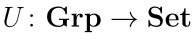
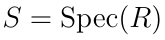
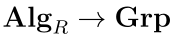
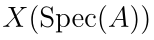
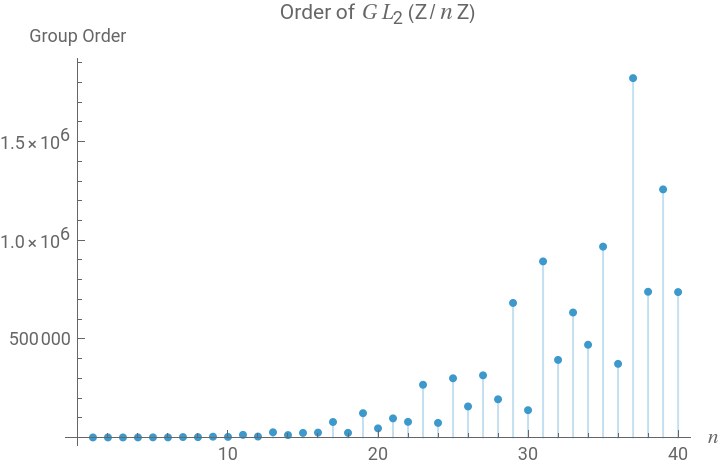
The primary approach to approximating continuous groups taken in this essay involves the consideration of group schemes and their associated functors of points. Here, a group scheme is considered to be a functor such that if is the forgetful functor, then is represented by an -scheme. If is another -scheme, then the group is taken to consist of the ‘-rational points’ of . If for a ring , then can be considered as a functor whose value at an-algebra is given by, where this group is considered as consisting of the ‘-rational points of . In particular, in the case of affine group schemes, . As hom-functors preserve limits[2], this viewpoint allows the translation of limit diagrams in to diagrams in, which is useful for constructing limits of group schemes, because it allows the geometric restriction of having scheme structure to be converted to an algebraic restriction of having ring structure.Different sequences of rings were considered in order to construct the limit of groups. The first of these were the rings of integers modulo . While they provide a fine sequence of rings, the corresponding sequences of groups are highly irregular. In addition, the ring-theoretic properties of arbitrary , such as the existence of homomorphisms between members of the family, varied too wildly for consideration.











Out[]=
Another family of rings considered were the finite fields. The advantage of working in terms of finite fields was that many constructions would be much easier to consider, with the existence of vector spaces allowing techniques from linear algebra to be employed. In addition, the condition for the existence of embeddings between finite fields was easier to evaluate: a homomorphism exists between two finite fields if and only if they have the same characteristic and the degree of the domain divides the degree of the co-domain. The injective limit of finite field extensions of is its algebraic closure. While this was beneficial in the sense that working in algebraically closed fields would simplify much algebraic geometry, the algebraic closure would remain in characteristic . The linear algebraic groups in characteristic do not closely resemble those in characteristic 0, and lifting out of characteristic was not feasible without machinery beyond the scope of this essay.The system of rings , with increasing, was ultimately selected for the task, where the projective limit would be taken. This was motivated by the fact that the are local rings, with easily-predicted order of unit groups (due to the group of units being the complement of the ideal .) In addition, the rings can be arranged into a linear limit system, which is easier to work with than the more complex degree-divisibility poset structures involved in taking injective limits of finite fields. Finally, the projective limit of the rings is the ring of -adic integers . This ring is well-studied, naturally forms a topological ring, and, perhaps most importantly, is of characteristic 0. The latter fact makes base-change between and other characteristic-0 rings, such as , , , or , much easier than in the positive-characteristic case, which simplifies application to classical geometry.


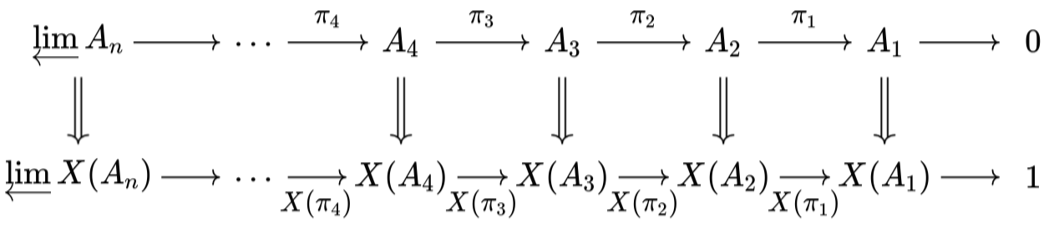
This illustrates the transfer between a sequence of rings and projection homomorphisms, and the image of the sequence under the functor of points .

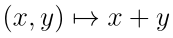
The first group scheme studied with this method was the additive group functor , which sends a commutative ring to its underlying additive group and is represented by , with addition sending for points in . The implementation of this group in Wolfram is quite simple, and is presented here for the case.




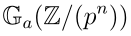
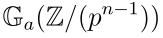
Cayley diagram of as ranges from 1 to 5, while The kernel of the projection map onto is highlighted in red.

Out[]=
 ,
 ,
 ,
 ,

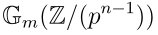
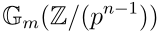
Another early example is the multiplicative group , which, in the case of , is also cyclic.

Cayley diagram of as ranges from 1 to 5 and , with the kernel of the projection map to highlighted in red.
Out[]=
 ,
 ,
 ,
 ,

This multiplicative group limits toward the -adic unit group, i.e. the -adic integers that are not divisible by p.
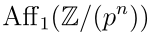
The primary model for the development of the essay was the affine group of degree 1, , consisting of combined scaling and translation of the affine line. This group was significant because it was a linear group with Krull dimension 2, that was additionally non-abelian. This non-abelian structure, combined with the fact that was is a simple example of a linear-algebraic group, made a good toy model for the sort of behavior expected from continuous transformation groups. It is represented below.


Cayley diagram of , drawn similarly to those above.
Out[]=
 ,
 ,
 ,

The Cayley diagram for appeared to form a twisted torus shape as the base ring grows, reflecting the fact that it is a non-abelian semi-direct product of two cyclic groups.

Hopf Algebras
Hopf Algebras
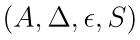
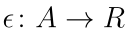
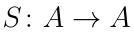
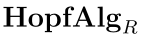
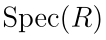
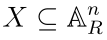
The computational study of affine group schemes, such as , is simplified by their duality with (commutative, unital) Hopf algebras. For the purposes of this essay, a Hopf algebra over a ring is taken to be a cogroup object in the category of-algebras, with coassociative comultiplication , counit , and antipode homomorphisms forming the categorical duals to the associative multiplication, unit, and inverse operations in a group. Hence there is a contravariant equivalence of categories between the category of Hopf algebras over and the category of affine group schemes over , following the equivalence of categories. Working in the language of abstract Hopf algebras is more convenient for answering many questions about affine group schemes, because they describe both the algebraic (group) and geometric (scheme) structure in one algebraic structure. This motivated the implementation of Hopf algebras in Wolfram Language.For simplicity, only closed subschemes are considered in this essay. This allowed ring homomorphisms to be implemented via Wolfram’s native symbolic manipulation abilities. The generic approach taken here made frequent changes of base ring much more convenient.
:




Ring Homomorphisms
Ring Homomorphisms
Defining the constructor for ring homomorphisms, as well as an overload which assumes it maps into the base ring:
Functionality for generating lists of indeterminate elements was also added:
This functionality was applied to generate inclusion homomorphisms between polynomial rings and, by extension, identity maps:
The final ingredient needed for affine group schemes was the ability to tensor ring morphisms together to form a map out of their tensor product of algebras:
Hopf Algebra Implementation
Hopf Algebra Implementation
A constructor for Hopf algebras was implemented:
A conjugation function was also added:
An example demonstrating how modular arithmetic is compatible with the Hopf algebra structure on an algebraic group:
Differentiation
Differentiation
Defining a routine to extract the tangent vector from a point:
Defining a function to set the tangent vector of a point:
Example of storing and retrieving a tangent vector associated with a point:
Conclusions
Conclusions
While exactly expressing Lie groups as a limit of finite subgroups was found to often be impossible, approximating continuous transformation groups with a series of discrete groups was possible using techniques from algebraic group theory. This found particular success when applied to linear-algebraic groups. It was possible to extend traditional notions of differentiation to finite algebraic groups, and do so in a manner that limited toward the standard concept as the groups get larger. Difficulty was found, however, in faithfully interchanging between results in zero and positive characteristic.
Future Work
Future Work
Future work would focus on extending the Zariski differentiation used here, and producing an analog to the Lie bracket from traditional Lie theory, most likely by extending tangent vectors at the identity to derivations on the entire algebraic group and taking a commutator of these. Another direction for continued work would be to generalize to non-affine schemes. This would likely require working in a different framework than Hopf algebras.
Acknowledgements
Acknowledgements
I would like to thank research program director Stephen Wolfram, as well as my mentor Dugan Hammock for his continuous help with unfamiliar topics differential geometry, and advocate Madeleine Sutherland for helping me advance my Wolfram Language skills. Finally, I would like to thank Dr. Pavel Hajek for taking the time to speak with me about synthetic geometry.
Additional thanks to Stephen Wolfram for suggesting this project.
Citations
Citations
[1] an Bui, Hong Thein. (2020, August 29). Classifying the Finite Subgroups of SO(3). https://math.uchicago.edu/~may/REU2020/REUPapers/Bui,An.pdf
[2] Hom-functor preserves limits in nLab. nCatLab. (2026, March 5).
https://ncatlab.org/nlab/show/hom-functor+preserves+limits
https://ncatlab.org/nlab/show/hom-functor+preserves+limits
[3] Milne, J. S. (2017). Algebraic groups: The theory of group schemes of finite type over a field. Cambridge University Press.
CITE THIS NOTEBOOK
CITE THIS NOTEBOOK
Group schemes over finite rings as approximations to lie groups
by Henry Lewis
Wolfram Community, STAFF PICKS, July 9, 2026
https://community.wolfram.com/groups/-/m/t/3754408
by Henry Lewis
Wolfram Community, STAFF PICKS, July 9, 2026
https://community.wolfram.com/groups/-/m/t/3754408