Solar eclipses often get all the attention and glory, especially if they are total, but they are often enjoyed by only those people in the narrow path of totality or that are able to travel to those locations. Partial solar eclipses, even though they can be observed over much larger areas of the Earth, they still require special equipment to observe so you aren’t blinded by the Sun. But lunar eclipses, whether total or partial, are accessible to almost everyone on an entire hemisphere of the Earth. Lunar eclipses are a great way to get kids and the general public engaged in astronomy since there is minimal effort to observe them since all you need are clear skies and the Moon to be above your horizon during the observation window.
The eclipse peaks late on August 27, 2026 in the western hemisphere or early on August 28 in the eastern hemisphere.
In[]:=
{eclipse,eclipseGMT}=LunarEclipse[DateObject[{2026,8}],"MaximumEclipseDate",TimeZone->#]&/@{"America/Chicago",0}
Out[]=
,
This particular eclipse is not a total eclipse, it’s partial.
In[]:=
LunarEclipse[eclipse,"Type"]
Out[]=
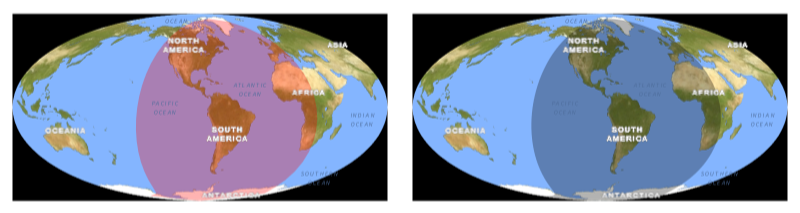
Since this is a partial lunar eclipse, we can obtain the relevant graphic element to visualize the coverage area by using the “PartialPhasePolygon” property of LunarEclipse.
In[]:=
poly=LunarEclipse[eclipse,"PartialPhasePolygon"];
We can show the partial phase polygon next to the NightHemisphere at peak eclipse to see that they are essentially identical. This means that if it is night where you are at the time of the eclipse, you will be able to see the partial eclipse.
GraphicsGridGeoGraphics{Red,poly},,GeoGraphics{NightHemisphere[eclipse]},,ImageSize->600
Out[]=
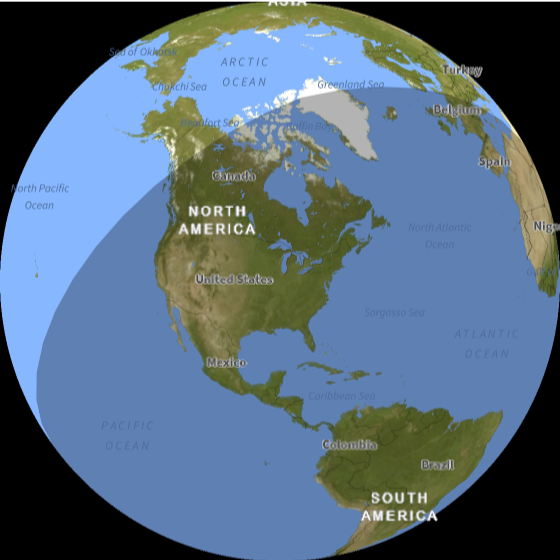
For a more location specific view, we can center the scene on your current location and see if you are in the hemisphere that will be able to see the eclipse.
GeoGraphics{poly},
Out[]=
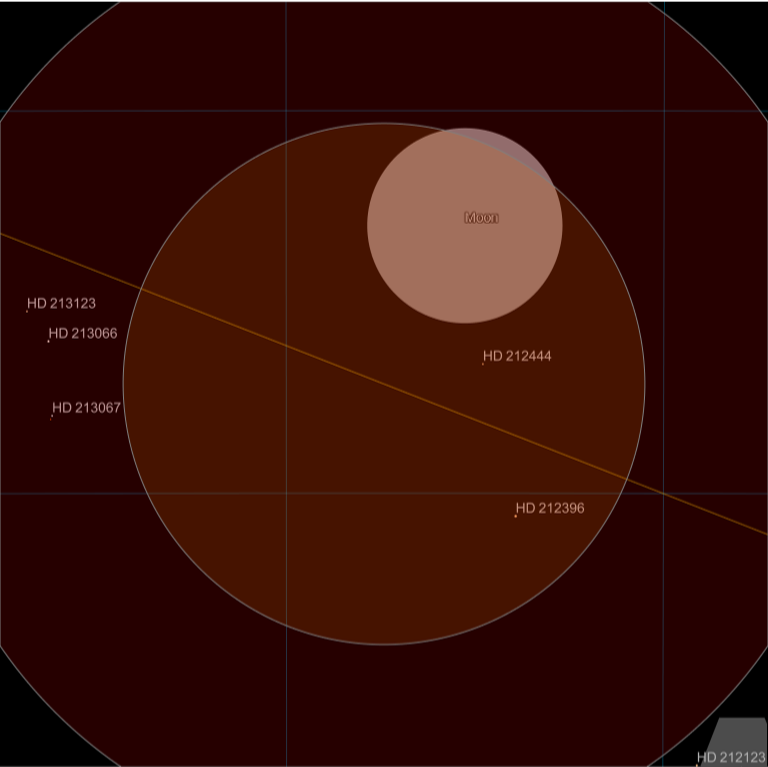
As mentioned above, the eclipse is partial, not total. But, it’s an extreme case of partial eclipse that is nearly total. The following Wolfram Function repository item makes it easy to see how much of the Moon is covered during the peak of the eclipse. Most of the Moon is eclipsed.
Out[]=
We can use AstroGraphics to get a sky map showing where the Moon will be in your local sky. From here in Champaign, it will be in the south-southeast.
In[]:=
AstroGraphics[AstroReferenceFrame->eclipse]
Out[]=
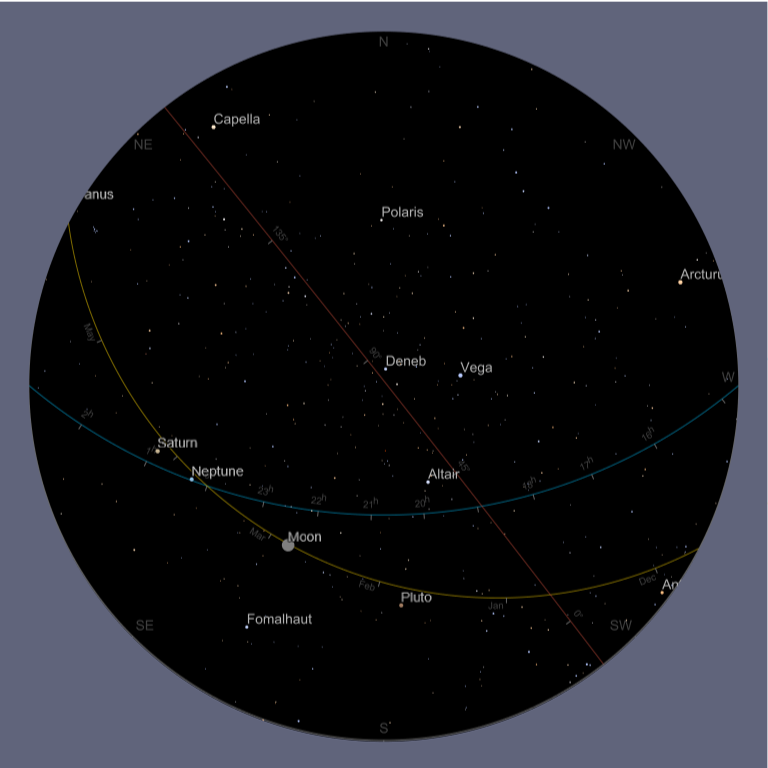
The Moon will be about 34.5 degrees above the SSE horizon in Champaign at peak eclipse.
In[]:=
AstroPosition["Moon",{"Horizon",eclipse}]
Out[]=
AstroPosition

We can use WolframAlpha to obtain more quantitative numbers to see that the Moon will be about 93.5% covered by the Earth’s shadow.
In[]:=
WolframAlpha["lunar eclipse on Aug 27 2026",{{"Properties",1},"ComputableData"}]
Out[]=
gamma,,{umbral magnitude,0.935},{penumbral magnitude,1.99},{saros number,138}
Something that may not be obvious to the casual observer, new to astronomy, is that lunar eclipses happen when the Moon and Sun are opposite in the sky from each other:
In[]:=
AstroAngularSeparation["Sun","Moon",eclipse]
Out[]=
This corresponds to the full moon:
In[]:=
MoonPhase[eclipse,"Name"]
Out[]=
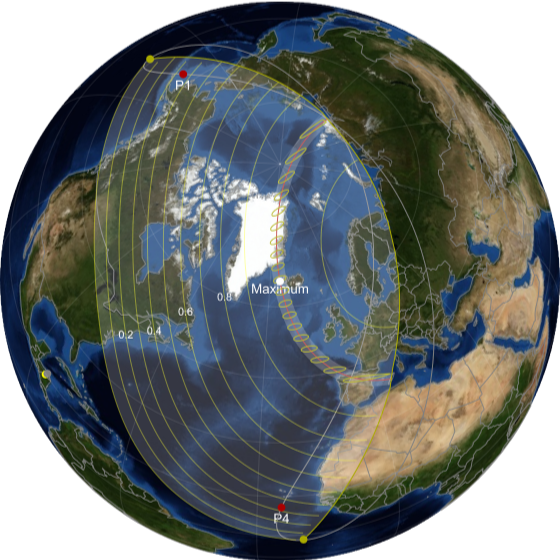
Another interesting fact is that the lunar eclipse follows the total solar eclipse a couple of week ago:
In[]:=
solareclipse=SolarEclipse[TimeDirection->-1]
Out[]=
In[]:=
SolarEclipse[solareclipse,"Type"]
Out[]=
In[]:=
eclipse-solareclipse
Out[]=
In[]:=
SolarEclipse[solareclipse,"EclipseMap"]
Out[]=
Even though this lunar eclipse is a partial eclipse of the Moon, it may be worth keeping the kids up past their bed time to witness this astronomical event. No telescope needed.
CITE THIS NOTEBOOK
CITE THIS NOTEBOOK
Lunar eclipse of August 27, 2026
by Jeffrey Bryant
Wolfram Community, STAFF PICKS, August 24, 2026
https://community.wolfram.com/groups/-/m/t/3787009
by Jeffrey Bryant
Wolfram Community, STAFF PICKS, August 24, 2026
https://community.wolfram.com/groups/-/m/t/3787009