Do you have a favorite frying pan? The one you always grab first to scramble an egg or sauté a chopped onion? I have mostly used aluminum or stainless steel pans, but I have been drawn to cast iron more often these days. I decided to find out how my pan choices can affect my cooking.
The thermal properties of conductivity, density and specific heat capacity determine how effectively heat is transferred during cooking. Here I'll be comparing the thermal properties of frying pans made from copper, aluminum, cast iron, carbon steel and stainless steel.
Thermal conductivity
Thermal conductivity
Thermal conductivity describes how well a material can conduct heat. A material with high thermal conductivity transfers heat quickly, while one with low thermal conductivity transfers heat slowly:
In[]:=
materials={"copper","aluminum","iron","carbon steel","stainless steel"};thermalConductivity=AssociationThread[materials,UnitConvert[WolframAlpha["thermal conductivity "<>#,{{"Result",1},"ComputableData"}],"Watts"/("Kelvins"*"Meters")]&/@materials]
Out[]=
copper,aluminum,iron,carbon steel,stainless steel
Density
Density
Density is the amount of mass per unit volume of a material. It's a measurement of how tightly matter is packed together, often expressed as kilograms per cubic meter:
In[]:=
density=AssociationThread[materials,UnitConvert[WolframAlpha["density "<>#,{{"Result",1},"ComputableData"}],"Kilograms"/"Meters"^3]&/@materials]
Out[]=
copper,aluminum,iron,carbon steel,stainless steel
Specific heat
Specific heat
Specific heat is the amount of heat energy required to raise the temperature of a unit mass of a material by one degree Celsius (or one Kelvin). A material with a high specific heat can absorb more heat without a large temperature change.
Retrieve the specific heat for the pan materials in their solid phase:
In[]:=
specificHeat=UnitConvert[WolframAlpha["specific heat "<>#,{{"Result",1},"ComputableData"}],"Joules"/("Kilograms""Kelvins")]&/@materials;selectSolidPhase=Map[If[ListQ[#],First[Select[Flatten[#],QuantityQ]],#]&,specificHeat];solidPhaseSpecificHeat=AssociationThread[materials,UnitConvert[selectSolidPhase,"Joules"/("Kelvins"*"Kilograms")]]
Out[]=
copper,aluminum,iron,carbon steel,stainless steel
Heating times to reach a target temperature
Heating times to reach a target temperature
I created a plot of heating times for each material to reach a target temperature over medium-high heat of 175°C, which is the recommended temperature for shallow pan frying.
Define the average thickness (in meters) for each type of pan:
In[]:=
thicknessData=<|"copper"->2.5*0.001,"aluminum"->3.5*0.001,"iron"->3.7*0.001,"carbon steel"->2.5*0.001,"stainless steel"->2.4*0.001|>;
Construct associations of the specific heat capacity, density and thickness for each material:
In[]:=
materialsData=Association[KeyValueMap[Function[{key,thickness},Module[{specificHeat,dens},specificHeat=If[KeyExistsQ[solidPhaseSpecificHeat,key],solidPhaseSpecificHeat[key][[1]],Missing["NotAvailable"]];dens=If[KeyExistsQ[density,key],density[key][[1]],Missing["NotAvailable"]];key-><|"SpecificHeatCapacity"->specificHeat,"Density"->dens,"Thickness"->thickness|>]],thicknessData]]
Out[]=
copperSpecificHeatCapacity327.3,Density8960.,Thickness0.0025,aluminumSpecificHeatCapacity904.,Density2700.,Thickness0.0035,ironSpecificHeatCapacity449.,Density7874.,Thickness0.0037,carbon steelSpecificHeatCapacity460.548,Density7800.,Thickness0.0025,stainless steelSpecificHeatCapacity460.548,Density7900.,Thickness0.0024
Convert a 10-inch diameter pan to meters and calculate the area of the pan:
In[]:=
panArea=QuantityMagnitude[WolframAlpha["area of a 10-inch diameter circle in square meters",{{"Result",1},"ComputableData"}]]
Out[]=
16129π
1000000
The average power input of a burner set to medium-high heat on an electric stovetop is 1,500 to 2,000 watts:
In[]:=
electricalPowerInput=1500;
The pans are starting at room temperature, with a target temperature of 175°C:
In[]:=
initialTemperature=20;targetTemperature=175;
The data points are plotted at intervals of 1 second:
In[]:=
timeStep=1;
Set up an equation to calculate the temperature over time for each pan material:
In[]:=
temperatureIncreaseOverTime=KeyValueMap[Function[{materialName,properties},With[{density=properties["Density"],specificHeatCapacity=properties["SpecificHeatCapacity"],thickness=properties["Thickness"]},Module[{mass,temperatureFunction},mass=density*panArea*thickness;temperatureFunction[t_]:=initialTemperature+(electricalPowerInput*t)/(mass*specificHeatCapacity);{materialName,temperatureFunction}]]],materialsData];
Define a color for each material:
In[]:=
materialColors=<| "copper"->ColorData["HTML","DarkOrange"], "aluminum"->ColorData["HTML","SteelBlue"], "iron"->ColorData["HTML","Black"], "carbon steel"->ColorData["HTML","OliveDrab"], "stainless steel"->ColorData["HTML","Silver"] |>;
Plot the time it takes for each material to reach the target temperature:
In[]:=
PlotEvaluate[Through[temperatureIncreaseOverTime[[All,2]][t]]],{t,0,300},
Out[]=
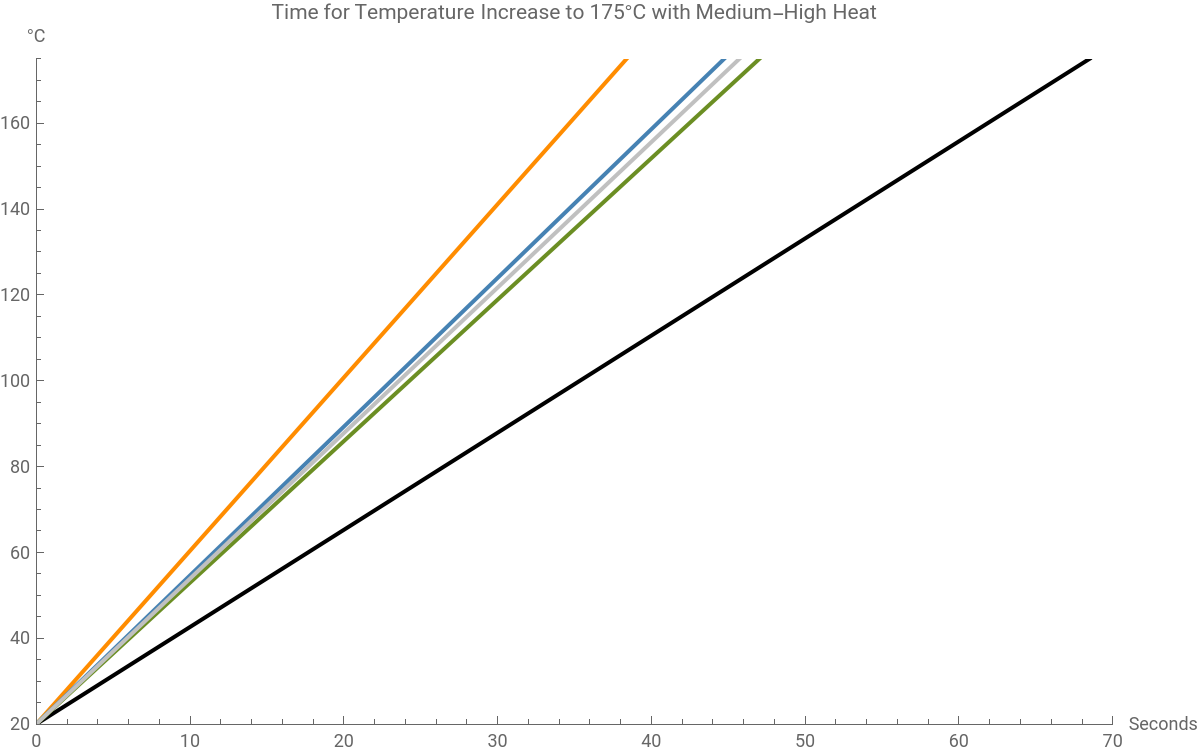


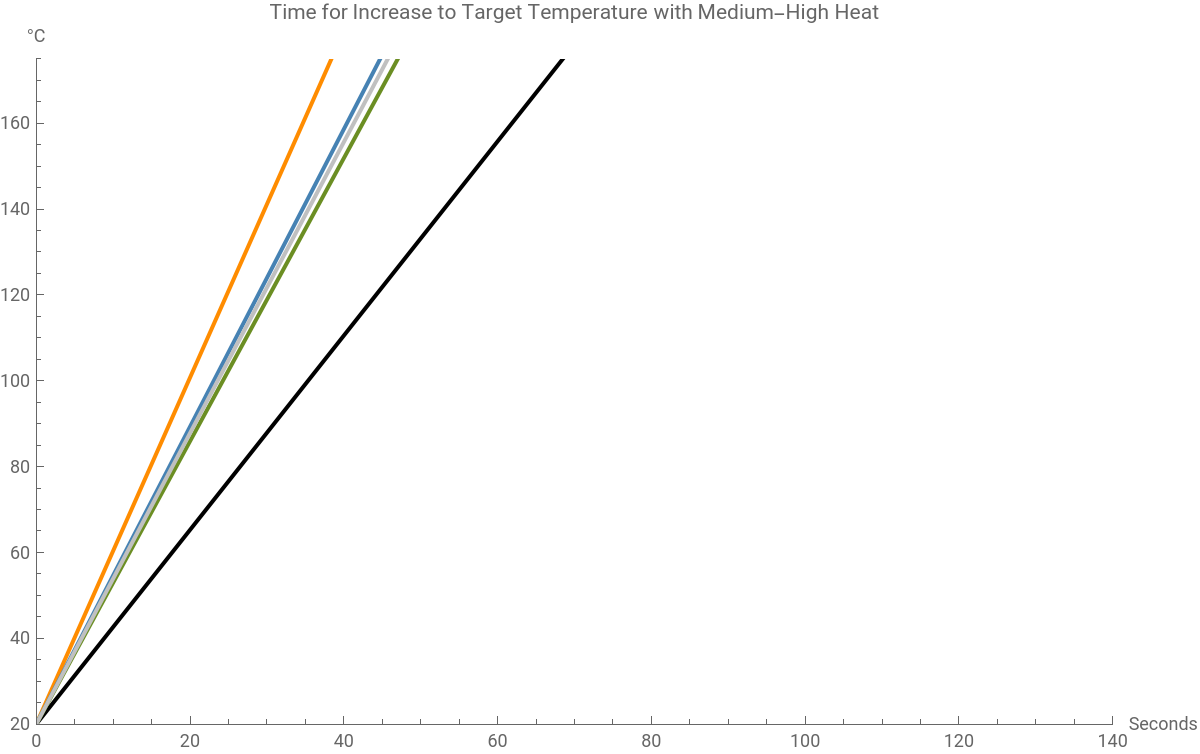
The plot shows that copper pans win the race for heating time. A copper pan will heat up quickly and evenly. Then it will cool quickly when you turn down the temperature, making copper pans suited for delicate dishes that need strict temperature control, such as sauces, eggs and risotto.
Copper pans come with drawbacks. They are beautiful additions to your kitchen decor, but they are expensive. Also, and most important, copper is highly reactive with acidic foods, which may release hazardous levels of copper into your food. For that reason, modern copper pans are lined with a non-reactive metal, such as stainless steel. If you have unlined copper pans that you found at an estate sale or have been passed down through your family, do not use them with acidic foods, such as tomato sauce or lemon juice. Perhaps it's best to just polish them and hang them in your kitchen, so that you can enjoy their beauty while you cook.
As shown in the plot, the runner-up in the heating race is aluminum. Like copper, aluminum pans heat up and cool down quickly, making them well-suited for quick cooking techniques like sautéing.
Manipulate the plot to view heating times at various target temperatures:
In[]:=
ManipulatetemperatureIncreaseOverTime;PlotEvaluate[Through[temperatureIncreaseOverTime[[All,2]][t]]],{t,0,300},,{targetTemperature,100,300,5},SaveDefinitions->True
Out[]=


Stainless steel is in the middle of the pack for heating time. It's a poor conductor of heat on its own, but it often has a built-in aluminum or copper core for better heat performance. Stainless steel has good heat retention once it reaches the target temperature, making it ideal for searing and browning foods. It's also durable and non-reactive, so acidic foods are not a concern.
Last in the heating race is cast iron. It takes longer to heat up due to moderately poor conductivity, but it is a winner in heat retention. Cast iron stays hot for a long time, which is great for high-heat cooking like deep frying. Be sure to clean your cast iron pan properly (no soaking or dishwasher), dry it thoroughly, and keep it seasoned to maintain its non-stick surface.
Last in the heating race is cast iron. It takes longer to heat up due to moderately poor conductivity, but it is a winner in heat retention. Cast iron stays hot for a long time, which is great for high-heat cooking like deep frying. Be sure to clean your cast iron pan properly (no soaking or dishwasher), dry it thoroughly, and keep it seasoned to maintain its non-stick surface.
Thermal diffusivity
Thermal diffusivity
Thermal diffusivity measures how quickly the temperature of a material adjusts in response to a change in heat. It considers thermal conductivity, density and specific heat to calculate how fast a change in temperature spreads through a material.
Create a 3D plot of these properties for each pan material:
Create a bar chart of thermal diffusivity, which is typically measured in square meters per second:
Like with thermal conductivity, copper and aluminum have the highest thermal diffusivity. They can adjust the most quickly to temperature changes. At the other end, stainless steel has the lowest thermal diffusivity of the pans since it has a relatively high density (almost three times that of aluminum) and low thermal conductivity, reducing the overall rate at which heat diffuses through the pan.
CITE THIS NOTEBOOK
CITE THIS NOTEBOOK
Compare thermal properties of frying pans made from different materials
by Gay Wilson
Wolfram Community, STAFF PICKS, February 21, 2025
https://community.wolfram.com/groups/-/m/t/3398827
by Gay Wilson
Wolfram Community, STAFF PICKS, February 21, 2025
https://community.wolfram.com/groups/-/m/t/3398827