This project models the construction of large, hyperbranched macromolecules in silico, often referred to dendrimers, using various computational approaches, and to provide a computational analysis of some of their properties. These dendrimers are first constructed computationally using SMILES and SMARTS input systems, then with the identification of substructures using the Wolfram Language’s built-in tools. A repository of various dendrimers, containing over 60 models, is created and analyzed using various methods in order to further elucidate their use cases in various fields. Finally, basic analyses of these dendrimers is done, modeling properties such as mass and hydrophobicity, in order to provide a framework for future dendritic studies in silico.
Introduction
Introduction
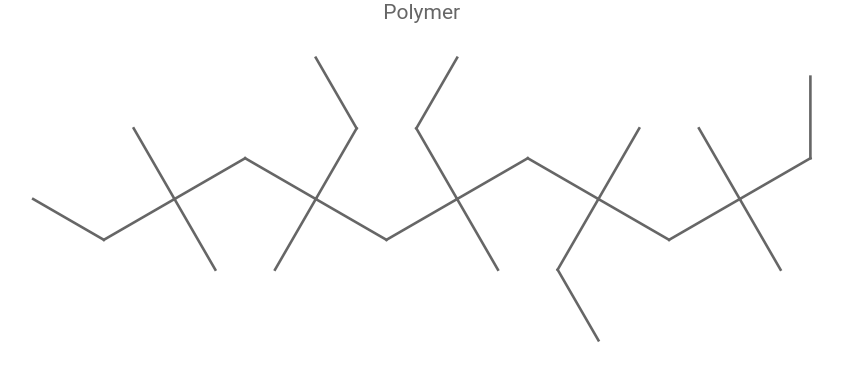
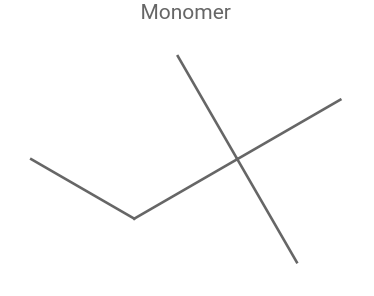
Polymers are large molecules formed by linking together chains of smaller, repeating monomers. They are commonplace in many different scientific fields, and are interesting for the multitude of different applications they have.
Note: All molecule visualizations in this project use traditional Organic Chemistry skeletal formulae, where all hydrogen atoms are implicit, and every corner indicates a carbon atom, unless otherwise noted.
Create a grid visualizing polymers and monomers:
In[]:=
PlotGrid
,
Out[]=
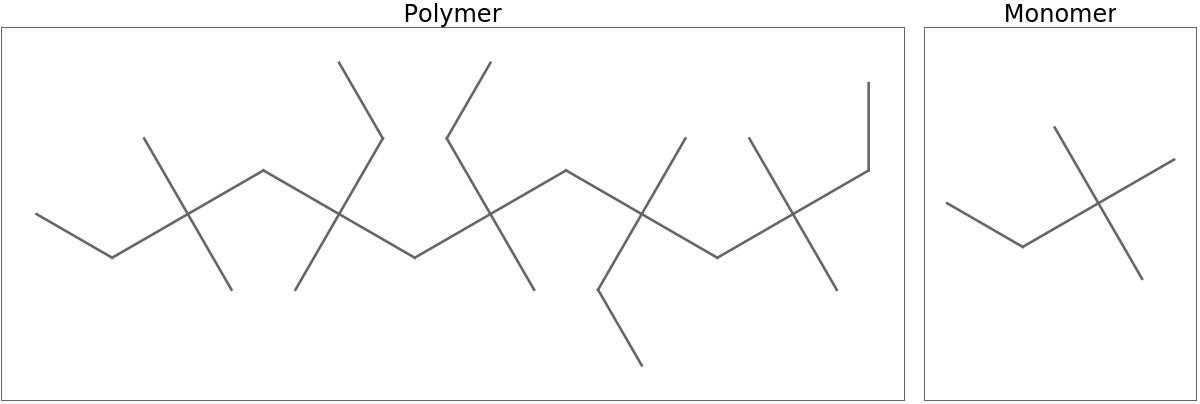
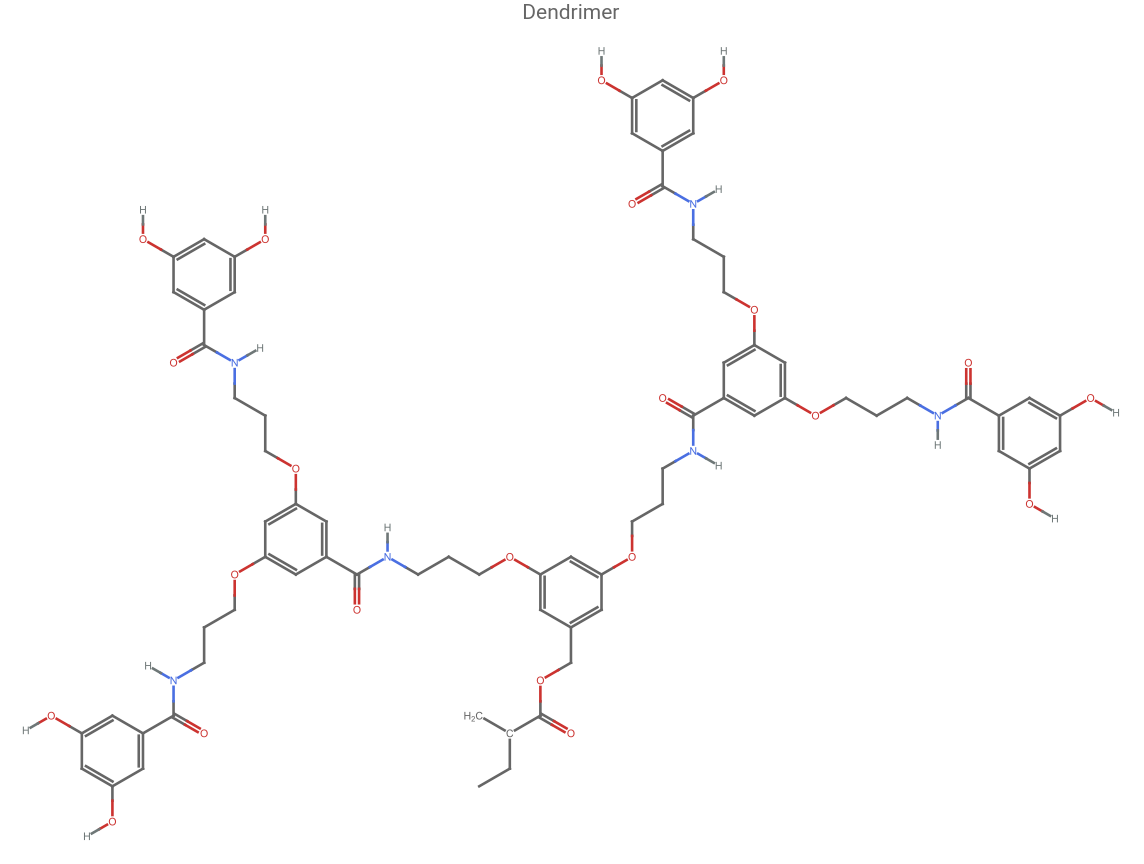
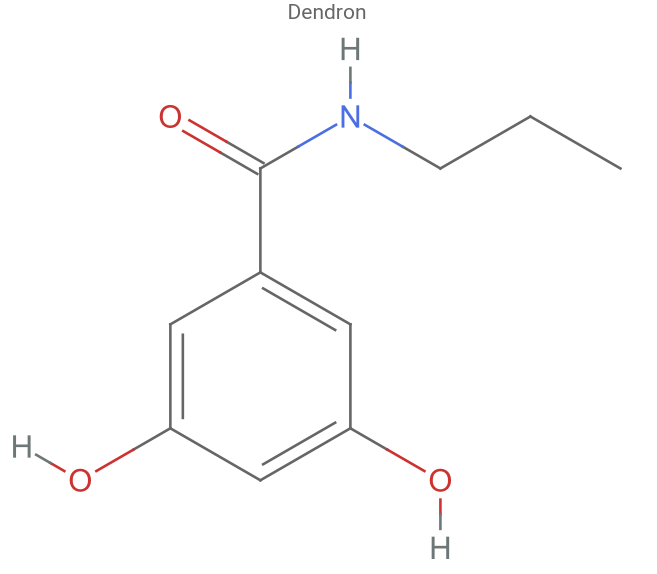
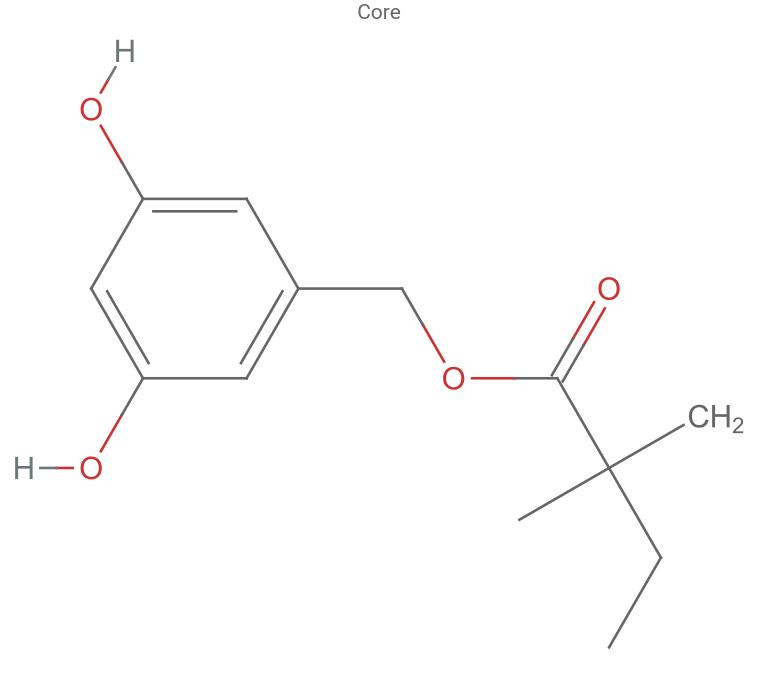
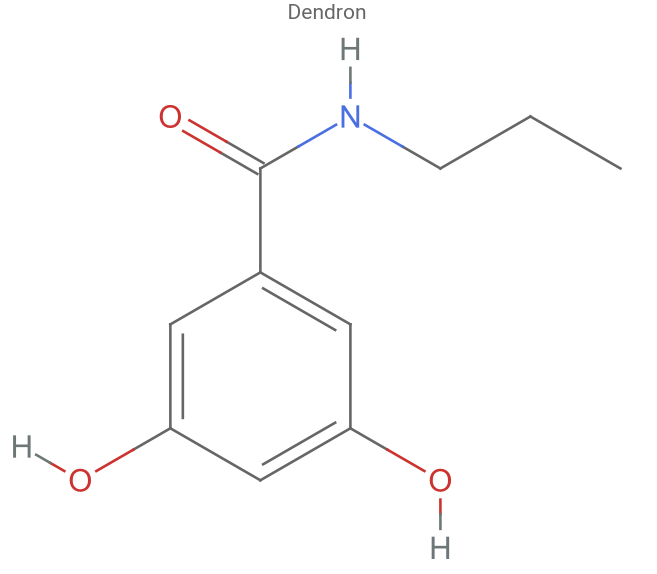
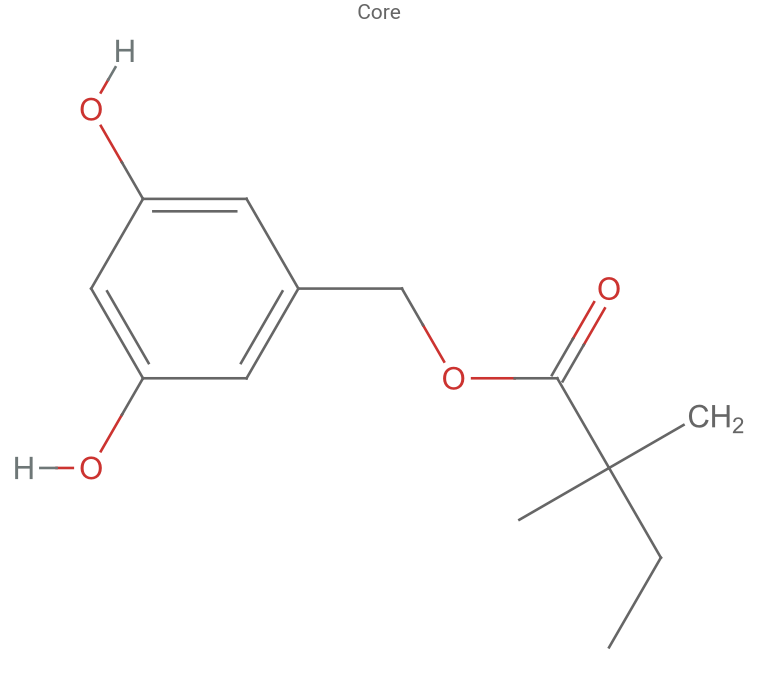
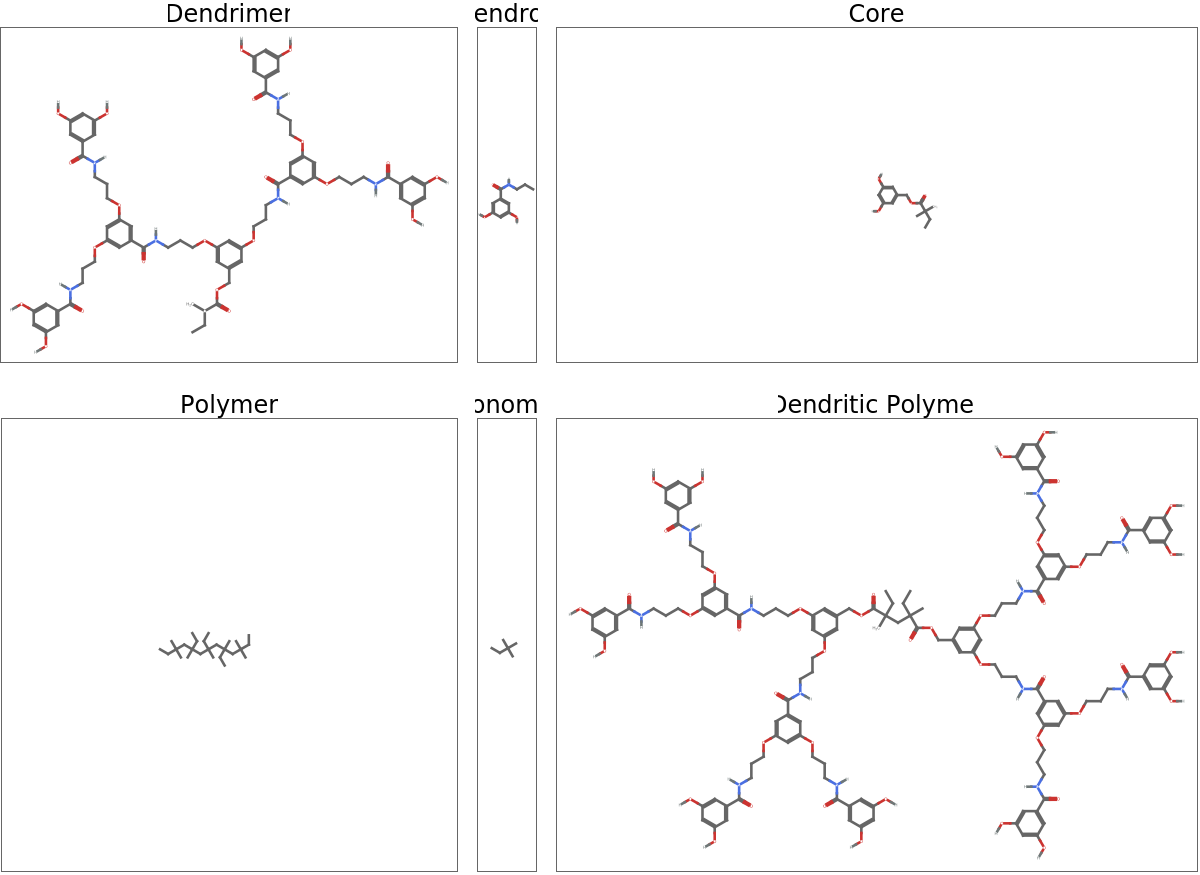
Above is a visualization that demonstrates the binding of several monomers into one polymer, demonstrating the basic makeup of these structures. During the study of these polymers, one may find a similar structure, called a dendrimer. These dendrimers follow a related logic to polymers. They are built from repeated branching units, or dendrons, arranged around a central core such that the structure grows radially in successive generations.
Create a grid visualizing dendrimers and dendrons:
In[]:=
PlotGrid
,
,
Out[]=
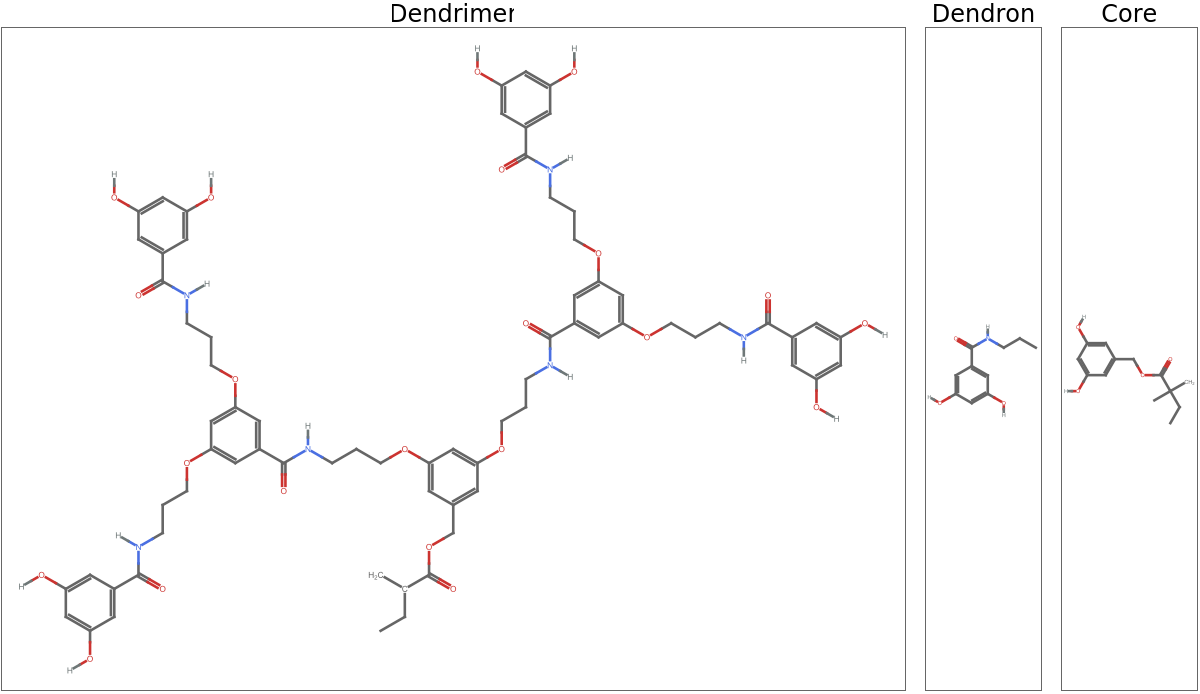
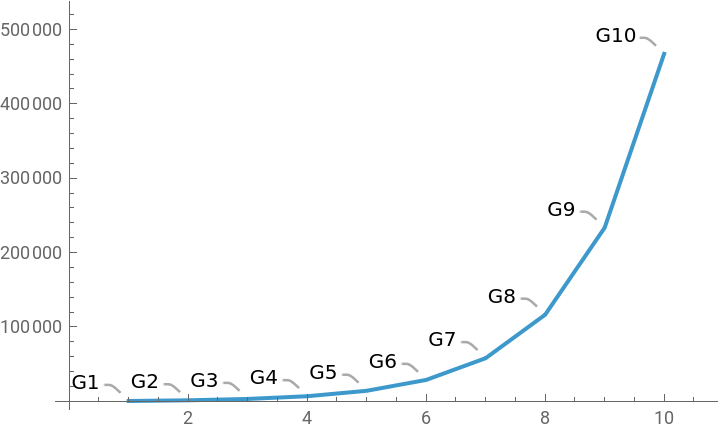
Each successive binding of the dendrons to the core is called a generation, where the dendrons are attached to the free valences of the core or the existing dendrimer. This produces a macromolecule that grows exponentially over time.
Create a line plot visualizing the growth of common dendrimer PAMAM over time:
In[]:=
ListLinePlot[MoleculeValue[#,"MolecularMass"]&/@ResourceData[ResourceObject[CloudObject["https://www.wolframcloud.com/obj/ananyapichai/DeployedResources/Data/Common-Dendrimer-Structures"]]][[2]]]
Out[]=
These extremely large structures are interesting in many different fields and applications, particularly various areas of biology. Since dendrimers are branched macromolecules, they exhibit properties such as monodispersity, polyvalency, and extremely precise and predictable structure. In fact, the versatility of these dendrimers makes them extremely useful for cancer treatment, drug delivery, and more. In the field of drug delivery alone, they have exhibited stimuli-responsiveness to many different conditions, including temperature and light, and have proven to perform exceptionally well in the contexts of biocompatibility and accurate targeting. They have even been used in applications such as gene therapy and photodynamic therapy. Despite this, certain barriers still stand in the way of widespread use of these dendrimers in therapy today. These include the notoriously expensive, meticulous, and time-consuming synthesis for these molecules, complex safety assessments for long-term usage, and meeting regulatory standards for FDA approval
More efficient computational modeling of these dendrimers may help to break some of these barriers. Modeling dendrimers in silico can augment wet-lab experimentation, making it possible to predict molecular weight, geometry, and energy before or alongside physical synthesis. The cost needed to perform basic experimentation on them is reduced greatly. For example, knowing the SMILES string of a molecule allows efficient modeling in a molecule simulation software, where drug payloads can be studied. Such use cases exemplify the need for fast, systematic generation of these molecules, especially as the field of dendrimer science continues to grow exponentially.
To add, the repository of dendrimers that this project models reduces the barrier to entry in dendrimer science not only by reducing cost, but by increasing access. The need to comb through literature to find certain common dendrimer structures is no longer existent. Instead, these dendrimers are consolidated, and their models can quite easily and efficiently be visualized.
Visualize common dendron in biomedical applications, PLL:
In[]:=
MoleculePlot3D[ResourceData[ResourceObject[CloudObject["https://www.wolframcloud.com/obj/ananyapichai/DeployedResources/Data/Common-Dendrimer-Structures"]]]["PLL","G2"],PlotTheme->"HeavyAtom"]
Out[]=

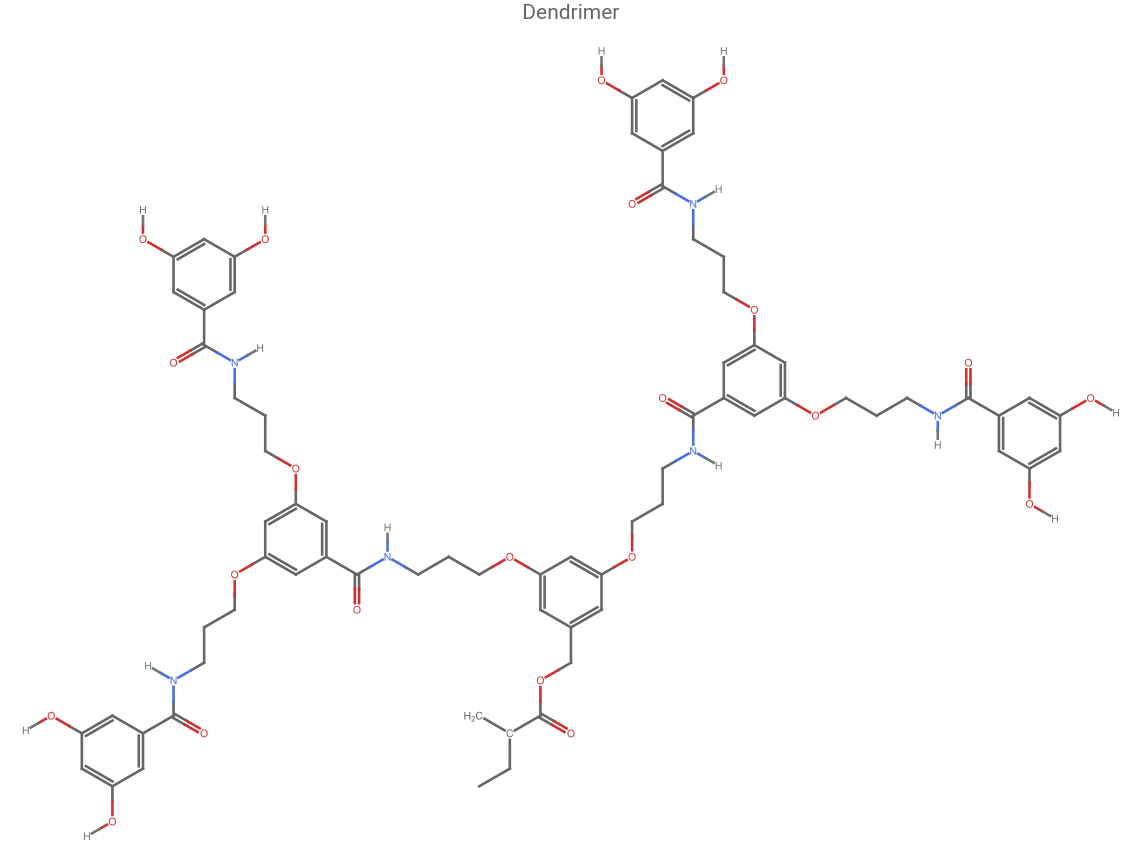
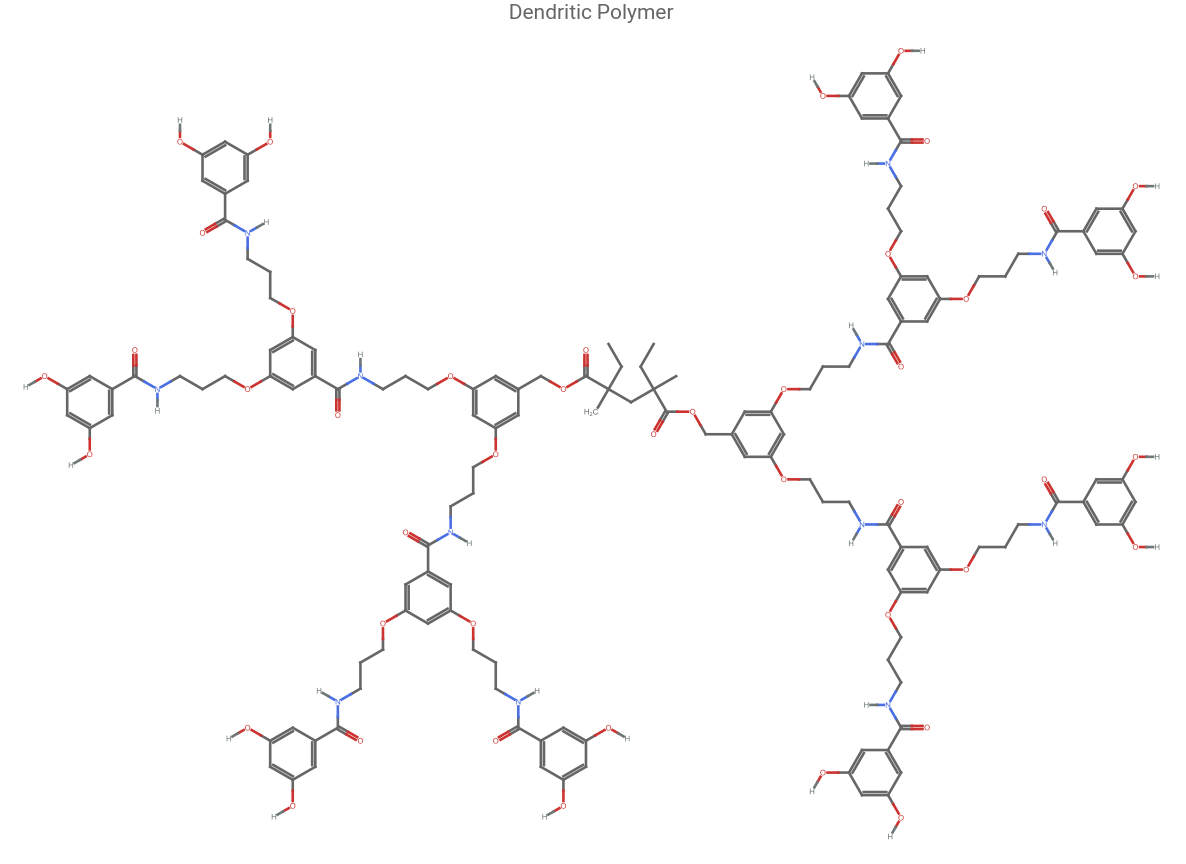
The combination of these two structures produces a dendritic polymer, also referred to as a polymeric dendrimer, which is composed of dendrimers acting as each monomer.
Create a grid visualizing polymeric dendrimers:
In[]:=
PlotGrid
,
,
,
,
,
Out[]=
While this project models a large variety of these dendrimers, and provides a tool to model almost any type, this essay begins by modeling PG5, a polymeric dendrimer synthesized in 2011 by A. Dieter Schlüter’s group at the Swiss Federal Institute of Technology in Zürich (ETH Zürich). At the time, PG5 was reported as the largest synthetic macromolecule to date, with a molecular weight of roughly 200 megadaltons and on the order of 17 million atoms at the longest length of the polymer.
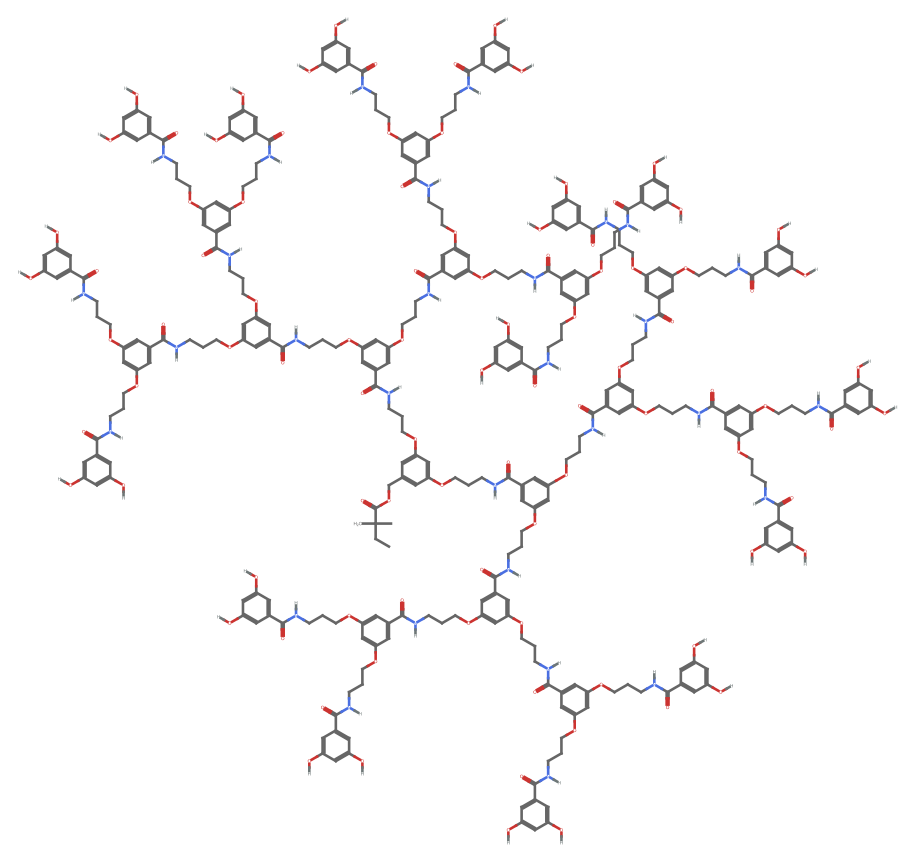
The visualization above is simply one monomer of the larger PG5 polymer, yet it, in and of itself, contains almost 800 atoms. The molecule is the result of a long synthesis procedure, in which PG5 was the fifth generation (G5) of the dendrimer. Starting from the core of the molecule, it expands radially, with its scale increasing exponentially as well.
Create a table and plot containing the properties of PG5:
In[]:=
Grid,FrameAll
Out[]=
PG1 | PG2 | PG3 | PG4 | PG5 | |
Molar Mass | |||||
# of Atoms | 34 | 80 | 180 | 380 | 780 |
The following sections explore the specifics of building these dendrimers using two different methods.
The first uses SMILES and SMARTS notation, for reproducibility in other molecule visualization software. The notations stand for Simplified Molecular Input Line Entry System and SMILES Arbitrary Target Specification respectively.
While the two are similar, they cannot be conflated. SMARTS notation allows user input of specific molecules.
Visualizing benzene using SMILES notation:
SMARTS notation allows the specification of substructures within SMILES strings, and to generate patterns for reactions based on those substructures.
Bond two oxygen atoms to the benzene ring using SMARTS notation:
The second method of dendrimer construction, while relatively less reproducible in other systems, is using the Wolfram Language’s in-built identification of substructures to attach dendrons and construct the dendrimers.
Find the benzene ring and replace with pyridine:
Method 1: SMARTS and SMILES Computational Construction
Method 1: SMARTS and SMILES Computational Construction
This section models the reactions needed to model the PG5 dendrimer using SMARTS and SMILES inputs. Substructures are defined using SMARTS notation, and the dendrimers themselves are modeled using SMILES. The construction is designed to ensure that the techniques used in this project will be reproducible in other computational systems, and that the notation used is understandable such that dendrimers will be more easily constructed with the notations in the future.
With that, the first part of the dendrimer, the monomer backbone, is modeled. Here, the center carbon is marked as one without parentheses: [C], and it is surrounded by four other carbon atoms, put in parentheses. The last carbon atom connected to the central carbon is not put in parentheses such that it can be built off further.
With that, the first part of the dendrimer, the monomer backbone, is modeled. Here, the center carbon is marked as one without parentheses: [C], and it is surrounded by four other carbon atoms, put in parentheses. The last carbon atom connected to the central carbon is not put in parentheses such that it can be built off further.
Plot the backbone using SMILES notation:
Create a pattern that binds two monomers together:
This then results in two monomers bonded together, and also marks the introduction of the first SMARTS conditional. SMARTS conditionals are specifications within the larger SMARTS reaction that indicate bonding location. For example, “D1”, as indicated in the reaction, is an atom only bonded to one heavy atom, or in other words, an atom with a degree of one.
One carbon atom does not have enough bonds with other atoms to fill its valence shell (highlighted), which marks the location of the next monomer.
One carbon atom does not have enough bonds with other atoms to fill its valence shell (highlighted), which marks the location of the next monomer.
Visualize the bonding of these two monomers:
PG1
PG1
With this in mind, the pattern reaction for PG1 is made. While this is labeled as the first generation in the ETH Zürich study, this molecule is the “core” of the dendrimer, oftentimes denoted as “PG0”. Since this is the first generation of the dendrimer, it is only necessary to bond it to the monomer, and then run the same function to visualize a polymer of the same length.
Model and visualize PG1:
Create a reaction that binds PG1 to each monomer in the backbone:
Here, we repeat the same analysis as was done previously. More SMARTS specification using conditionals is again necessary to define the bonding sites of PG1. Note the use of “H0” and “!$” in order to specify the specific bonding locations of PG1.
Create a function that returns a PG1 polymer of length n:
The above function, keeping in mind the conditionals again specified using SMARTS strings, returns a PG1 molecule bonded using the same logic as the monomer backbone.
Visualize a PG1 polymer of length five:
PG2
PG2
The next generation of dendrimer, dubbed “PG2” is the dendron that will be bonded in all future stages of the dendrimer’s growth. Again, we follow the same general pattern as PG1 in order to create the polymer chain. However, since this is now the second generation of dendrimer, we can see that PG2 bonds specifically to the two oxygen atoms on PG1. This again requires more SMARTS specification.
Model and visualize the dendron:
Create a reaction that binds PG2 to each monomer in the backbone:
Now to make the monomer bonded to PG2.
This now follows the same generative pattern as PG1 and the polymer backbone.
Create a function that returns a PG2 polymer of length n:
Visualize the dendrimer PG2:
Building Other Generations
Building Other Generations
Using the same logic as PG2, we can build the next three generations, as they all follow the same general pattern. Those interested in the final PG5 product may skip to the section titled “PG5”, as the next few sections essentially repeat the same functions as PG2.
PG3
PG3
Now that the dendrimer has one dendron layer, PG3 adds the second layer of dendrons to the core (PG1/Monomer Backbone).
Create a PatternReaction to bind PG3 to each free valence:
Create a function that bonds the dendron PG3 to every free oxygen valence attached to the benzene groups:
Create a variable for later:
Visualize the dendrimer PG3:
PG4
PG4
Now that the dendrimer has two dendron layers, PG4 adds the third layer of dendrons to the core (PG1/Monomer Backbone) .
Create a PatternReaction to bind PG4 to each free valence:
Create a function that bonds the dendron PG4 to every free oxygen valence attached to the benzene groups:
Create a variable for later use:
Create a function that returns a PG4 polymer of length n:
Visualize the dendrimer PG4:
PG5
PG5
Now that the dendrimer has three dendron layers, PG5 adds the fourth layer of dendrons to the core (PG1/Monomer Backbone) .
Create a PatternReaction to bind PG5 to each free valence:
Create a function that bonds the dendron PG5 to every free oxygen valence attached to the benzene groups:
Create a function that returns a PG5 polymer of length n:
With this process, the dendrimer is modeled using SMARTS and SMILES strings. Dendrons are systematically bonded to specific substructures within the dendrimer core. However, this workflow is oftentimes somewhat complicated, and has some limitations. For example, the following dendrimer, called PGLSA-OH, is extremely complex to model using SMARTS strings.
Visualize PGLSA-OH:
Since each dendron and the dendrimer core are essentially identical structurally, specifying the bonding location with SMARTS substructures begins to get quite tricky very quickly. The more efficient method is generally using some of Wolfram Language’s in-built functions for the generation of these dendrimers. While the reproducibility is decreased, it trades off with efficiency.
Method 2: Substructure Construction
Method 2: Substructure Construction
Almost all of the other dendrimers modeled in this project were done without the use of SMARTS and SMILES pattern-matching. Most of these dendrimers were constructed with Wolfram’s MoleculeModify function, which has tooling that identifies certain substructures and replaces them.
Model the core of the dendrimer:
Model the repeating dendron:
Taking the core of the dendrimer, there are four locations where the next generation of the dendrimer should bond. MoleculeModify[] identifies these locations, and “replaces” them with dendrons. While this is not technically creating reactions, it is essentially the same in that the final output is chemically identical.
Create the recursive function to model the dendrimer:
The above molecule is PGLSA-OH, or poly(glycerol-succinic acid) dendrimers, terminating in -OH groups. Using this same method, ten other dendrimers were synthesized, culminating in the following data resource:
Import the resource:
This resource, soon to be added to the Wolfram Data Repository, models G1-G6 of many common dendrimer structures, including many of those used in biomedical applications.
Find the model of PAMAM:
Analysis
Analysis
Finally, since a large number of these dendrimers have been modeled in the Wolfram language, it is possible to perform systematic analysis of them. While in reality, much of the variation in these dendrimers’ properties arise from the variation of their terminal groups, which are the groups attached to the dendrons in the final generation, the dendrimers themselves also have significant effect on their properties and applications. Hence, the following two analyses were performed on the dataset of dendrimer structures:
◼
Molecular Weight
◼
Hydrophobicity
Molecular Weight
Molecular Weight
By now, it should be evident that these dendrimers are extremely large and complex structures. With that, these structures also have extremely high molecular weights that scale exponentially over time. Since more dendrimers are continually added to all free bonding sites of the previous generation, the size of these dendrimers grows by a scale factor of the number of free bonding sites of the last generation. While this is relatively intuitive, it may be interesting to visualize the molecular weights of these dendrimers as they grow.
Hydrophobicity
Hydrophobicity
The hydrophobicity of these dendrimers can be derived using the in-built wolfram function CrippenLogP. This is a function used to estimate the hydrophobicity of a chemical compound without the need for real experimental data. The function itself calculates the octanol-water partition coefficient, which is the ratio of a chemical’s concentration in the octanol phase to its concentration in the aqueous phase. It predicts this concentration as a sum of individual atomic contributions to the total score, finally ending with a quantitative measure of the molecule’s hydrophobicity. A higher, positive score with LogP indicates a more hydrophobic, or water-fearing molecule, while a lower, negative score indicates a hydrophilic, or water-loving molecule.
Compare the difference in hydrophobicity between ethanol and methane:
For instance, ethanol, a polar alcohol, has a lower hydrophobicity than methane, which is a non-polar gas.
Plot the logP values of various dendrimers on a bar chart:
Here, triazine is the only structure that is hydrophobic, whereas all other dendrimers are hydrophilic. There are many possible explanations for this phenomenon, but one may be the fact that triazine, out of this list of molecules, is the only dendrimer that is not amine-bonded. Amines are highly polar and readily form strong hydrogen bonds with water, whereas the aromatic rings that triazine is built from are non-polar, although they do contain nitrogen. However, given that these are simply the base dendrimer structures, the hydrophobicity of these molecules may not necessarily be the same in real medical contexts. Base dendrimer structures are quite often varied, with different terminal end groups applied to the molecule in order to alter their properties. This is a quite intuitive observation, but these calculations are more of a demonstration for the larger computational analyses that could be performed when one has access to a large set of dendrimers like the one represented here.
Conclusion
Conclusion
This project provides two computational methods of building dendrimer structures efficiently, and basic analysis of their properties, including hydrophobicity, force-field energy optimization, and molecular weight. The chemical composition of these structures are modeled not only using the tools native to the Wolfram Language, but also using SMARTS and SMILES input systems that provide much greater reproducibility. The project culminates in a repository of many different dendrimer structures, used for several different applications.
References
References
Britannica Editors (2026, June 9). polymer. Encyclopedia Britannica. https://www.britannica.com/science/polymer
Halgren, T. A. (1996). Merck molecular force field. I. Basis, form, scope, parameterization, and performance of MMFF94. Journal of Computational Chemistry, 17(5–6), 490–519. https://doi.org/10.1002/(SICI)1096-987X(199604)17:5/6%3C490::AID-JCC1%3E3.0.CO;2-P
Zhang, B., Wepf, R., Fischer, K., Schmidt, M., Besse, S., Lindner, P., King, B. T., Sigel, R., Schurtenberger, P., Talmon, Y., Ding, Y., Kröger, M., Halperin, A., & Schlüter, A. D. (2011). The largest synthetic structure with molecular precision: Towards a molecular object. Angewandte Chemie International Edition, 50(3), 737–740. https://doi.org/10.1002/anie.201005164
Vasile, C. (2019). Polymeric nanomaterials. In Polymeric nanomaterials in nanotherapeutics (pp. 1–66). Elsevier. https://doi.org/10.1016/B978-0-12-813932-5.00001-7
Cambridge Chemistry Challenge Lower 6th. (2022). Understanding skeletal formulae. https://c3l6.com/uploads/1661046848-C3L6_Understanding_Skeletal_Formulae.pdf
Martinho, N., Florindo, H., Silva, L., Brocchini, S., Zloh, M., & Barata, T. (2014). Molecular Modeling to Study Dendrimers for Biomedical Applications. Molecules (Basel, Switzerland), 19(12), 20424–20467. https://doi.org/10.3390/molecules191220424
Adnan Raza, M., Firdous, A., Gupta, U., Patil, U., Singh, A., & Ajazuddin. (2025). Emerging trends in designing the dendrimer-based drug delivery for antineoplastic therapies. ACS Applied Bio Materials, 8(7), 5462-5495. https://doi.org/10.1021/acsabm.5c00498
Tiong, W. H., Damodaran, G., Naik, H., Kelly, J. L., & Pandit, A. (2008). Enhancing amine terminals in an amine-deprived collagen matrix. Langmuir : the ACS journal of surfaces and colloids, 24(20), 11752–11761. https://doi.org/10.1021/la801913c
Alamos-Musre, S., Beltrán-Chacana, D., Moyano, J., Márquez-Miranda, V., Duarte, Y., Miranda-Rojas, S., Olguín, Y., Fuentes, J. A., González-Nilo, D., & Otero, M. C. (2025). From Structure to Function: The Promise of PAMAM Dendrimers in Biomedical Applications. Pharmaceutics, 17(7), 927. https://doi.org/10.3390/pharmaceutics17070927
Kojima, C. (2025). Biomedical applications of anionic-terminal phenylalanine-modified dendrimers with unique stimuli-responsive behaviors. Polymer Journal, 58(4), 357-364. https://doi.org/10.1038/s41428-025-01115-8
Acknowledgements
Acknowledgements
I would like to thank my mentor, Dr. Jason Sonnenberg, and William Choi-Kim for their invaluable support and guidance throughout the creation of this project. Many thanks also to my TA’s, Kaavya Majumder and Eileen Lee, who always encouraged me and supported me not in my project, but in my time at the program as a whole. I would also like to thank the program’s wonderful staff, including the program directors, TA’s and mentors, all of whom made this program thoroughly delightful. Finally, thank you to Stephen Wolfram.
CITE THIS NOTEBOOK
CITE THIS NOTEBOOK
Recursively constructing and analyzing dendritic polymers
by Ananya Hariprasad
Wolfram Community, STAFF PICKS, July 9, 2026
https://community.wolfram.com/groups/-/m/t/3752569
by Ananya Hariprasad
Wolfram Community, STAFF PICKS, July 9, 2026
https://community.wolfram.com/groups/-/m/t/3752569