ABSTRACT (original article): Understanding crystal growth over arbitrary curved surfaces with arbitrary boundaries is a formidable challenge, stemming from the complexity of formulating nonlinear elasticity using geometric invariant quantities. Solutions are generally confined to systems exhibiting rotational symmetry. In this paper, we introduce a framework to address these challenges by numerically solving these equations without relying on inherent symmetries. We illustrate our approach by computing the minimum energy required for an elastic network containing a disclination at any point and by investigating surfaces that lack rotational symmetry. Our findings reveal that the transition from a defect-free structure to a stable state with a single fivefold or sevenfold disclination strongly depends on the shape of the domain, emphasizing the profound influence of edge geometry. We discuss the implications of our results for general experimental systems, particularly in elucidating the assembly pathways of virus capsids. This research enhances our understanding of crystal growth on complex surfaces and expands its applications across diverse scientific domains. CITATION (original article): Yankang Liu, Siyu Li, Roya Zandi, Alex Travesset (2025), General solution for elastic networks on arbitrary curved surfaces in the absence of rotational symmetry, Phys. Rev. E 111, 015423. https://doi.org/10.1103/PhysRevE.111.015423
Introduction
Introduction
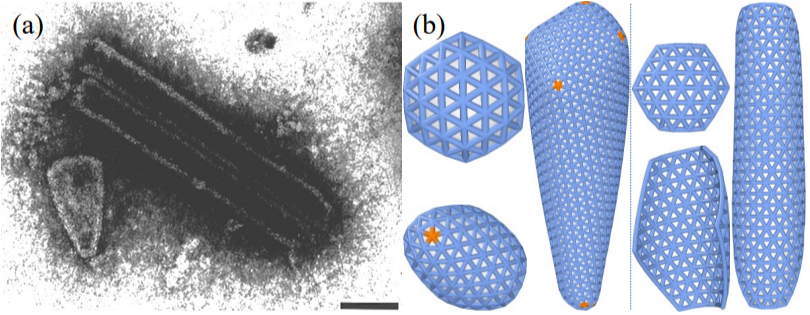
Elasticity theory has been widely applied in physics and other disciplines. The most notably, it has been used to uncover the growth mechanism of viral capsids [PNAS 115, 10971 (2018)], which enclose the viral genetic material. Under suitable conditions, disclinations form precisely at the correct position, resulting in the capsid structure of HIV (Fig.1a shows the experimental results. Fig.1b presents simulation), or icosahedra with different triangulation numbers $T$. In the absence of disclinations, the capsid instead adopts a cylindrical shape (Fig.1b right). In Fig.1b, the disclinations (pentagons) are highlighted in orange. Thus, the formation of the first disclination plays a crucial role in determining the final structure.
To further explore the growth mechanism, a general elasticity theory was developed [PRL 129, 088001 (2022)]. The theory describes the elastic deformation from a reference space, with an arbitrary distribution of disclinations, to the actual space. In the original publication of this notebook [PRE 111, 015423 (2025)], we systematically analyzed the conditions leading to the emergence of the first disclination using this framework. In this notebook, we provide the computational implementation of the lattice model used in this publication.
To further explore the growth mechanism, a general elasticity theory was developed [PRL 129, 088001 (2022)]. The theory describes the elastic deformation from a reference space, with an arbitrary distribution of disclinations, to the actual space. In the original publication of this notebook [PRE 111, 015423 (2025)], we systematically analyzed the conditions leading to the emergence of the first disclination using this framework. In this notebook, we provide the computational implementation of the lattice model used in this publication.
Reference Space
Reference Space
The reference space consists of equilateral triangles with an arbitrary distribution of disclinations. Following the approach of Seung and Nelson [PRA 38, 1005 (1988).], we begin by generating a hexagonal lattice, where each hexagon is composed of six equilateral triangular wedges. A 5-fold disclination is introduced by removing one wedge and joining the exposed two edges, while a 7-fold disclination is created by inserting one additional wedge into the hexagon. Here, we introduce the 7-fold disclination by combining a 4-wedge and a 3-wedge.
Since the elastic deformation is determined within a certain region, the points outside the region--choose to be a circle here--will be removed. It is important to note that maintaining equal distances in the plane becomes impossible after introducing disclinations, leading to the so-called “buckling effect”. As a result, our visualization actually shows a planar projection of such a reference lattice.
Since the elastic deformation is determined within a certain region, the points outside the region--choose to be a circle here--will be removed. It is important to note that maintaining equal distances in the plane becomes impossible after introducing disclinations, leading to the so-called “buckling effect”. As a result, our visualization actually shows a planar projection of such a reference lattice.
Remove two wedges from the hexagon to obtain a four-wedge
Remove two wedges from the hexagon to obtain a four-wedge
In[]:=
xy[p_]:=p[[1]]{Cos[p[[2]]],Sin[p[[2]]]}rph[p_]:=+,Which[p[[1]]0&&p[[2]]0,0,p[[2]]<0,2π+ArcTan[p[[1]],p[[2]]],p[[2]]≥0,ArcTan[p[[1]],p[[2]]]]approxp[pts_,p_]:=Module{s},s=Selectpts,Norm[#-p]<&;If[Length[s]1,s[[1]],If[Norm@s[[1]]<Norm@s[[2]],s[[1]],s[[2]]]]rempts[p_,i_]:=(xy[#]+p)&/@Selectrph[#-p]&/@pts,0<#[[1]]&&#[[2]]<||#[[2]]>π&
2
p[[1]]
2
p[[2]]
3
3.
π
3
5
3
In[]:=
R1=96.;pts=FlattenTable16+k,+
1
2.
3
2.
3
j,k,3.
j,{j,-10,10},{k,-20,20},2;pents=xy[#]&/@{{16,0}};dis={0,0}&/@Range[1,Length[pents]];Graphics[{Circle[{0,0},R1],Point[pts],Red,PointSize[0.015],Point[pents],Blue,Point[rempts[pents[[1]],1]]}](*Thepointsinbluewillberemovedinthenextstep.*)Out[]=
In[]:=
cutmovepts[pts_,p_,i_]:=Module{cutp},cutp=DeleteCasesrph[#-p]&/@pts,{x_,y_}/;0<x&&y<||y>π;(xy[#]+p)&/@#1,#2(*-i*)&@@@cutp
π
3
5
3
6
7
π
3
In[]:=
vcor=pts;For[i=1,i≤Length[pents],i++,dis[[i]]=approxp[vcor,pents[[i]]];vcor=(*cutpts*)cutmovepts[vcor,dis[[i]],i]]vcor1=DeleteCases[vcor,x_/;Norm[x]>R1];Graphics[{Circle[{0,0},R1],Point[vcor1],Red,PointSize[0.015],Point[vcor1]}]
Out[]=
Remove three wedges from the hexagon to obtain a three-wedge
Remove three wedges from the hexagon to obtain a three-wedge
In[]:=
approxp[pts_,p_]:=Module{s},s=Selectpts,Norm[#-p]<&;If[Length[s]1,s[[1]],If[Norm@s[[1]]<Norm@s[[2]],s[[1]],s[[2]]]]rempts[p_,i_]:=(xy[#]+p)&/@Selectrph[#-p]&/@pts,0<#[[1]]&&#[[2]]<||#[[2]]>π&
3
3.
π
3
4
3
In[]:=
pts=FlattenTable16+k,+
1
2.
3
2.
3
j,k,3.
j,{j,-10,10},{k,-20,20},2;pents=xy[#]&/@{{16,0}};dis={0,0}&/@Range[1,Length[pents]];Graphics[{Circle[{0,0},R1],Point[pts],Red,PointSize[0.015],Point[pents],Blue,Point[rempts[pents[[1]],1]]}]Out[]=
In[]:=
cutmovepts[pts_,p_,i_]:=Module{cutp},cutp=DeleteCasesrph[#-p]&/@pts,{x_,y_}/;0<x&&y<||y>π;(xy[#]+p)&/@#1,#2(*-i*)-π&@@@cutp
π
3
4
3
6
7
π
3
In[]:=
vcor=pts;For[i=1,i≤Length[pents],i++,dis[[i]]=approxp[vcor,pents[[i]]];vcor=(*cutpts*)cutmovepts[vcor,dis[[i]],i]]vcor2=DeleteCases[vcor,x_/;Norm[x]>R1];Graphics[{Circle[{0,0},R1],Point[vcor2],Red,PointSize[0.015],Point[vcor2]}]
Combine the four-wedge and the three-wedge
Combine the four-wedge and the three-wedge
The finite element method in the next chapter solves the elastic deformation within a certain region which is chosen to be a circle in this example. This step is to ensure all points are strictly inside this region.
Manually locate the position of the heptagon.
Elastic Deformation on Curved Surfaces
Elastic Deformation on Curved Surfaces
The energy can be minimized by directly relaxing the elastic energy between the neighboring vertexes as illustrated in PRL 123, 145501 (2019). In our original publication, we achieve this by solving the nonlinear elastic equations on general surfaces using the finite element method. This solution is the actual coordinates as the function of the reference coordinates, which provides the lattice in the actual space given it in the reference space. In the notebook, we export the reference coordinates for the finite element process in a different platform. As an example, we choose the surface to be a hyperbolic paraboloid.
Actual Space
Actual Space
The actual coordinates are obtained by the finite element method. As an example, we have chosen the surface to be a hyperbolic paraboloid. Now we visualize it in the actual space.
Summary
Summary
In this notebook, we demonstrate the imposition of a single disclination on a hexagonal lattice and its visualization on a general surface. The mapping between the coordinates in the reference space and the actual space is obtained through the finite element method. Alternatively, one can find the imposition of multiple disclinations and the direct energy relaxation on a surface in the supplemental material of PRL 129, 088001 (2022). We hope this notebook can provide a minimum example for researchers who are interested in the spring-bead model.
References
References
[1] Original Publication: Y. Liu, S. Li, R. Zandi, A. Travesset, General solution for elastic networks on arbitrary curved surfaces in the absence of rotational symmetry, Phys. Rev. E 111, 015423 (2025).
[2] S. Li, P. Roy, A. Travesset, and R. Zandi, Why large icosahedral viruses need scaffolding proteins, Proc. Natl. Acad. Sci. USA 115, 10971 (2018).
[3] Y. Dong, R. Zandi, and A. Travesset, Exact solution for elastic networks on curved surfaces, Phys. Rev. Lett. 129, 088001 (2022).
[4] H. S. Seung and D. R. Nelson, Defects in flexible membranes with crystalline order, Phys. Rev. A 38, 1005 (1988).
[5] S. Li, R. Zandi, A. Travesset, and G. M. Grason, Ground states of crystalline caps: Generalized jellium on curved space, Phys. Rev. Lett. 123, 145501 (2019).
CITE THIS NOTEBOOK
CITE THIS NOTEBOOK
General solution for elastic networks on arbitrary curved surfaces in absence of rotational symmetry
by Yankang Liu, Siyu Li, Roya Zandi & Alex Travesset
Wolfram Community, STAFF PICKS, February 13, 2025
https://community.wolfram.com/groups/-/m/t/3393531
by Yankang Liu, Siyu Li, Roya Zandi & Alex Travesset
Wolfram Community, STAFF PICKS, February 13, 2025
https://community.wolfram.com/groups/-/m/t/3393531