Wolfram Computational Research Club at SUNY Korea
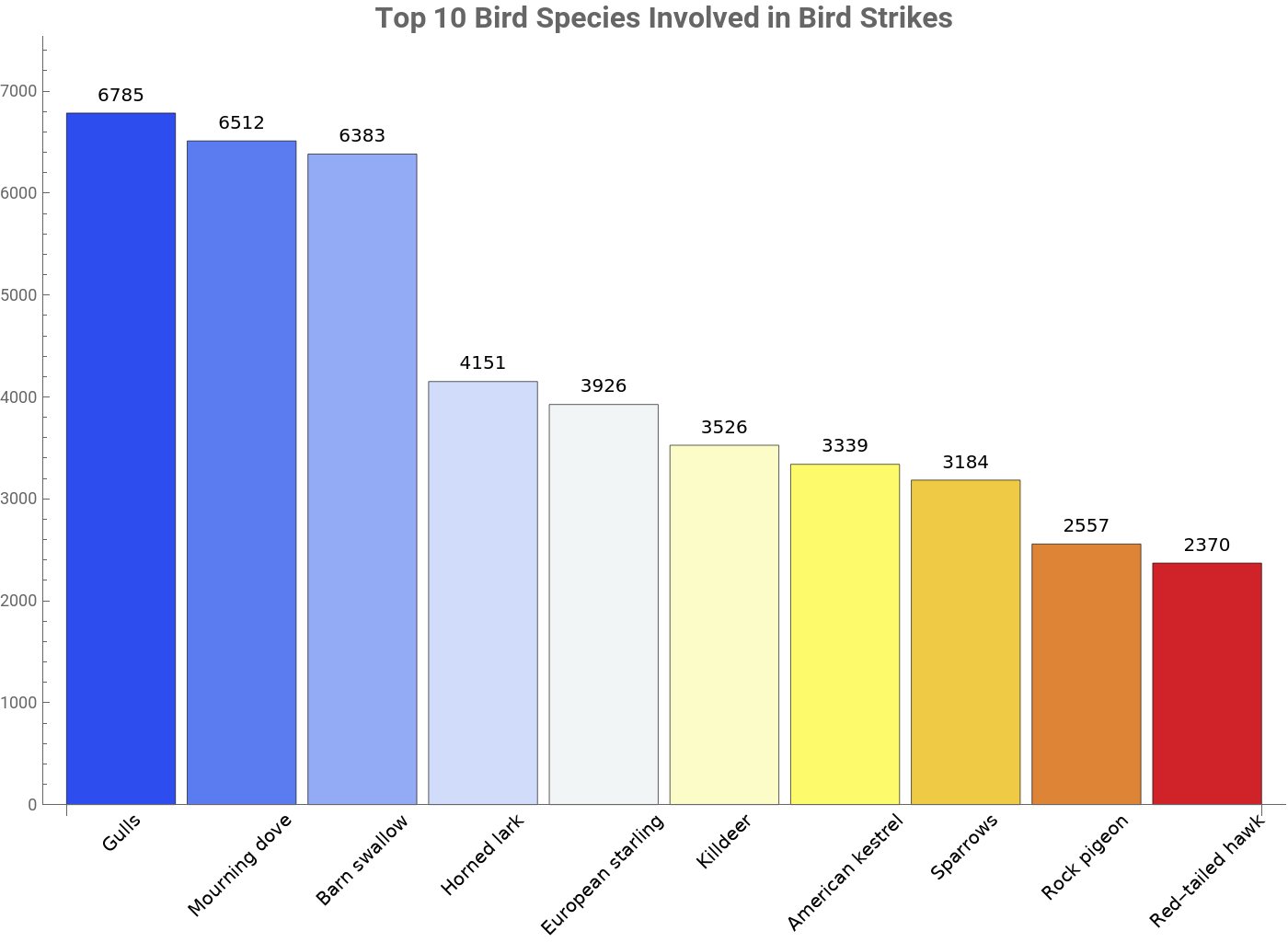
Bird strikes pose a continuous and costly threat to aviation safety. This study analyzes the environmental and physical factors influencing the frequency and severity of aircraft-bird collisions using the FAA National Wildlife Strike Database. Environmental analysis reveals that strike frequency peaks during summer and autumn migration periods, with specific species (e.g., gulls, mourning doves) dominating based on airport geography and surrounding habitats. Operationally, data shows that high collision frequencies occur primarily at lower aircraft velocities (130–150 knots) during low-altitude flight phases (takeoff, climb, and approach). Conversely, collision severity is governed by impact kinetic energy. Employing a binary logistic regression model, this study proves that as avian mass increases, the probability of structural damage escalates significantly (P < 0.001). Despite reporting limitations across different airports, these findings mathematically reinforce that integrating habitat management with physical predictive modeling is essential to mitigate bird strike vulnerabilities.
Correlation Between Seasonal Migration and Collision
Correlation Between Seasonal Migration and Collision
In[]:=
rawData = Import["/Users/youngjunhong/Desktop/Mathematica/Public.xlsx", {"Data", 1}];
In[]:=
monthList = rawData[[2;;, 3]];validMonths = Select[monthList, NumberQ];seasons = validMonths /. { 3|4|5|3.|4.|5. -> "Spring", 6|7|8|6.|7.|8. -> "Summer", 9|10|11|9.|10.|11. -> "Autumn", 12|1|2|12.|1.|2. -> "Winter"};counts = Counts[seasons];orderedSeasons = {"Spring", "Summer", "Autumn", "Winter"};finalData = Table[Lookup[counts, s, 0], {s, orderedSeasons}];totalN = Total[finalData];expectedValue = totalN / 4.; chiSqStat = Total[(finalData - expectedValue)^2 / expectedValue];df = 3; pValue = SurvivalFunction[ChiSquareDistribution[df], chiSqStat];Column[{ BarChart[finalData, ChartLabels -> orderedSeasons, ChartStyle -> { RGBColor[0.6, 0.8, 0.4], RGBColor[0.2, 0.6, 0.8], RGBColor[0.8, 0.4, 0.2], RGBColor[0.7, 0.9, 1.0] }, PlotLabel -> Style["Bird Strike Distribution by Season", Bold, 20], FrameLabel -> {None, "Incident Count"}, LabelingFunction -> Above, ImageSize -> 600, GridLines -> {None, Automatic}], Spacer[20], Panel[ Grid[{ {Style["Statistical Analysis: Chi-Square Goodness-of-Fit", Bold, 16], SpanFromLeft}, {"Null Hypothesis (H0)", ": Bird strikes are evenly distributed (25% per season)."}, {"Total Sample Size (N)", ": " <> ToString[totalN]}, {"Test Statistic (χ^2)", ": " <> ToString[NumberForm[chiSqStat, {15, 2}]]}, {"Degrees of Freedom", ": " <> ToString[df]}, {"P-Value", ": " <> Style[ScientificForm[pValue], 14, Bold, Red]}, {"Result", ": " <> If[pValue < 0.05, Style["Statistically Significant (Reject H0)", Red, Bold], "Not Significant (Fail to Reject H0)"]} }, Alignment -> Left, Spacings -> {1.5, 1.5}], Background -> GrayLevel[0.95], FrameMargins -> 20 ]}, Center]
Out[]=
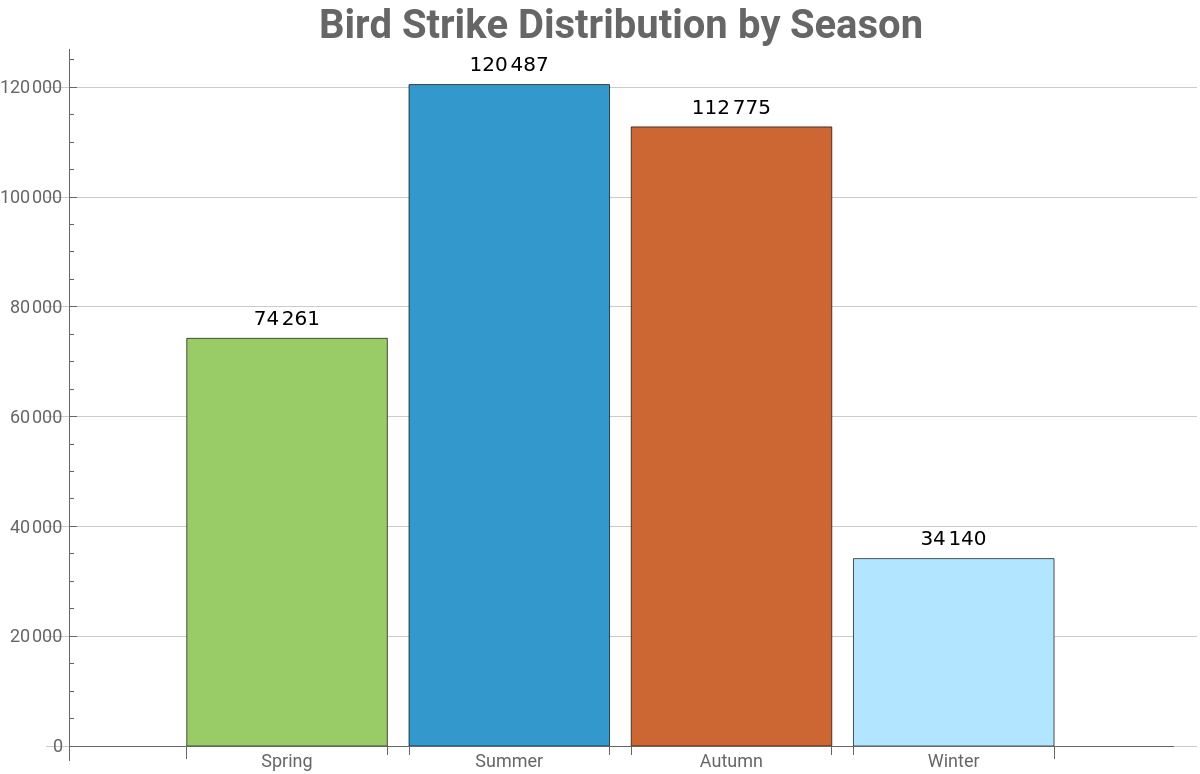

Bird strike incidents are influenced by seasonal factors, with certain seasons experiencing a higher frequency than others. The northern hemisphere, where the U.S. is located, has a pattern of August to October having the highest number of bird strikes (Tirth et al., 2024). This is because this season coincides with the fall migration, when birds move south, and juvenile birds begin to experience flying (Ekici, 2023). The intersection of these biological movements with the flight creates a serious safety problem and causes expensive damage to the aircraft. As shown in the above chart, which analyzes bird strike data from the FAA, the number of incidents changes significantly depending on the season. The graph shows that Summer and Autumn have 120,487 and 112,775 crashes since the 1990s, respectively, which have much higher strike counts compared to Winter. This data supports the idea that bird activities during warmer months and migration periods are the main factors increasing the bird strikes.
Impact of Bird Species and Geography
Impact of Bird Species and Geography
speciesData = rawData[[2;;, 83]];cleanIndices = Select[Range[Length[speciesData]], Module[{sp = speciesData[[#]]}, StringQ[sp] && !StringContainsQ[sp, "Unknown", IgnoreCase -> True] && StringLength[sp] > 0 ] &];filteredSP = speciesData[[cleanIndices]];top10SP = Take[ReverseSortBy[Counts[filteredSP], Identity], UpTo[10]];spChart = BarChart[Values[top10SP], ChartLabels -> Placed[Keys[top10SP], Below, Rotate[#, 45 Degree] &], ChartStyle -> "TemperatureMap", PlotLabel -> Style["Top 10 Bird Species Involved in Bird Strikes", Bold, 16], LabelingFunction -> Above, ImageSize -> 700, PlotRangePadding -> {{None, None}, {None, Scaled[0.1]}}]
|

Physical Factors: Speed and Mass in Bird Strikes
Physical Factors: Speed and Mass in Bird Strikes
Current limitations in Bird Strike Research
Current limitations in Bird Strike Research
References
◼
Altringer, L., Navin, J., Beiger, M. J., Shwiff, S. A., & Anderson, A. (2021, Aug). Estimating wildlife strike costs at US airports: A machine learning approach. Transportation Research Part D: Transport and Environment, Volume 97. https://doi.org/10.1016/j.trd.2021.102907
◼
Dolbeer, Richard A., Begier, Michael J., Miller, Phyllis R, Weller, John R, Anderson, Amy L. (2021, Feb). Wildlife Strikes to Civil Aircraft in the United States, 1990–2019. United States Department of Transportation. https://rosap.ntl.bts.gov/view/dot/58293
◼
Ekici, F., Gümüs, Ö., Uslu, A., & Kale, U. (2023, Jul). An investigation of bird strike cases in the aviation sector with a novel approach within the context of the principal-agent phenomenon: Bird strikes and insurance in the USA. Heliyon, 9(7). https://doi.org/10.1016/j.heliyon.2023.e18115
◼
Federal Aviation Administration. (2026). FAA Wildlife Strike Database. Retrieved Apr 2026, 29, from https://wildlife.faa.gov/home
◼
Ha, Kyoo-Man. (2025, Nov). Bird strikes on civil aircraft: A systematic literature review. Transportation Research Interdisciplinary Perspectives, 34. https://doi.org/10.1016/j.trip.2025.101755
◼
Metz, I. C., Ellerbroek, J., Mühlhausen, T., Kügler, D., & Hoekstra, J. M. (2020). The Bird Strike Challenge. Aerospace, 7(3), 26. https://doi.org/10.3390/aerospace7030026
◼
Parsons D, Leib S, Martin WL. (2025, Jul). A Review of Wildlife Strike Reporting in Aviation: Systems, Uses and Standards. Wild, 2(3). https://doi.org/10.3390/wild2030029
◼
Pfeiffer, M. B., Kougher, J. D., DeVault, T. L. (2018, Nov). Civil airports from a landscape perspective: A multi-scale approach with implications for reducing bird strikes. Landscape and Urban Planning, 179. https://doi.org/10.1016/j.landurbplan.2018.07.004
◼
Tirth, V., John, H., & Kevin C. B. (2024, Sep 18). Biogeographical patterns in the seasonality of bird collisions with aircraft. Ecological Solutions and Evidence, 5(3). https://doi.org/10.1002/2688-8319.12384