Gridiron Pendulum
Gridiron Pendulum


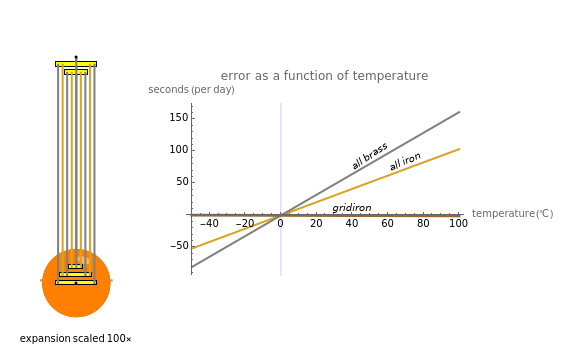
The gridiron pendulum was designed by John Harrison in 1726 to make the swing period insensitive to changes in temperature. It consists of alternating brass and iron rods with lengths selected so that the effects of thermal expansion counteract. In this Demonstration, you can explore the effects of the temperature and the length of the gridiron pendulum on the clock error.
Details
Details
The period of a pendulum is , where is the pendulum length and is the acceleration due to gravity. The thermal expansion of a pendulum made of all iron or brass can lead to minutes of inaccuracy per day. The gridiron pendulum consists of a framework of nine alternating iron and brass rods. These metals have different coefficients of thermal expansion, where =12×m/mK and =18.7×m/mK.
2π
L
g
L
g
α
iron
-6
10
α
brass
-6
10
The total expansion of the gridiron pendulum is , where is the length of the gridiron portion. The variable can be selected so that the total expansion is always zero.
(L+(2-2)x)m/mK
α
iron
α
iron
α
brass
x
x
References
References
[1] The Engineering ToolBox. "Coefficients of Linear Thermal Expansion." www.engineeringtoolbox.com/linear-expansion-coefficients-d_ 95.html.
External Links
External Links
Permanent Citation
Permanent Citation
Aaron Becker
"Gridiron Pendulum"
http://demonstrations.wolfram.com/GridironPendulum/
Wolfram Demonstrations Project
Published: December 13, 2012