This is part of live presentation series called Mathematical Games in which we explore a variety of games and puzzles using Wolfram Language. In this episode, we explore the mathematical games and puzzles involving configurations.
Demonstrations related to configurations
Demonstrations related to configurations
More than a thousand demonstrations involving configurations. https://demonstrations.wolfram.com/search.html?query=configurations
Configurations
Configurations
Hilbert[1] :
“There was a time when the study of configurations was considered the most important branch of geometry.”
Grünbaum[2]:
“The author would like to conjecture that this is the greatest exaggeration of the truth that can be found in any of Hilbert’s writings.”
“There was a time when the study of configurations was considered the most important branch of geometry.”
Grünbaum[2]:
“The author would like to conjecture that this is the greatest exaggeration of the truth that can be found in any of Hilbert’s writings.”
Definitions
Definitions
Configuration rules
Configuration rules
1. Each point is incident to the same number of lines.
2. Each line is incident to the same number of points.
2. Each line is incident to the same number of points.
Instead of a line, it might be a curve or a plane.
Triangle 32
Triangle
3
2
In[]:=
pts={{0,0},{0,1},{1,1}};Graphics[{Disk[#,.03]&/@pts,Line[#]&/@Subsets[pts,{2}]}]
Out[]=
Complete quadrangle 4362
Complete quadrangle
4
3
6
2
In[]:=
pts={{0,0},{0,1},{1,1},{1,0}};Graphics[{Disk[#,.03]&/@pts,Line[#]&/@Subsets[pts,{2}]}]
Out[]=
Complete quadrilateral 6243
Complete quadrilateral
6
2
4
3
In[]:=
pts={{0,0},{0,3},{0,6},{3,6},{6,6},{2,4}};lines=ResourceFunction["FindExtraordinaryLines"][pts];Graphics[{Disk[#,.2]&/@pts,Line[pts[[#]]]&/@lines}]
Out[]=
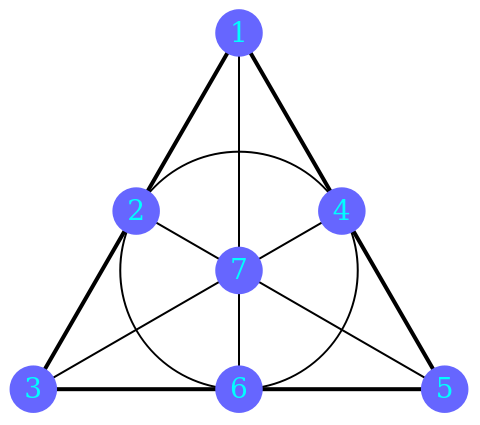
The Fano Plane 73
The Fano Plane
7
3
Configuration rules
Configuration rules
1. Each point is incident to the same number of lines.
2. Each line is incident to the same number of points.
2. Each line is incident to the same number of points.
Projective plane rules
Projective plane rules
1. Every point pair defines a line.
2. Every line pair defines a point.
3. There are 4 points not on a line.
2. Every line pair defines a point.
3. There are 4 points not on a line.
In[]:=
lines=Select[Subsets[Range[7],{3}],BitXor@@#==0&]
Out[]=
{{1,2,3},{1,4,5},{1,6,7},{2,4,6},{2,5,7},{3,4,7},{3,5,6}}
In[]:=
config={1,2,3,6,5,4,7};ResourceFunction["FindFanoPlaneIsomorphism"][config,"Diagram"][config]
Out[]=
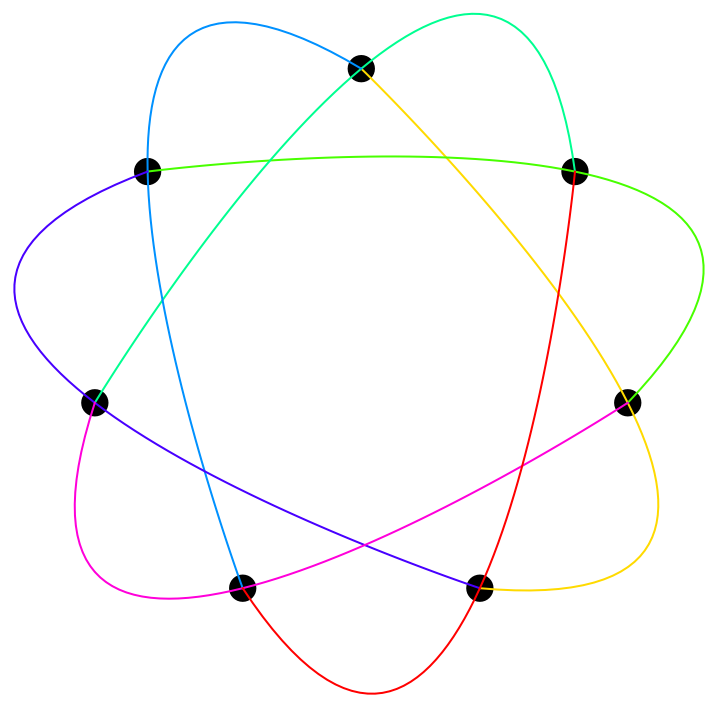
Another representation:
In[]:=
pts=CirclePoints[7];pick=Table[Mod[{1,2,4}+n,7,1],{n,0,6}];Graphics[{Disk[#,.05]&/@pts,{Hue[#[[1]]/7],ResourceFunction["CubicSplineCurve"][pts[[#]]]}&/@pick}]
Out[]=
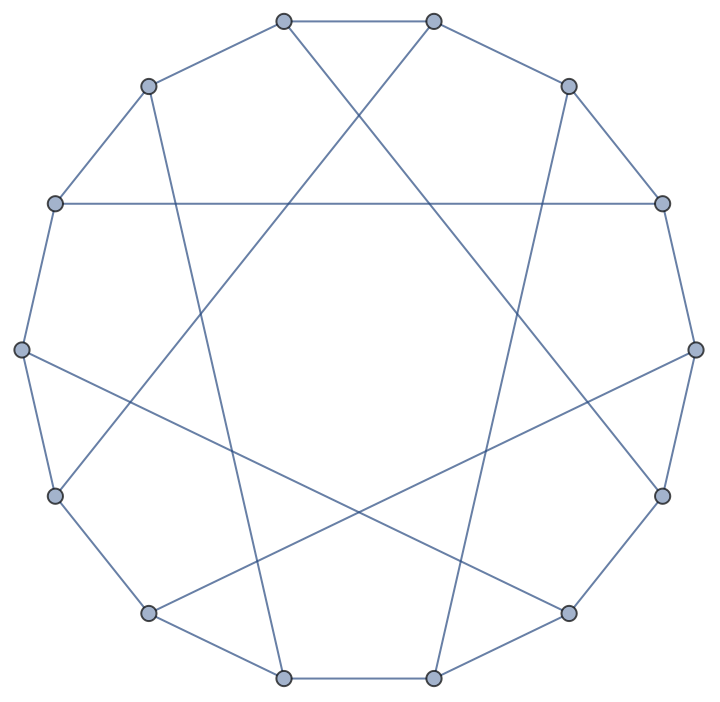
If a graph is made of the connection between the 7 points and 7 lines, you’ll get the Heawood graph.
In[]:=
GraphData["HeawoodGraph"]
Out[]=
The Heawood Graph on the Szilassi Polyhedron:
No-3-in-a-line
No-3-in-a-line
Trying to avoid items lining up is also difficult. A 52×52 square with 104 checkers has no three points in a line in any direction. The Wolfram Demonstration No-Three-in-Line Problem, shows the placement of 2N points on an NxN grid such that no three points are collinear. The possibility of a larger solution remains uncertain.
This week, Joerg Arndt looked at connected polycubes with no three cubes centers in a row, in any direction. The largest is a unique 26-cube. The specific cube coordinates are as follows:
To verify the absence of a three-in-a-row configuration, the following Wolfram Language code is employed, which yields empty set:
The Wolfram Language function FindExtraordinaryLines identifies lines passing through three or more points, enabling exploration of the given set of points in any direction.
Jeorg also looked at No-4-in-a-line, with a further restriction that no cube was at the midpoint of two others. That led to manageable growth: 1, 1, 1, 2, 3, 7, 11, 20, 32, 59, 96, 155, 234, 334, 464, 643, 890, 1204, 1486, 1903, 2330, 2899, 3437, 4102, 4654, 5494, 6121, 6982, 7645, 8725, 9562, 10597, 11137, 11895, 12200, 12674, 12602, 12733, 12339, 12191, 11756, 11476, 10774, 10373, 9860, 9670, 9073, 8603, 7830, 7300, 6725, 6077, 5292, 4524, 3672, 3016, 2382, 1843, 1375, 1077, 781, 555, 390, 275, 182, 111, 71, 42, 25, 14, 8, 7, 5, 3, 1, 0, 0, 0
Ending with 75 cubes. “For this glorious object...”
We can make this configuration with a bit of cheating.
The eight lines of the configuration:
If a graph is made of the connection between the 8 points and 8 lines, you’ll get the Möbius-Kantor Graph:
But that’s easy to fix
If a graph is made of the connection between the 9 points and 9 lines, you’ll get the Pappus graph.
Another configuration is based on the golden ratio:
This is in GraphData
A third configuration is also in GraphData
Two triangles in perspective.
A center of perspectivity.
An axis of perspectivity.
A center of perspectivity.
An axis of perspectivity.
In 1883, Kempe made a graph connecting the lines that did not share a point.
Twelve years later, Petersen noted that Kempe’s graph had interesting properties.
Guess who the graph is named after?
Twelve years later, Petersen noted that Kempe’s graph had interesting properties.
Guess who the graph is named after?
Another configuration is based on a pentagon. We can solve for it.
Leading to this curious value:
In a geometric 3-configuration, every line goes through three points, and three points are on each line. For ten lines and ten points, there are nine different 3-configurations. The first is known as the Desargues configuration.
This gives the Nauru graph, or the Rolling Octahedron graph.
This is the same graph as the positions of a 2×2×2 Rubik’s cube with half-twists only.
Another configuration is based on a pentagon.
The generalized hexagon is a larger configuration:
The Levi graph of the configuration is the Tutte-12-cage:
This, without diagonals
The Coxeter 298 Configuration:
With red and blue positive and negative, all triplets on a line sum to 0, mod 15.
Here are six circles, each on 4 points.
Here are eight points, each on 3 circles.
Here are eight points, each on 3 circles.
If a circular wheel is used, a perfect set of measuring marks is called a difference set, a Ganymede circle, or an n-switch. All the distances between selected red points are different. The distances are indicated by arcs inside the circle.
Here are 13 parabolas, each on 4 points.
Here are 13 points, each on 4 parabolas.
From FourPointParabolas.
Here are 13 points, each on 4 parabolas.
From FourPointParabolas.
Add a point to the center to get 28 lines of 4 on 22 points, an orchard record.
35 points, each on four circles.
35 circles, each on four points.
35 circles, each on four points.
Here are six points on an ellipse:
The Hexagrammum Mysticum
The Hexagrammum Mysticum
From six points on a conic section (circle, ellipse, parabola or hyperbola), label them B L A I S E and connect them to form a hexagon. There are 15 ways to choose two points, leading to 15 lines that intersect at 45 points.
PASCAL: If opposing sides (BL-IS, LA-SE, AI-EB) are extended, the three intersections are collinear, forming what is called a Pascal line. Six points give 60 possible hexagons, with a Pascal line for each hexagon. L(BLAISE) is one of these 60 Pascal lines.
CAYLEY: Consider the vertices of a hexagon as a cyclic permutation and square that as a permutation. For example, BLAISE, BLSEAI and BISLAE have permutations (123456), (125634) and (145236), all with the same permutation square BAS.LIE or (135)(246). There are 20 possible results in sets of three, always giving a pair of 3-cycles. In any of these sets, the three corresponding Kirkman points are collinear, forming what is called a Cayley line. L(BAS.LIE) is one of these 20 Cayley lines.
PLÜCKER: Consider one of the 15 triplets of 2-cycles, such as BL.AI.SE or (12)(34)(56). Find the four Steiner points that commute with the given cycle under permutation products. In this case, (12)(34)(56)×(135)(246)(135)(246)×(12)(34)(56), and similarly for (136)(245), (145)(236) and (146)(235). These four Steiner points are collinear, forming what is called the Plücker line. L(BL.AI.SE) is one of these 15 Plücker lines.
KIRKMAN: For a given hexagon on six points, consider the three other hexagons that share no edges with the first. For the hexagon BLAISE, the three others are BASLEI, BAEILS and BILEAS. These three hexagons define three Pascal lines that concur on a Kirkman point. Each of the 60 hexagons defines a Kirkman point. P(BLAISE) is one of these 60 Kirkman points.
STEINER: Just as in Cayley’s case, consider a hexagon as a cyclic permutation and square that as a permutation. There are 20 possible results in sets of three. In any of these sets, the three corresponding Pascal lines concur on a Steiner point. P(BAS.LIE) is one of these 20 Steiner points.
SALMON: As shown in Plücker, consider one of the 15 triplets of 2-cycles. The four corresponding Cayley lines concur on a Salmon point. P(BL.AI.SE) is one of these 15 Salmon points.
The 20 Steiner points and 15 Salmon points for the six points above:
The 20 Cayley lines and 15 Plücker lines:
12 points, each on six planes.
12 planes, each with six points.
12 planes, each with six points.
Reye’s configuration consists of 12 planes and 12 points such that six points lie in every plane and six planes pass through every point. Alternatively, the configuration consists of 16 lines and the same 12 points such that four lines pass through every point and three points lie on every line [1]. This Demonstration shows a realization without any points at infinity.
I’d call this more of a covering than a geometric configuration
For points and lines, Leah Berman found the first 5-configuration.
Leah Berman also found the first 6-configuration.
Areal or Barycentric coordinates -- Triangle
Areal or Barycentric coordinates -- Triangle
The minimal sign of an areal coordinate determines if a point is inside, outside, or on the boundary of a given simplex:
Often, it’s handy to just list the numerators of an areal coordinate. The denominator is the sum of the numerators:
A barycentric line and barycentric coordinates have the same format. {2,4,-1} is both a barycentric point and a barycentric line:
27 areal points, each on four lines.
27 areal lines, each on four points.
27 areal lines, each on four points.
Smallest Projective Space
Smallest Projective Space
15 points, each on 7 planes.
15 planes, each on 7 points. {1,2,3,4,5,6,7}, {2,4,6,9,11,13,15}, {2,4,6,8,10,12,14}
Also, 35 lines each with BitXor sum 0.
15 planes, each on 7 points. {1,2,3,4,5,6,7}, {2,4,6,9,11,13,15}, {2,4,6,8,10,12,14}
Also, 35 lines each with BitXor sum 0.
Klein Configuration
Klein Configuration
60 points and 60 planes.
Each point on 15 planes. Each plane has 15 points.
A point is on a plane if the dot product is zero.
A point is on a plane if the dot product is zero.
If the dot product equals zero, then the point is on the plane.
Lay out twelve cards at random. Can you find a plane with three points on it?
Lay out twelve cards at random. Can you find a plane with three points on it?
Unsolved Question
Unsolved Question
What are other self-dual barycentric graphs?
What other graphs pair up with interesting configurations?
References
References
[1] D. Hilbert and S Cohn-Vossen, Anschauliche Geometrie, Springer, Berlin, 1932.
[2] B. Grünbaum, Configurations of Points and Lines, AMS, Providence, 2009.
[2] B. Grünbaum, Configurations of Points and Lines, AMS, Providence, 2009.
CITE THIS NOTEBOOK
CITE THIS NOTEBOOK
Mathematical Games: configurations
by Ed Pegg
Wolfram Community, STAFF PICKS, December 21, 2023
https://community.wolfram.com/groups/-/m/t/3089201
by Ed Pegg
Wolfram Community, STAFF PICKS, December 21, 2023
https://community.wolfram.com/groups/-/m/t/3089201