Modeling With Differential Equations
Modeling With Differential Equations
Based on the online module I attended from the University of Delft via EDx
We pretend that we grow rainbowfish to sell in pet stores.
The question is, how fast does the population grow?
We start to breed rainbowfish in a big nice aquarium .
We start with 30 fish, half of them male, half of them female. So our initial condition is
P(0)30.
Assumethatarainbowfishlivesnaturallyforapproximately1000days.Theagesofthefishinaquariumaremixed.Thedeathrateisdeathsperdayandthebirthrateisgivebirthsperday
d
1
1000
b0.7
The balance equation is given by the formula
ΔP(b-d)P(t)Δt
and 0.7P(t) describes how the population changes.
dP
dt
(*definethedifferentialequation*)
In[]:=
eqn={P'[t]==0.7*P[t]}
Out[]=
{[t]0.7P[t]}
′
P
(*definetheinitialcondition*)
In[]:=
cond={P[0]==30}
Out[]=
{P[0]30}
(*solvetheproblemwiththecommandDSolve*)
In[]:=
sol=DSolve[{eqn,cond},P[t],t]
Out[]=
{{P[t]30.}}
0.7t
Does this solution represent a realistic solution to our problem?
In[]:=
Plot[P[t]/.sol,{t,0,10},AxesLabel->{"Time (days)","Population"},PlotLabel->"Rainbowfish Population Over Time"]
Out[]=
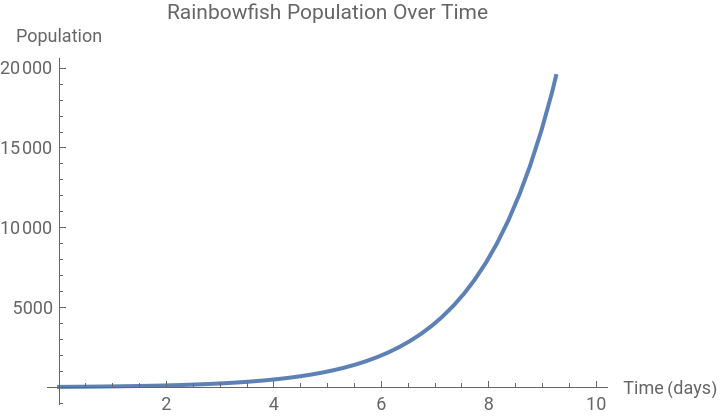
It is not realistic . Because after of a period of time we will have overpopulation of rainbow fish