On July 1, 2025 a new object was found moving through the solar system, temporarily named “A11pl3Z” . With only a few data points, indications were that this object had a hyperbolic orbit and was from interstellar space, beyond our solar system. On July 2, additional observations allowed the construction of an orbit that confirmed the initial observations. This new object has an orbital eccentricity of about 6! Remember that elliptical orbits have an eccentricity of less than 1, parabolas have an orbital eccentricity of 1, and hyperbolas have an orbital eccentricity above 1. With the orbit determined, the object received a name from the IAU, actually a couple of names: C/2025 N1 (ATLAS) as well as 3I/ATLAS. The ATLAS is short for Asteroid Terrestrial-impact Last Alert System since it was discovered as part of that observational program.
The orbit shows that the object is incoming and will pass inside the object of Mars before heading back out into interstellar space:
In[]:=
Out[]=

Some quantitative analysis can be done on this object now that the orbit is defined. The following looks at the date range between June 1, 2025 and June 1, 2026.
In[]:=
dr=DateRange,,;
In[]:=
createDateValuePairs[values_]:=Transpose[{dr,values}]
The heliocentric speed will peak in October, 2025 with a maximum value of around 68 km/s.
In[]:=
cometHeliocentricSpeed=createDateValuePairsEntityValue,Dated["VelocityAroundSun",#]&/@dr;
In[]:=
DateListPlot[cometHeliocentricSpeed,TargetUnits->"Kilometers"/"Seconds"]
Out[]=
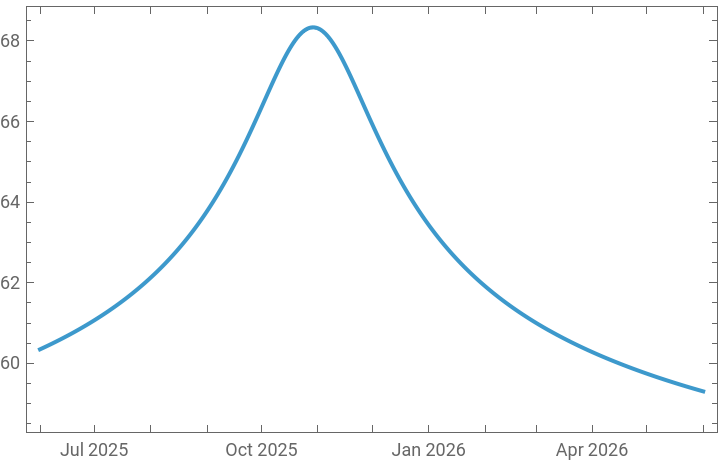
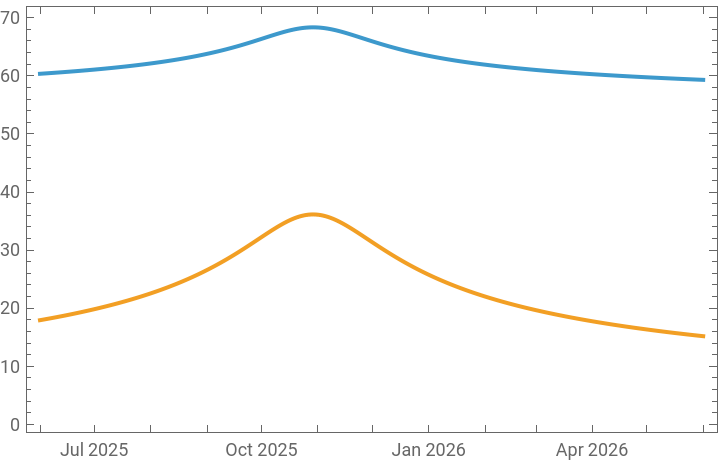
For context, the escape velocity of the Sun can be computed as a function of distance. If the escape velocity is plotted at the distance of the comet over time, it can be seen that the comet is always well above the escape velocity of the Sun at that distance.
escapeSpeedAtCometDistance=createDateValuePairsUnitConvertFormulaData"EscapeVelocity","m"->["Mass"],"r"->AstroDistance,Dated,#[[2]],"Kilometers""Seconds"&/@dr;
In[]:=
DateListPlot[{cometHeliocentricSpeed,escapeSpeedAtCometDistance},TargetUnits->"Kilometers"/"Seconds",PlotLegends->Placed[{"heliocentric speed of C/2025 N1 (ATLAS)","escape speed of the Sun at comet distance"},Below]]
Out[]=


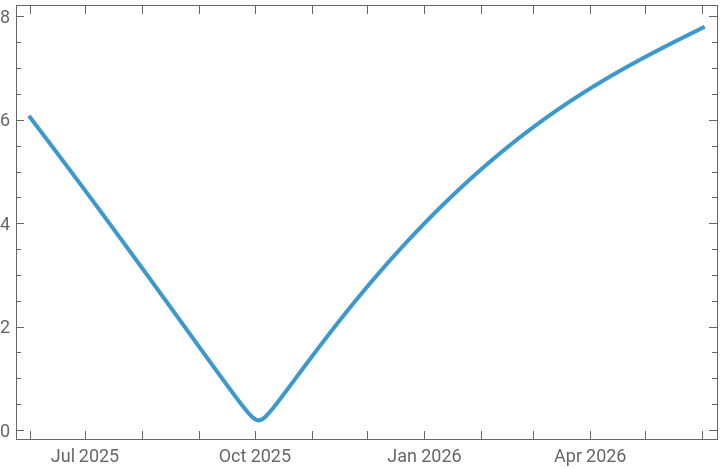
As the comet flies through the inner solar system, it will come less than 0.2 AUs from Mars, opening the possibility that it might become visible from satellites orbiting Mars.
DateListPlotcreateDateValuePairsAstroDistance,Dated,#&/@dr,TargetUnits->"AstronomicalUnit"
Out[]=
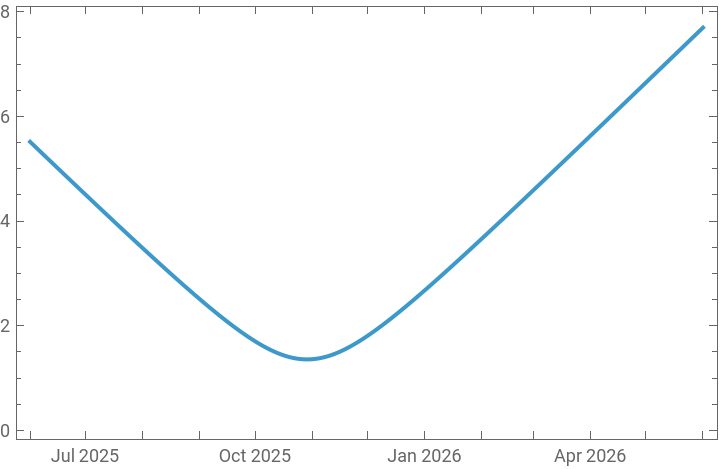
The comet’s distance from the Sun never gets below about 1.4 AU.
DateListPlotcreateDateValuePairsAstroDistance,Dated,#&/@dr,TargetUnits->"AstronomicalUnit"
Out[]=
UnitConvert["Periapsis"],"AstronomicalUnit"
Out[]=
As of this post, this new object is being studied intensely. Its orbit will likely be refined, and more predictions will become available concerning visibility from Earth. Assuming its identification as a comet holds true, how much volatile ices does the object contain and will it develop a bright tail? Or will its distance of 1.4 AU prevent a significant brightening from happening. Keep watching!
CITE THIS NOTEBOOK
CITE THIS NOTEBOOK
A new interstellar object: comet C/2025 N1 (ATLAS), (a.k.a. 3I/ATLAS and A11pl3Z)
by Jeffrey Bryant
Wolfram Community, STAFF PICKS, July 3, 2025
https://community.wolfram.com/groups/-/m/t/3491021
by Jeffrey Bryant
Wolfram Community, STAFF PICKS, July 3, 2025
https://community.wolfram.com/groups/-/m/t/3491021