Multistage Batch Distillation
Multistage Batch Distillation



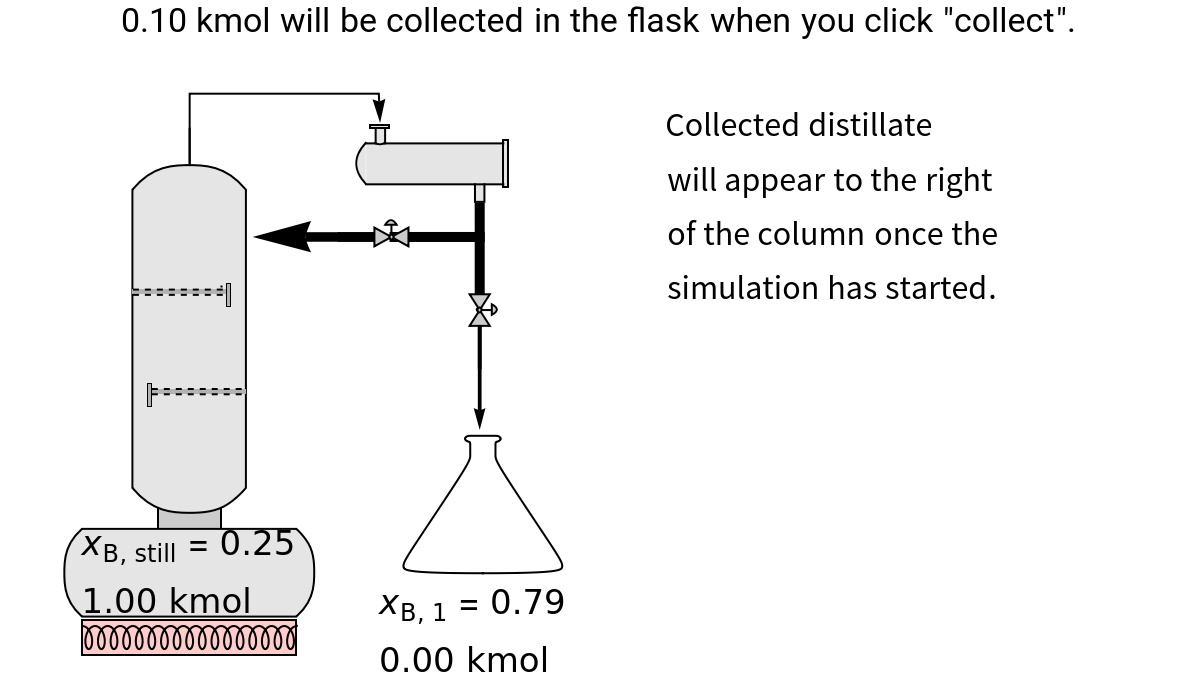
Multistage batch distillation is simulated by an animation. One kmol of a binary mixture (components and with being the more volatile component) is placed in a batch still. Use the first slider to set the initial mole fraction of component in the still. Next, adjust the number of trays in the column with the "equilibrium stages" slider, and adjust the reflux ratio of the column with the "reflux ratio ()" slider. Specify the amount of liquid to be collected using the "amount to evaporate" slider.
A
B
B
B
L/D
When you click "collect", the liquid evaporates into a collection flask. After the specified amount of distillate is collected, the collection flask is set aside and an empty flask is substituted. This process can be repeated until 0.2 mol remains in the still or eight flasks have been filled. The graphic on the right side may be changed by choosing an option next to "display". Select "reset" to start over. Tooltips enable hovering the mouse over components and streams in the graphic.
Details
Details
Multistage batch distillation can obtain much higher product purity than simple batch distillation. The overall mass balance is:
F=+
W
final
D
total
where is the initial molar quantity of the feed mixture, is the molar quantity in the bottoms vessel (the "waste" product), and is the total molar quantity of collected distillate. The component mass balance is:
F
W
final
D
total
F=+
x
F
W
final
x
W,final
D
total
x
D,avg
where is the initial mole fraction of component in the feed, is the average mole fraction of component within the collected distillate, and is the final mole fraction within the bottoms vessel.
x
F
B
x
D,avg
B
x
W,final
Each tray in the column is assumed to be in vapor-liquid equilibrium:
y=f(x)
The function represents an equilibrium curve, plotted on an - diagram. The composition of each stage lies somewhere upon this curve.
y=f(x)
x
y
An operating line relates the composition of a stage to the adjacent stage composition. The operating line equation is:
y
n
R
R+1
x
n+1
R
R+1
x
D
where is the vapor mole fraction of at stage , is the reflux ratio, and is the liquid mole fraction of at stage . The reflux ratio is:
y
n
B
n
R
x
n+1
B
n+1
R=
L
D
where is the flow rate of liquid returning from the condenser to the column, and is the flow rate of distillate being collected. The Rayleigh equation can be used to solve for the final composition of distillate and bottoms:
L
D
ln=-
W
final
F
x
W,final
∫
x
F
1
x
D
x
W
dx
W
but the relationship between distillate composition and bottoms composition is complicated with multistage columns, and the mole fractions are obtained numerically.
f()=
x
W
x
D
References
References
[1] P. C. Wankat, "Batch Distillation," Separation Process Engineering: Includes Mass Transfer Analysis, 3rd ed., Upper Saddle River, NJ: Prentice Hall, 2012 pp. 329–347.
External Links
External Links
Permanent Citation
Permanent Citation
Neil Hendren, John L. Falconer
"Multistage Batch Distillation"
http://demonstrations.wolfram.com/MultistageBatchDistillation/
Wolfram Demonstrations Project
Published: December 9, 2019