Why Location Matters: The Bid Rent Curve
Why Location Matters: The Bid Rent Curve


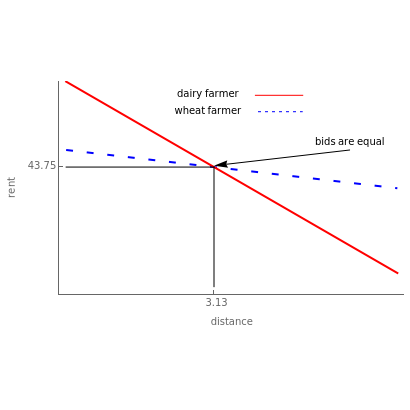
Classic land use theory holds that rent is a function of distance from the center of commercial activity. Land users bid against one another, paying higher rent for proximity to the center of business based on respective transportation costs. At one extreme, those with the highest transportation cost will outbid others for land nearest the center. Alternatively, for land far from the center, value drops to zero when it is no longer profitable for anyone to locate there; hence no rent will be paid for such land. The plot shows a dairy farmer with high transportation costs outbidding a wheat farmer whose transportation costs are lower.
Details
Details
The graphic shows the intersection point where two users are equally willing to locate at the same rent. The axis is the distance from the center, and the axis is the rent paid at that point on the earth. Higher bidders with higher transportation costs will locate to the left of this point. The lower bidder will locate to the right of this point.
x
y
R. J. Brown, Private Real Estate Investment: Data Analysis and Decision Making, Burlington, MA: Elsevier Academic Press, 2005.
Permanent Citation
Permanent Citation
Roger J. Brown
"Why Location Matters: The Bid Rent Curve"
http://demonstrations.wolfram.com/WhyLocationMattersTheBidRentCurve/
Wolfram Demonstrations Project
Published: January 17, 2008