Effect of Tube Diameter on Plug Flow Reactor
Effect of Tube Diameter on Plug Flow Reactor


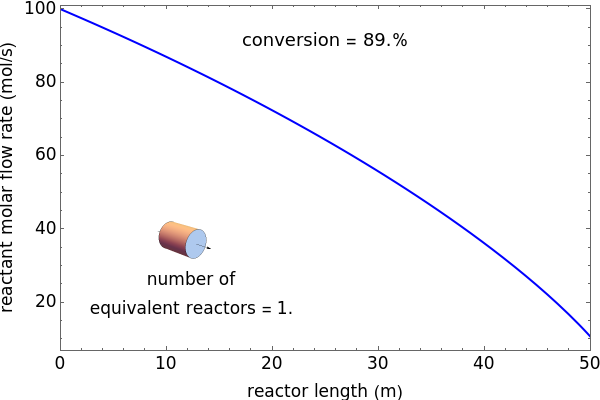
A first-order, exothermic reaction takes place in a plug flow reactor (PFR) that has pressure drop and heat transfer through the walls. Use the slider to observe the effects of changing reactor diameter; the total feed flow rate is kept constant by changing the number of parallel reactors (number of equivalent reactors) so that the total reactor cross section does not change. Use buttons to observe how reactant molar flow rate, temperature, and pressure depend on reactor length. For small-diameter reactors, the pressure drop is higher, which increases the volumetric flow rate and reduces the residence time; this lowers conversion. Since heat transfer is more efficient for smaller-diameter reactors because the surface area per volume is larger, the temperature increases less; this also lowers conversion.
Details
Details
Ergun equation for pressure drop in a plug flow reactor:
dP
dz
f
D
h
2
(v/)
A
C
2
A
C
π
4
2
D
h
v
0
F
A,0
T
0
P
0
v=
v
0
F
A
F
A,0
P
0
P
T
T
0
where is pressure (), is distance down the reactor (m), is fluid density (), is friction factor, is the hydraulic diameter, which is equal to reactor diameter in absence of heating or cooling (m), is volumetric flow rate (/s), is the cross-sectional area of the reactor (), is the molar flow rate of (mol/s), is temperature (K), is the ideal gas constant (J/[mol K]), and the subscript refers to the inlet.
P
N/
2
m
z
ρ
kg
3
m
f
D
h
v
3
m
A
C
2
m
F
A
A
T
R
0
The pipe is assumed to be commercial steel. For laminar flow, the following equation is used to calculate the Darcy friction factor. For turbulent and transitional flow, Serghide's explicit solution to the Colebrook equation is used:
f=
64
N
Re
N
Re
f=0.25
-2
log+
ϵ
3.7
D
h
5.74
0.9
N
Re
N
Re
N
Re
v
A
C
D
h
D
h
D
r
where is the Reynolds number, is wall roughness (m), is dynamic viscosity (kg/[m s]), and is reactor diameter (m).
N
Re
ϵ
μ
D
r
Mass balance:
d
F
A
dz
C
A
A
C
C
A
F
A
where is the reactant concentration (), and is the rate law constant (1/s).
C
A
mol/
3
m
k
Energy balance:
T
z
Ua(Ta-T)-kΔH
C
A
A
C
F
A
where is the heat transfer coefficient times area/volume (), is the temperature of the coolant (K), is heat of reaction (J/mol), and is heat capacity of reactants (J/[mol K]).
Ua
J/[sK]
3
m
Ta
ΔH
Cp
The screencast video at[1] shows how to use this Demonstration.
References
References
[1] Effect of Tube Diameter on Plug Flow Reactor. http://www.learncheme.com/simulations/kinetics-reactor-design/effect-of-tube-diameter-pfr.
External Links
External Links
Permanent Citation
Permanent Citation
Rachael L. Baumann, John L. Falconer
"Effect of Tube Diameter on Plug Flow Reactor"
http://demonstrations.wolfram.com/EffectOfTubeDiameterOnPlugFlowReactor/
Wolfram Demonstrations Project
Published: April 8, 2014