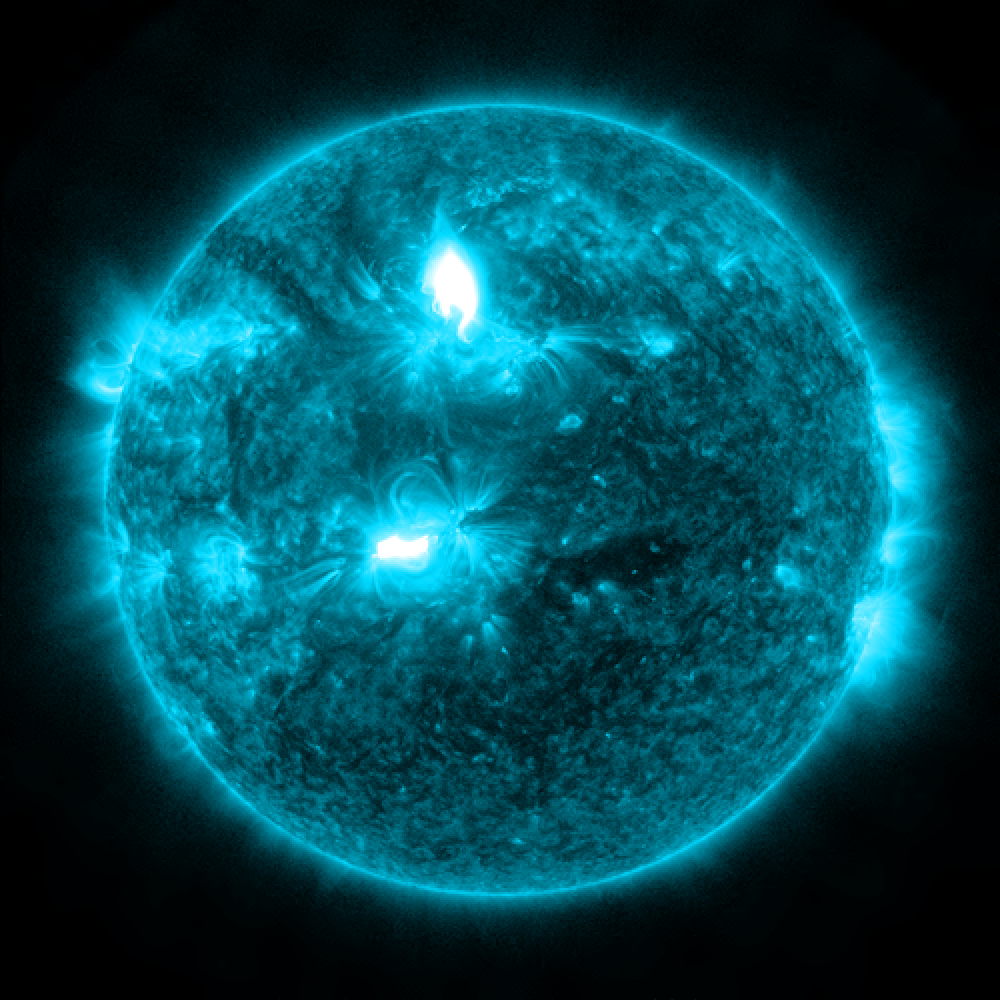
Early on March 23, 2024 GMT, the Sun unleashed a powerful solar flare a ranking of X1.1. Typically, solar flares emerge from the complex magnetic fields above a sunspot group, but sometimes they can be linked to other sunspot groups quite some distance away. The solar flares that result from such entangled, but distant, sunspot groups are known as sympathetic flares because the two separate regions unleash energy at the same time. Here is an image of the Sun near the moment that the X1.1 flare was unleashed.
In[]:=
ResourceFunction["SolarImage"][DateObject[{2024,3,23,1,30,0},TimeZone->0],9,"Colorize"->True,ImageSize->500]
Out[]=
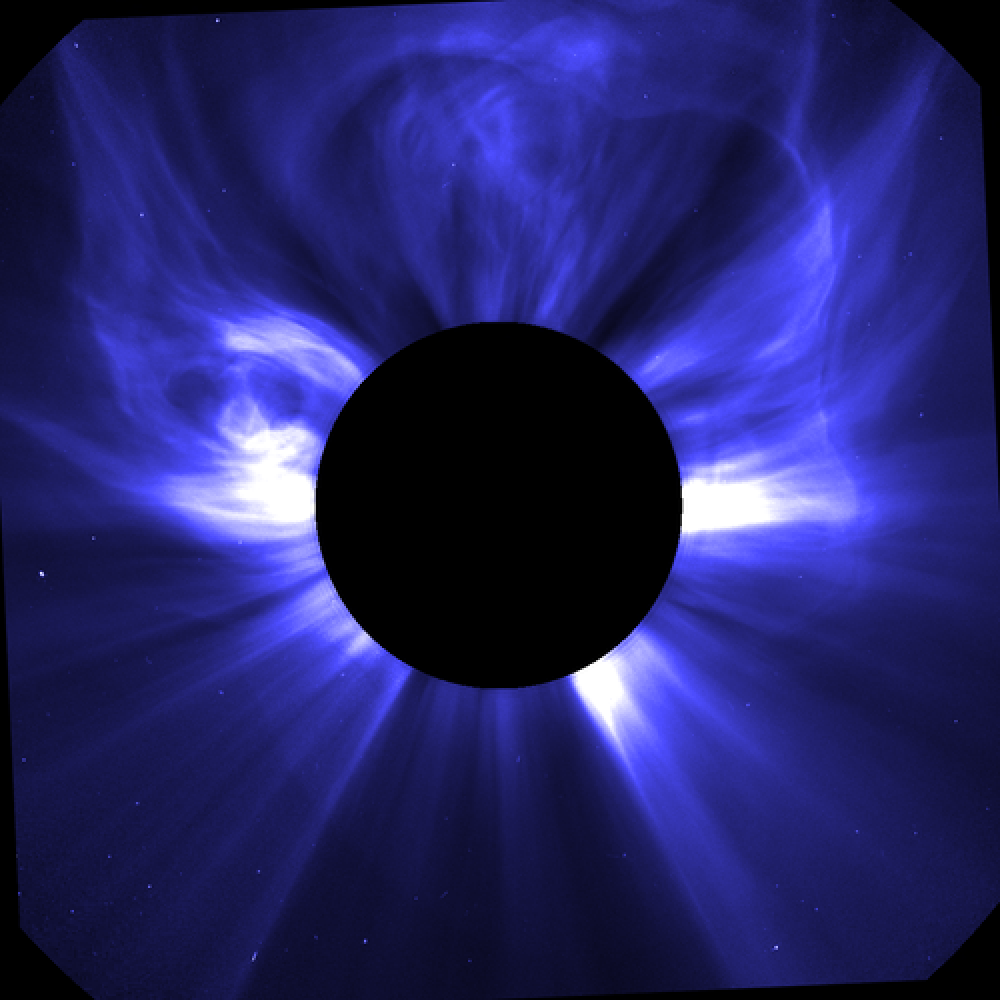
Shortly after the solar flare, a bright coronal mass ejection (CME) was triggered that threw off substantial solar plasma.
In[]:=
ResourceFunction["SolarImage"][DateObject[{2024,3,23,2,30,0},TimeZone->0],4,"Colorize"->True,ImageSize->500]
Out[]=
Here is a wider view showing the emerging CME. The Sun’s image is artificially blocked by the instrument so the details of the solar corona can be observed.
In[]:=
ResourceFunction["SolarImage"][DateObject[{2024,3,23,2,30,0},TimeZone->0],5,"Colorize"->True,ImageSize->500]
Out[]=
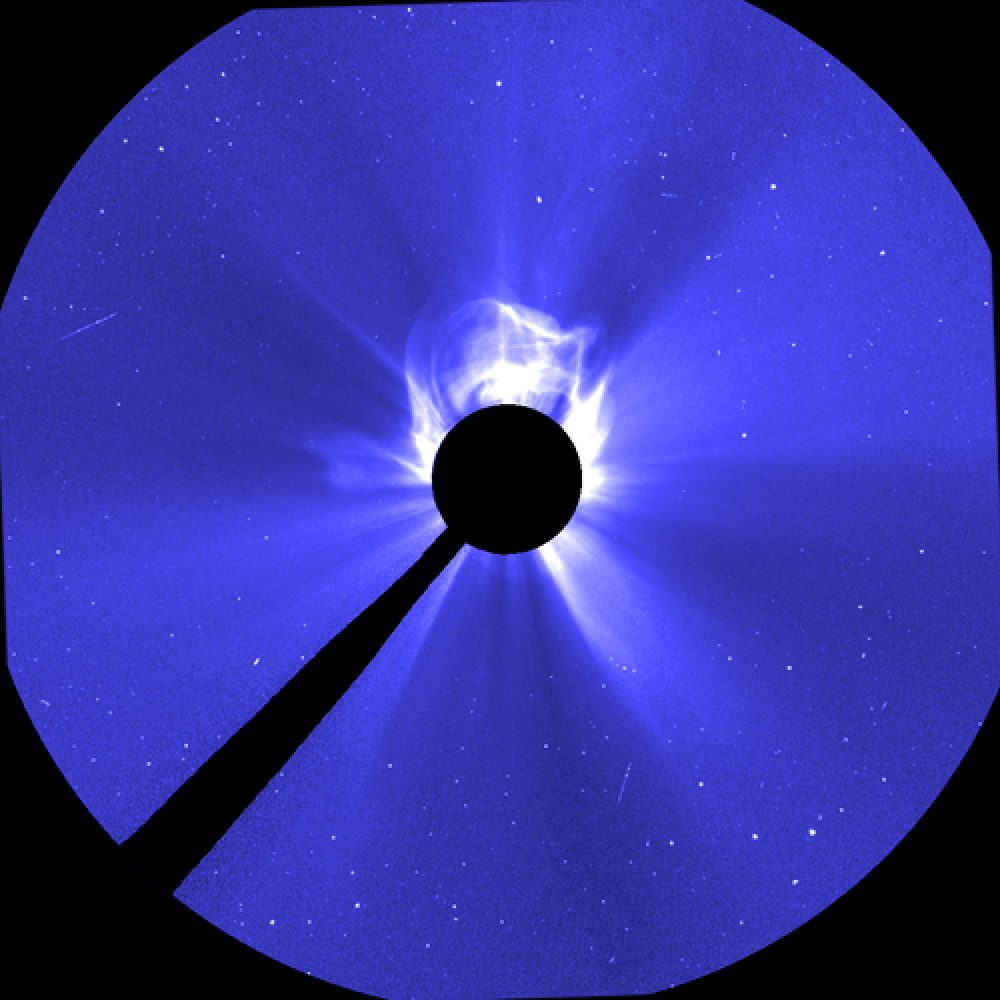
The CME is Earth directed and will likely be geo-effective when it arrives in our vicinity, sometime early on March 25. Without knowing the orientation of the embedded magnetic fields in the CME, the strength of this impact remains to be seen, but enhanced auroral activity is likely. Time will tell how far south any auroras may be visible or if the weather will allow observing any auroras if they are present.
In[]:=
dr=DateRange[DateObject[{2024,3,23,0,45,0},TimeZone->0],DateObject[{2024,3,23,4,45,0},TimeZone->0],Quantity[1,"Minutes"]];
In[]:=
frames=ResourceFunction["SolarImage"][dr,5,"Colorize"->True,ImageSize->800];
In[]:=
SlideShowVideo[Values[frames]]
Out[]=
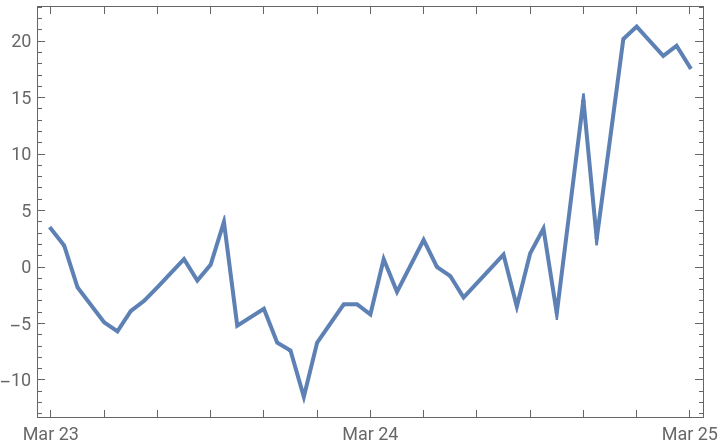
Addendum: In fact the CME did arrive, hours earlier than expected. Typically, in order to see auroras further south than usual, the z-component of the interplanetary magnetic field needs to dip south (negative) in response to the CME. In fact, it actually trended strongly north (positive) so its not likely to allow any associated auroras further than the US/Canada border unless conditions change.
In[]:=
tsBz=ResourceFunction["SpaceWeatherData"][{DateObject[{2024,3,23,0,0,0},TimeZone->0],DateObject[{2024,3,25,0,0,0},TimeZone->0]},"IMFBz"]
Out[]=
TimeSeries


In[]:=
DateListPlot[tsBz]
Out[]=
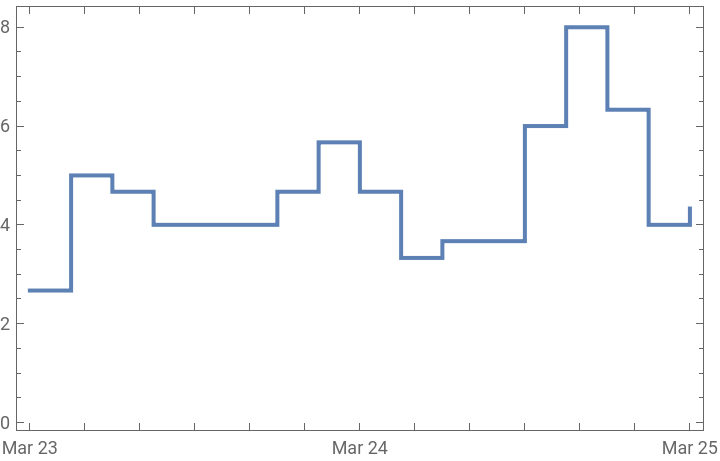
However, the impact was strong and the planetary K-index value did briefly spike at about 8, but is already showing signs of subsiding.
In[]:=
tsKp=ResourceFunction["SpaceWeatherData"][{DateObject[{2024,3,23,0,0,0},TimeZone->0],DateObject[{2024,3,25,0,0,0},TimeZone->0]},"PlanetaryKIndex"]
Out[]=
TimeSeries

In[]:=
DateListPlot[tsKp,InterpolationOrder->0]
Out[]=
CITE THIS NOTEBOOK
CITE THIS NOTEBOOK
Sympathetic solar flare and geoeffective coronal mass ejection
by Jeffrey Bryant
Wolfram Community, STAFF PICKS, March 24, 2024
https://community.wolfram.com/groups/-/m/t/3146725
by Jeffrey Bryant
Wolfram Community, STAFF PICKS, March 24, 2024
https://community.wolfram.com/groups/-/m/t/3146725