The documentary explains the Europa Clipper mission, detailing its launch on October 14, 2024, from Kennedy Space Center and its scheduled arrival at Jupiter’s moon Europa in April 2030. It highlights the probe's indirect route, which involves flybys of Mars and Earth to gain gravitational assists and save fuel. The documentary uses Wolfram Language to illustrate the probe’s speed and trajectory, showing its approach to and recession from Mars and Earth during flybys. The Jet Propulsion Laboratory (JPL) Europa Clipper system engineering team was awarded the Wolfram Innovator Award for using Wolfram Language and Wolfram System Modeler to validate the spacecraft’s thermal management system performance before launch. CITATION: Wolfram R&D, Unveiling the Europa Clipper’s Unusual Route to Jupiter’s Moon. https://youtu.be/sqmQh_WKcPc
On October 14th 2024 Europa Clipper was launched from complex 39A at the Kennedy Space Center. It’s scheduled to reach Jupiter’s icy Moon Europa in April of 2030. Between now and then the Europa Clipper space probe will take an indirect route to Jupiter, why?
In this video we will take a journey through history and the future to get a better understanding of the Moon Europa and the Europa Clipper space probe and its planned journey to get to its final destination. Let’s start with a bit of background, there are many types of objects in our solar system, planets, dwarf, planets, moons, asteroids comets, and so on. The planet Jupiter alone has 95 moons with confirmed orbits with Europa being just one of them. Being in a high radiation environment around Jupiter extremely cold having an exceptionally thin atmosphere completely covered by ice and with volatile geology Europa does not feel like a place you might want to plan a trip to. Despite all this hostility it has been identified as one of the locations in the solar system that could possibly Harbor extraterrestrial life. Using Wolfram Alpha and Wolfram language I will take you on this journey through history and the future.
In 1610 the planet Jupiter was the subject of a number of scientific Revelations. It was famously observed by Galileo Galilei in that year entered around the same time by Simon Marius. Among the revelations found at Jupiter was the observation that it had four moons that could be seen through the Primitive telescopes of the time. The position of these moons changed from night to night providing evidence that not everything in the solar system orbited Earth a common interpretation of the time. Collectively, these moons are known as the Galilean satellites but it is Simon Marius Who is credited for the modern naming of these moons from innermost to outermost the moons are Io, Europa, Ganymede and Callisto. A number of deep space probes have flown by Jupiter or orbited the system over the years the nature of the Galilean satellites began to be revealed thanks to discoveries starting with Pioneer 10 and 11 in the early to mid 1970s and the Voyager missions in the late 1970s to early 1980s and eventually including the Galileo probe in the ‘90s and early 2000s. With the exception of the innermost Moon Io which is covered in Sulfur and volcanoes the majority of the moons were icy bodies.
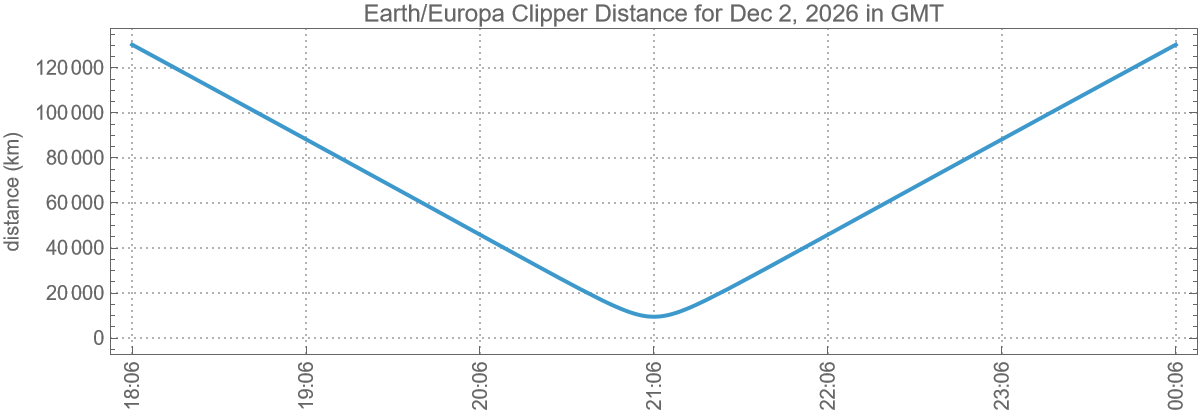
Of particular interest was the icy Moon Europa slightly smaller than Earth’s moon one of the most reflective bodies in the solar system and the smoothest. Analysis of the data from flybys of Europa by the Galileo space probe indicated the possibility that there may be a salty liquid water ocean underneath the icy crust this fascinating possibility led to the design of a probe dedicated to explore Europa which became the Europa Clipper space probe. Launched on October 14th of 2024 Europa Clipper departed on an indirect route to Jupiter to save fuel. This route involves flybys of Mars and Earth to obtain gravitational assists before arriving for a planned Jupiter rendezvous in April of 2030 using Wolfram language the speed and trajectory of the Europa Clipper probe can be examined in detail to show how close the probe gets to Mars and Earth and how its speed changes with each flyby maneuver. The plots shown below are relatively straightforward showing the gradual approach and then recession of the probe from each planet during each maneuver, but the lower plots in both flyby show a bit more asymmetry as the velocity of the probe changes due to a transfer of momentum from the planet to the probe. This gravitational assist involves the probe accelerating as it falls toward the planet resulting in an increase in speed but the probe isn’t on a collision course its trajectory carries it just near enough to the planet to either gain or lose velocity. For the Mars fly by, the velocity of the probe is reduced to prepare for the next event the flyby of Earth. When Europa Clipper passes by the Earth, the your approach is similar to that on Mars but this time the probe gains velocity and obtains the critical speed needed to make it to Jupiter, all without wasting fuel. To avoid the dangerous environment near Europa which orbits within Jupiter’s radiation belts, the Europa Clipper mission was designed to avoid orbiting Europa directly and instead make many short flybys of Europa over the course of its Mission lifetime. In the simulation below, the orbits of the Europa Clipper probe are color coded with early orbits colored red and later orbits colored blue. It will be a few years before we obtain any scientific data about Europa from the Europa Clipper missions. In the meantime you can use Wolfram to analyze the Europa Clipper Mission and many other spacecraft in deep space along with many objects in the solar system including the planets, moons, asteroids, and comets.
Congratulations should be given to the jet propulsion laboratory Europa Clipper system engineering team who were awarded with the Wolfram innovator award for their use of Wolfram language and Wolfram system modeler to validate requirements against performance of the Clippers thermal management system before launch.
Initialization
Initialization
Jupiter System
Jupiter System
Generate a virtual view of the Galilean moons and Jupiter as seen from inside the system.
In[]:=
jupiterTextured=["TexturedSurface"];
In[]:=
ioTextured=["TexturedSurface"];
In[]:=
europaTextured=["TexturedSurface"];
In[]:=
ganymedeTextured=["TexturedSurface"];
In[]:=
callistoTextured=["TexturedSurface"];
Out[]=
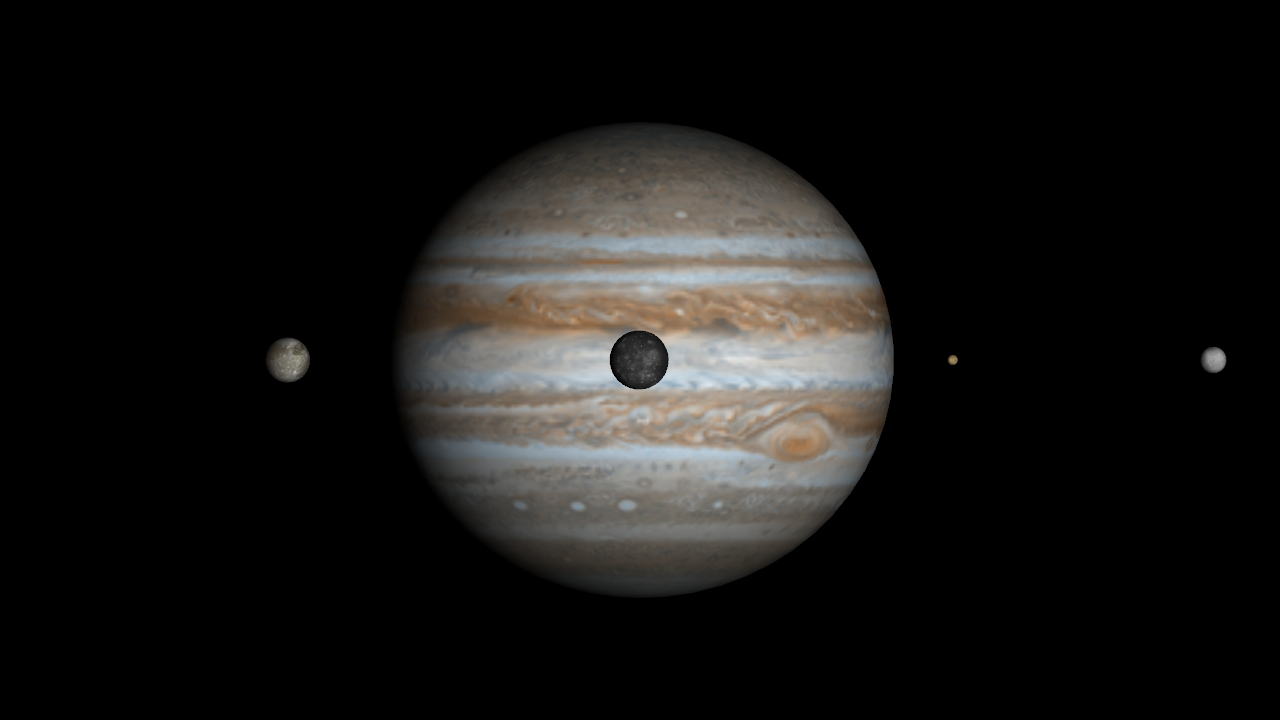
Video Code
Video Code
Rotating Galilean Satellites
Rotating Galilean Satellites
Generate a square collage of the four Galilean moons rotating based on their respective rotation periods.
In[]:=
callistoperiod=QuantityMagnitude["RotationPeriod"],"Days";
In[]:=
ganymedeperiod=QuantityMagnitude["RotationPeriod"],"Days"callistoperiod;
In[]:=
europaperiod=QuantityMagnitude["RotationPeriod"],"Days"callistoperiod;
In[]:=
ioperiod=QuantityMagnitude["RotationPeriod"],"Days"callistoperiod;
Out[]=
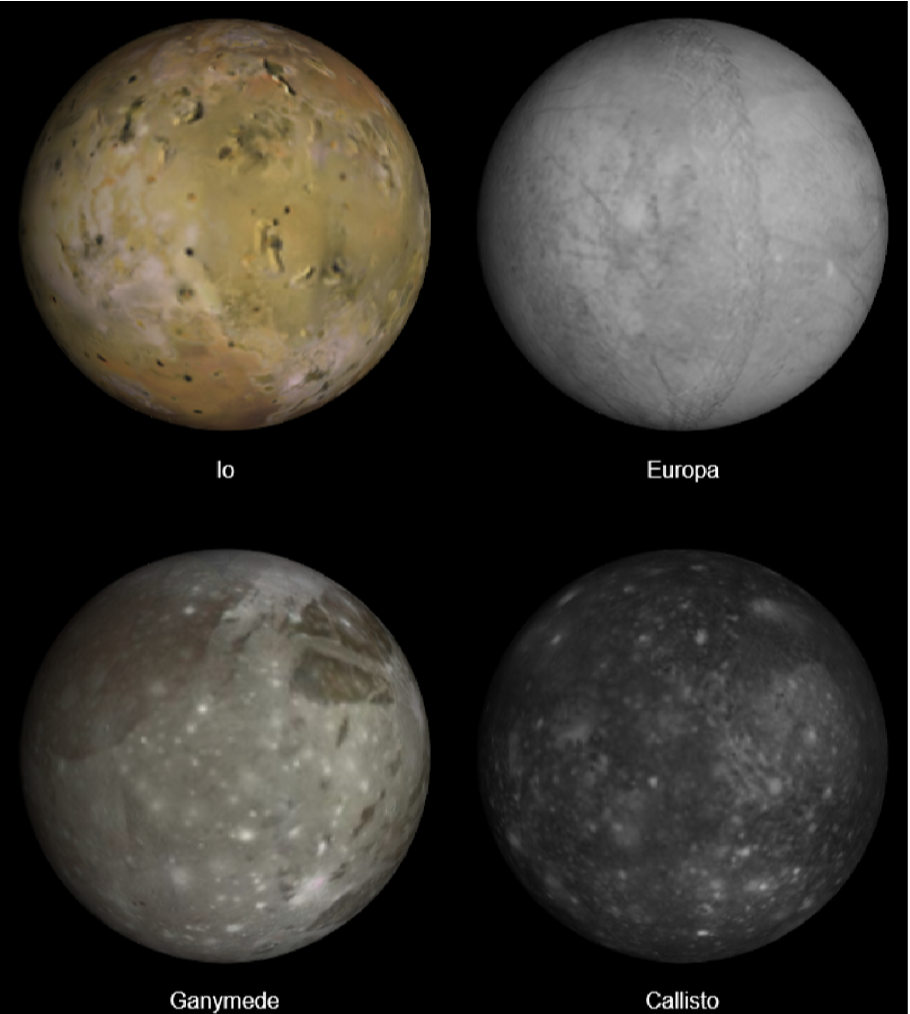
Video Code
Video Code
Mars Flyby
Mars Flyby
Plot the distance and velocity of the Europa Clipper space probe as it approaches Mars on its way to Jupiter.
In[]:=
marsflyby=FindAstroEvent[{"Distance",clipper,mars,"GlobalMinimum"},DateInterval@DateObject[{2025}],TimeZone->0]
Out[]=
In[]:=
init=marsflyby-Quantity[6.5,"Hours"];end=marsflyby+Quantity[6.5,"Hours"];
In[]:=
duration=end-init;
Out[]=
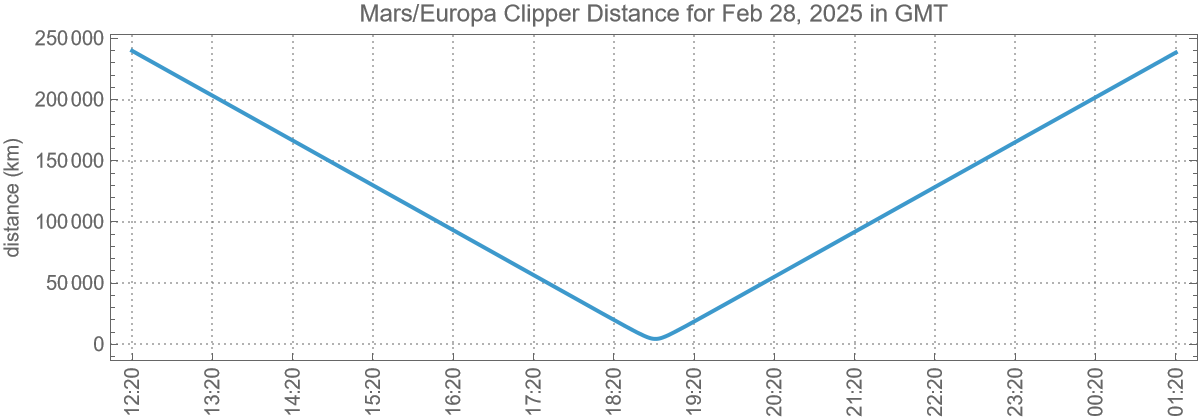
Out[]=
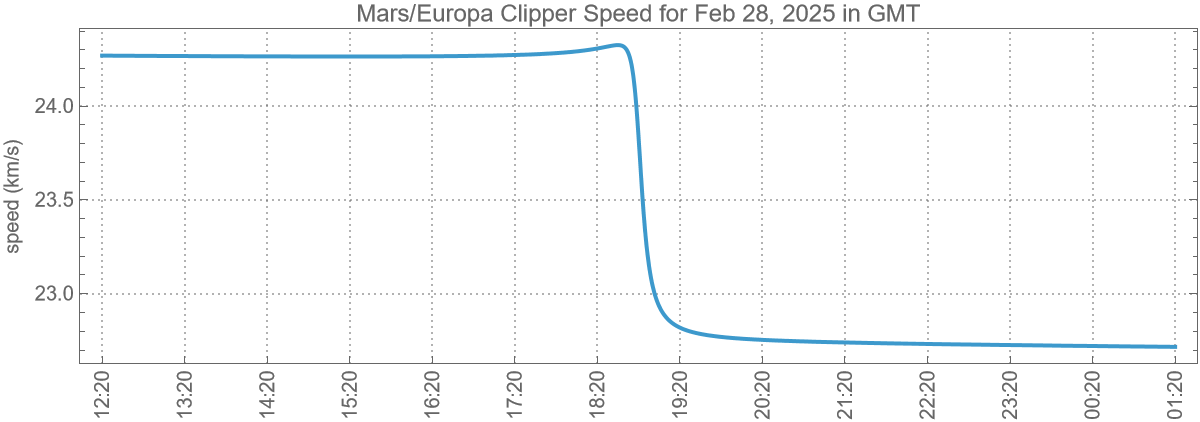
Earth Flyby
Earth Flyby
Plot the distance and velocity of the Europa Clipper space probe as it approaches Earth on its way to Jupiter.
In[]:=
earthflyby=FindAstroEvent[{"Distance",clipper,earth,"GlobalMinimum"},DateInterval@DateObject[{2026}],TimeZone->0]
Out[]=
In[]:=
init=earthflyby-Quantity[3,"Hours"];end=earthflyby+Quantity[3,"Hours"];
In[]:=
duration=end-init;
Out[]=
Jupiter Arrival
Jupiter Arrival
Plot the distance and velocity of the Europa Clipper space probe as it approaches Jupiter.
Jupiter Orbits
Jupiter Orbits
Create a simulation showing the entire trajectory of the Europa Clipper space probe from launch to arrival at Jupiter using a “fish-eye” effect as it approaches Jupiter to exaggerate the elliptical loops the probe makes during its initial orbits of Jupiter.
Solar System Collage
Solar System Collage
Create a collage of a miscellaneous solar system objects obtained from JPL imagery.
Jupiter Moon Orbits
Jupiter Moon Orbits
Create a rotating movie showing the orbits of all of Jupiter’s moons.
Animated Galileo Jupiter Illustration
Animated Galileo Jupiter Illustration
Create an animated video, in the style of Galileo’s original sketches, showing the Galilean satellites moving around Jupiter as seen through his telescope.
CITE THIS NOTEBOOK
CITE THIS NOTEBOOK
Unveiling the Europa Clipper's Unusual Route to Jupiter's Moon: documentary tech notes
by Jeffrey Bryant
Wolfram Community, STAFF PICKS, February 21, 2025
https://community.wolfram.com/groups/-/m/t/3398690
by Jeffrey Bryant
Wolfram Community, STAFF PICKS, February 21, 2025
https://community.wolfram.com/groups/-/m/t/3398690