Osmolality is not a number you see printed on beverage nutrition labels. But it’s valuable information to know. That’s why we created the resource function.Why is osmolality important? Two reasons: hydration and gastrointestinal tolerance. Osmolality can help you decide if a drink is suitable for staying hydrated during exercise. It also can help predict if you may have problems digesting that drink.Before looking at osmolality and hydration, I decided to explore sports and exercise with .
PhysicalActivityCalculator
PhysicalActivityCalculator
First, I checked the range of activities available:
In[]:=
EntityClassList["PhysicalActivity"]
Out[]=
,,,,,,,,,,,,,,,,,,,,,

I looked at lots of random samples. This was fun. I noticed among the activities. I’m confident that relaxed would not apply if I tried windsurfing.
In[]:=
RandomSample[EntityValue[EntityList["PhysicalActivity"]],50]
Out[]=
,,,,,,,,,,,,,,,,,,,,,,,,,,,,,,,,,,,,,,,,,,,,,,,,,
Next, I compared 50 minutes of dancing to aerobics. includes the metabolic equivalents (METs) for each activity. METs are a standardized way to compare the energy cost across multiple physical activities. 1 MET represents your resting metabolic rate, which is the energy you expend while sitting quietly.Aerobics was the winner in energy expenditure, METs, fat burned and oxygen consumed, but I’m sure that dancing would win if there were a category for fun.
In[]:=
Out[]=
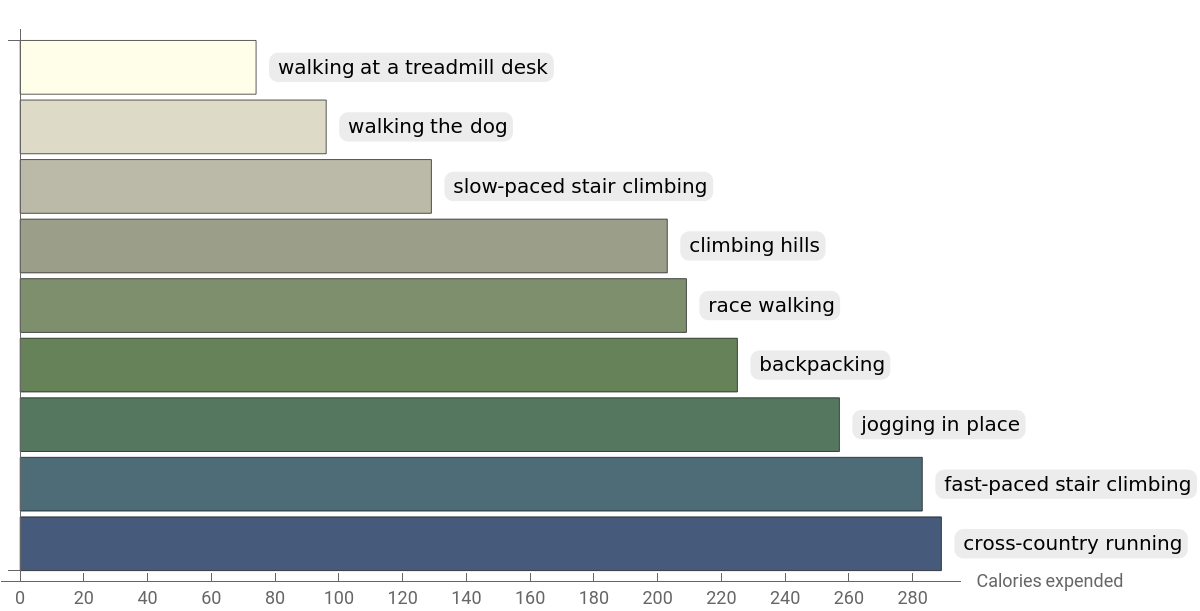
Finally, I compared different cardio activities for 30 minutes each, specifying my body weight to ensure that the results are accurate for me:
In[]:=
cardioData=[{{"walking the dog","30 min"},{"jogging in place","30 min"},{"hiking","30 min"},{"climbing hills","30 min"},{"race walking","30 min"},{"cross country running","30 min"},{"fast-paced stair climbing","30 min"},{"slow-paced stair climbing","30 min"},{"walking at a treadmill desk","30 min"}},"Association","BodyWeight"->Quantity[135,"Pounds"]];activityLabels=cardioData[[All,"interpreted activity"]];energyExpenditure=N@QuantityMagnitude[cardioData[[All,"energy expenditure"]]];sortedCardioData=Reverse@SortBy[Transpose[{energyExpenditure,activityLabels}],First];roundedEnergyExpenditure=Round[sortedCardioData[[All,1]]];sortedActivityLabels=sortedCardioData[[All,2]];ticks=Range[0,Max[roundedEnergyExpenditure],20];BarChartroundedEnergyExpenditure,
Out[]=
BeverageOsmolality
BeverageOsmolality
After analyzing energy expenditure during exercise, it was time to see which beverages are most appropriate:
In[]:=
Out[]=
|
Tonicity determines how quickly you can absorb a beverage into your bloodstream. Fluids are classified as isotonic, hypertonic or hypotonic. Isotonic fluids have particle concentrations that are roughly equivalent to bodily fluids. The average osmolality of human bodily fluids, such as blood plasma, is 275-295 milliosmoles of solute per kilogram of solvent (mOsm/kg). The United States does not regulate the term isotonic, but the European Food Safety Authority states that beverages must have an osmolality between 270 and 330 mOsm/kg to be designated as isotonic. Beverages with osmolality greater than 330 are hypertonic and below 270 are hypotonic.
Isotonic and hypotonic drinks promote water absorption to keep you hydrated, especially during sports and exercise. In contrast, rapid intake of hypertonic drinks can cause digestion problems for some people. To digest hypertonic drinks, your body has to move water out of your bloodstream and back into your intestine, to dilute the solutes to a level that allows absorption of nutrients and fluids back across the intestinal wall. If you consume hypertonic drinks too quickly, you can end up with nausea, cramping, bloating and, most important, dehydration.
Isotonic and hypotonic drinks promote water absorption to keep you hydrated, especially during sports and exercise. In contrast, rapid intake of hypertonic drinks can cause digestion problems for some people. To digest hypertonic drinks, your body has to move water out of your bloodstream and back into your intestine, to dilute the solutes to a level that allows absorption of nutrients and fluids back across the intestinal wall. If you consume hypertonic drinks too quickly, you can end up with nausea, cramping, bloating and, most important, dehydration.
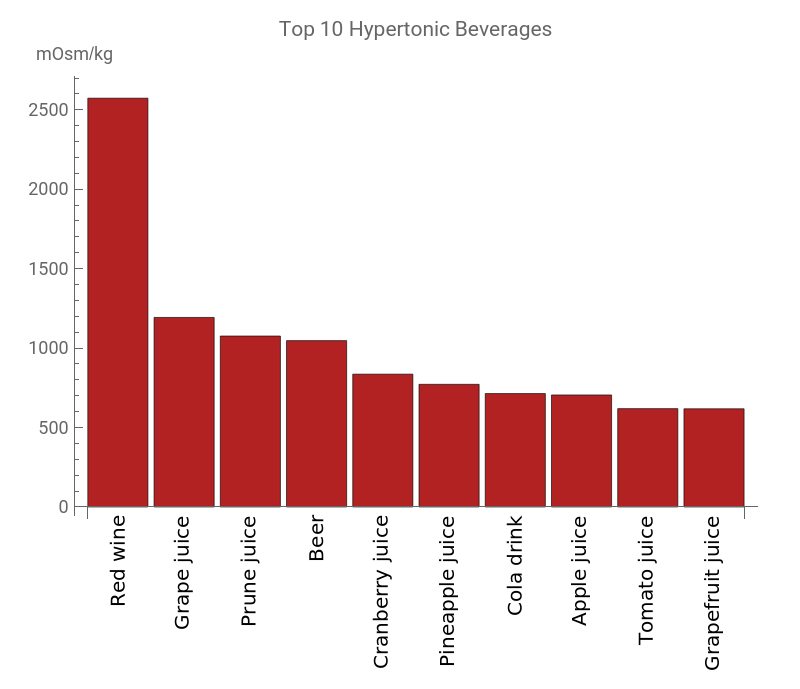
With that in mind, I wanted to see the calories and sugar in the top 10 hypertonic drinks in the dataset:
In[]:=
osmolalityRulesAssoc=Association["OsmolalityRules"];top10Osmol=TakeLargest[osmolalityRulesAssoc,10];osmolChart=BarChartSequencetop10Osmol,;entities=Lookup[ResourceFunction["BeverageOsmolality"]["EntityRules"],Keys@top10Osmol];calories=EntityValue[#,"RelativeTotalCaloriesContent"]&/@entities;caloriesChart=BarChartSequencecalories,;sugar=QuantityMagnitude[EntityValue[#,"RelativeTotalSugarContent"]&/@entities];sugarChart=BarChartSequencesugar,;GraphicsRow[{osmolChart},ImageSize->400]GraphicsRow[{caloriesChart,sugarChart},ImageSize->600]
Out[]=
Out[]=
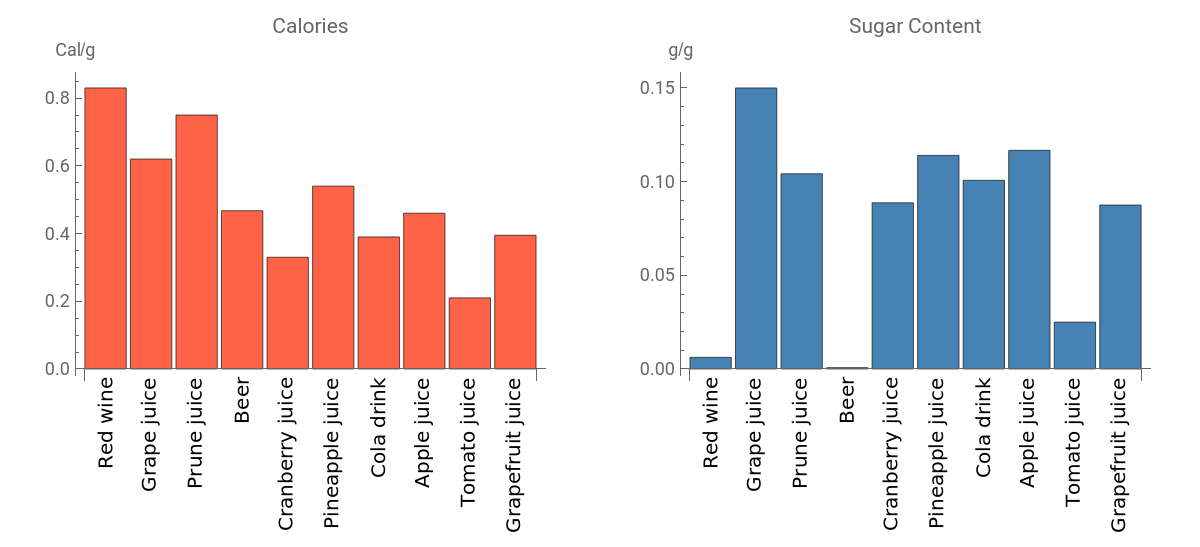
As expected, calories are closely associated with sugar content, except for red wine and beer. At 7 kcal/g, alcohol provides the bulk of their calories. Hypertonic drinks are useful when you want to consume calories quickly, and you’re not at risk of dehydration. Avoid hypertonic drinks during long-duration exercise when you’re sweating. Hydration is your priority in those situations.
Conversely, the water in hypotonic drinks flows naturally across the intestinal wall into blood via osmosis, meaning they are absorbed into the bloodstream the fastest. Because hypotonic drinks have lower amounts of carbohydrates, they don’t give you a rapid infusion of energy. But they do deliver fluids rapidly for hydration during high-intensity workouts. The same is true for isotonic drinks, although they may take slightly longer to be digested.
I compared the water content and osmolality values for multiple beverages. These dual plots display the generally negative relationship between the water content and osmolality of beverages:
Relaxed Windsurfing Revisited
Relaxed Windsurfing Revisited
Have a great summer, and stay hydrated!
CITE THIS NOTEBOOK
CITE THIS NOTEBOOK
Role of osmolality in sports, exercise and hydration
by Gay Wilson
Wolfram Community, STAFF PICKS, July 16, 2024
https://community.wolfram.com/groups/-/m/t/3222838
by Gay Wilson
Wolfram Community, STAFF PICKS, July 16, 2024
https://community.wolfram.com/groups/-/m/t/3222838