Tom Sirgedas triangle dissection
Tom Sirgedas triangle dissection
In 1990, Laczkovich proved that the 45-60-75 triangle was the only acute triangle that could tile a square. He gave an example with thousands of triangles. Ten years ago, I asked what was the fewest number of triangles, and gradually the square was divided into 46 similar acute triangle.
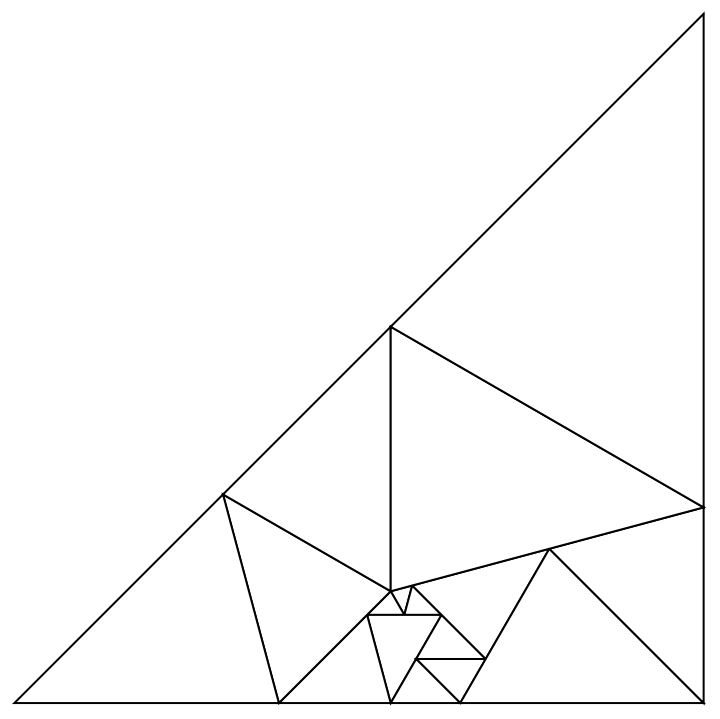
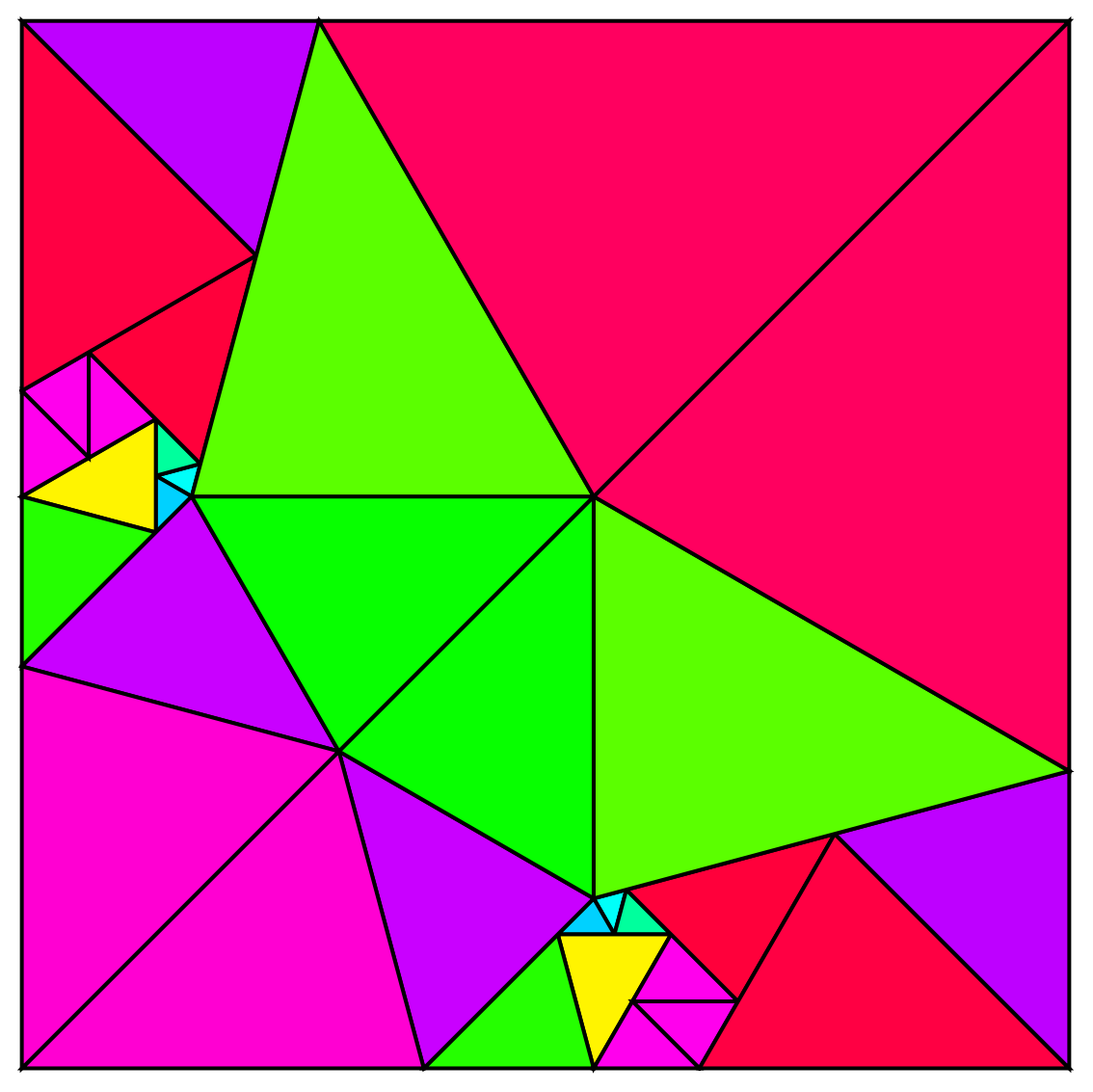
Today, Tom Sirgedas found a 32 triangle solution.
Today, Tom Sirgedas found a 32 triangle solution.

Some code for it.
In[]:=
Graphics[GraphicsComplex[With[{a=Sqrt[3]},{{328-12a,66+2a},{390-54a,192-60a},{370-98/3a,88+8/3a},{264+8a,66+2a},{392-32a,66+2a},{390-54a,0},{198+6a,0},{391-43a,33+a},{424-42a,0},{425-31a,33+a},{855-7a,231+7a}/2,{102+36a,102+36a},{0,0},{543,0},{543,336-105a},{390-54a,390-54a},{543,543}}],{EdgeForm[Black],White,Polygon/@{{2,3,1},{2,1,4},{1,3,5},{4,5,6},{6,4,7},{9,10,8},{8,6,9},{5,8,10},{10,3,11},{2,7,12},{7,12,13},{11,9,14},{15,11,14},{12,2,16},{2,16,15},{16,15,17}}}]]
Out[]=
In[]:=
vv=With[{a=Sqrt[3]},{{328-12a,66+2a},{390-54a,192-60a},{370-98/3a,88+8/3a},{264+8a,66+2a},{392-32a,66+2a},{390-54a,0},{198+6a,0},{391-43a,33+a},{424-42a,0},{425-31a,33+a},{855-7a,231+7a}/2,{102+36a,102+36a},{0,0},{543,0},{543,336-105a},{390-54a,390-54a},{543,543}}];ff={{2,3,1},{2,1,4},{1,3,5},{4,5,6},{6,4,7},{9,10,8},{8,6,9},{5,8,10},{10,3,11},{2,7,12},{7,12,13},{11,9,14},{15,11,14},{12,2,16},{2,16,15},{16,15,17}};Graphics[GraphicsComplex[vv,{EdgeForm[Black],White,Polygon/@ff}]]
Out[]=
All angles are , , or 45°-60°-75°. We can check that all of these are the same triangle in terms of angles.
π
4
π
3
5π
12
In[]:=
vv=With[{a=Sqrt[3]},{{328-12a,66+2a},{390-54a,192-60a},{370-98/3a,88+8/3a},{264+8a,66+2a},{392-32a,66+2a},{390-54a,0},{198+6a,0},{391-43a,33+a},{424-42a,0},{425-31a,33+a},{855-7a,231+7a}/2,{102+36a,102+36a},{0,0},{543,0},{543,336-105a},{390-54a,390-54a},{543,543}}];ff={{2,3,1},{2,1,4},{1,3,5},{4,5,6},{6,4,7},{9,10,8},{8,6,9},{5,8,10},{10,3,11},{2,7,12},{7,12,13},{11,9,14},{15,11,14},{12,2,16},{2,16,15},{16,15,17}};Union[RootReduce[ResourceFunction["TriangleEdgeAngles"][EuclideanDistance@@#&/@Subsets[vv[[#]],{2}]]]&/@ff]
Out[]=
,,ArcCos
π
4
π
3

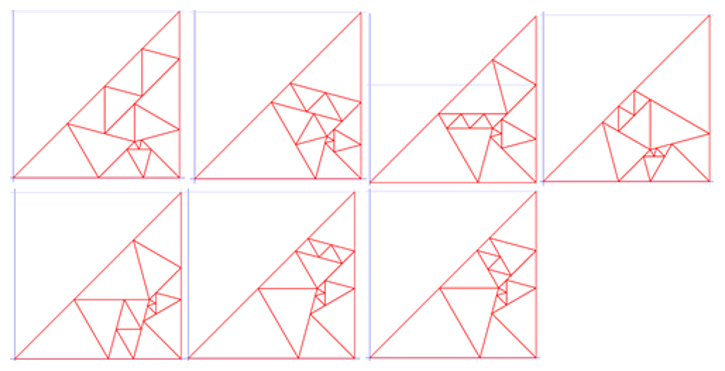
Known solutions for 17 triangles.
Square in 32 triangles.
In[]:=
vv1=With[{a=Sqrt[3]},{{328-12a,66+2a},{390-54a,192-60a},{370-98/3a,88+8/3a},{264+8a,66+2a},{392-32a,66+2a},{390-54a,0},{198+6a,0},{391-43a,33+a},{424-42a,0},{425-31a,33+a},{855-7a,231+7a}/2,{102+36a,102+36a},{0,0},{543,0},{543,336-105a},{390-54a,390-54a},{543,543}}];mirror={{0,0},{1,1}};vv=Join[vv1,ResourceFunction["ReflectPoints"][mirror,vv1]];ff1={{2,3,1},{2,1,4},{1,3,5},{4,5,6},{6,4,7},{9,10,8},{8,6,9},{5,8,10},{10,3,11},{2,7,12},{7,12,13},{11,9,14},{15,11,14},{12,2,16},{2,16,15},{16,15,17}};ff=Join[ff1,ff1+17];Graphics[{EdgeForm[{Black,Thick}],{Hue[Mod[Sqrt[Area[Polygon[vv[[#]]]]],1]],Polygon[vv[[#]]]}&/@ff}]
Out[]=
Is it possible with even fewer triangles?