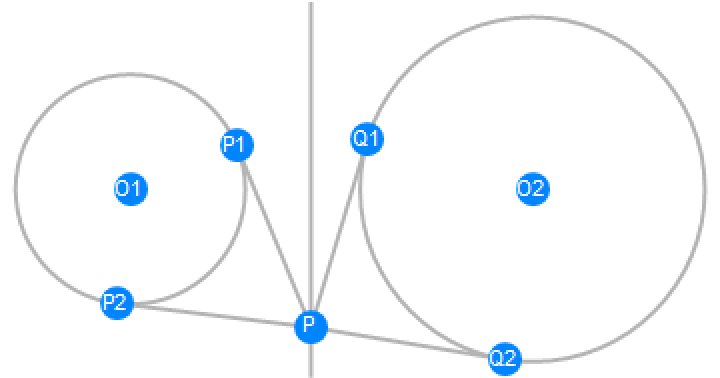
I would like to share an interesting way to generate radical axis for two circles given in the title by GeometricScene
In[]:=
Out[]=
Usually the procedural (compass and ruler version) to find the radical axis for two fixed detached circle O1 and O2 are the following: introduce a new circle O3 and find two sets of intersections, {P1,P2} and {Q1,Q2}.
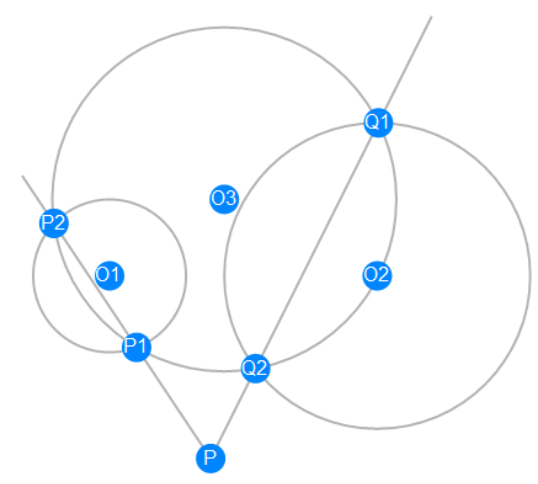
The two secant lines meet at . Do this again with smaller circle centered at O3 and find a new . By joining and ′ we have found the radical axis.
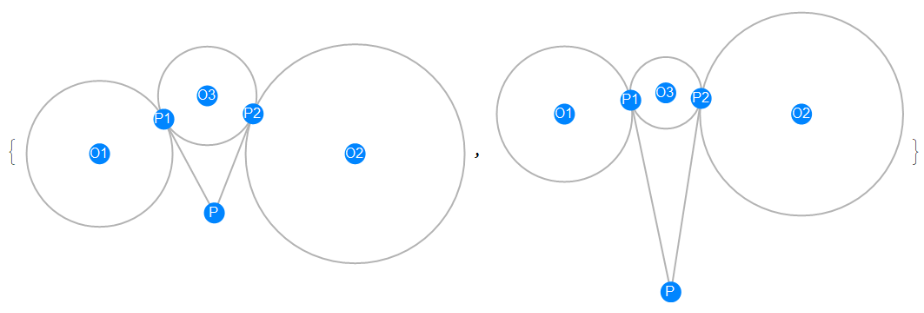
We can take advantage of RandomIntance to use tangent length as result of circle power of point:
P
P'
P
P
We can take advantage of RandomIntance to use tangent length as result of circle power of point:
In[]:=
gs=GeometricScene[{{"P1","P2","P","O1"->{0,0},"O2"->{7,0},"O3"},{r}},{cir1=Circle["O1",2],cir2=Circle["O2",3],GeometricAssertion[{cir1,Circle["O3",r]},{"Tangent","P1"}],GeometricAssertion[{Line[{"P","P1"}],Circle["O3",r]},{"Tangent","P1"}],GeometricAssertion[{cir2,Circle["O3",r]},{"Tangent","P2"}],GeometricAssertion[{Line[{"P","P2"}],Circle["O3",r]},{"Tangent","P2"}]}];instance=RandomInstance[gs,2,RandomSeeding->1001]
In[]:=
radicalLinePts="P"/.Through[instance["Points"]]
Out[]=
{{3.14286,-0.358263},{3.14286,-3.76018}}
We can visualize the tangent rays shooting from any point on the radical axis:
Out[]=