Matrix quantum mechanics
by Paul Abbott
School of Physics, Mathematics and Computing
The University of Western Australia
paul.c.abbott@uwa.edu.au
by Paul Abbott
School of Physics, Mathematics and Computing
The University of Western Australia
paul.c.abbott@uwa.edu.au
A fundamental problem in quantum mechanics is the calculation of the discrete spectrum of the Schrödinger operator. This question introduces a straightforward matrix method for computing the eigenvalues of operators. By expanding both the states of the system and the operators in a suitable basis set , , the problem is transformed into a matrix equation.
ν〉
ν=0,1,…
With a discrete matrix representation of the position, =μν, and momentum operators, =μν, in a convenient representation , , one can use the (completeness of the) matrix representation to compute matrix elements of other operators, such as the potential , the kinetic energy , or a general operator .
x
μ,ν
x
p
μ,ν
p
ν〉
μ,ν=0,1,2,…
μ()ν
V
x
μν
T
p
μ,ν
x
p
Harmonic oscillator eigenstates
Harmonic oscillator eigenstates
In terms of normalized eigenstates of the harmonic oscillator Hamiltonian,
H
0
2
p
2m
1
2
2
ω
0
2
x
(
1
)the (infinite) matrix representation of the position operator, , is
x
x=
,
x
0
2
0 | 1 | 0 | 0 | ⋯ |
1 | 0 | 2 | 0 | ⋯ |
0 | 2 | 0 | 3 | ⋯ |
0 | 0 | 3 | 0 | ⋯ |
⋮ | ⋮ | ⋮ | ⋮ | ⋱ |
(
2
)where ≡=μν, and the matrix representation of the momentum operator, , is
{x}
μ,ν
x
μ,ν
x
p
p=
,
p
0
2
0 | - 1 | 0 | 0 | ⋯ |
1 | 0 | - 2 | 0 | ⋯ |
0 | 2 | 0 | - 3 | ⋯ |
0 | 0 | 3 | 0 | ⋯ |
⋮ | ⋮ | ⋮ | ⋮ | ⋱ |
(
3
)where ≡=μν and = and =.
{p}
μ,ν
p
μ,ν
p
x
0
1/2
(ℏ/(m))
ω
0
p
0
1/2
(ℏm)
ω
0
Exercise 1
The harmonic oscillator eigenfunctions in coordinate space are
ψ
ν_
-1/2
ν!
π
aν
2
-2
2
x
2
a
H
ν
x
a
Verify that the are orthonormal by computing for . [3 Marks]
ψ
ν
〈μ|ν〉:=(x)(x)x
∞
∫
-∞
*
ψ
μ
ψ
ν
μ,ν=0,1,…,4
a>0
Solution
The are orthonormal:
ψ
ν
〈μ_ν_〉:=〈μν〉=Assuminga>0,(x)(x)x
∞
∫
-∞
*
ψ
μ
ψ
ν
Table[〈μν〉,{μ,0,4},{ν,0,4}]
1 | 0 | 0 | 0 | 0 |
0 | 1 | 0 | 0 | 0 |
0 | 0 | 1 | 0 | 0 |
0 | 0 | 0 | 1 | 0 |
0 | 0 | 0 | 0 | 1 |
Exercise 2
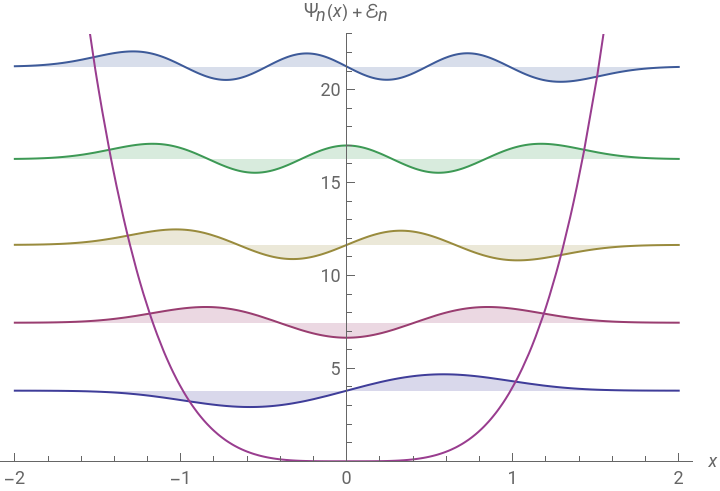
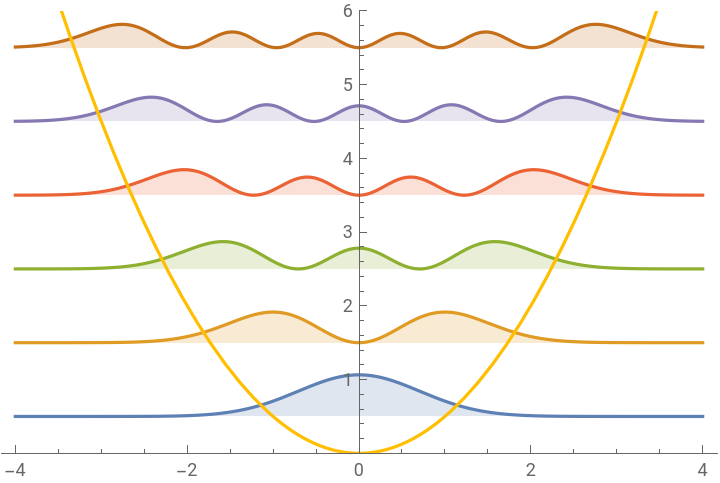
Visualize (x)+ for the energy eigenvalues =ν+1/2 for , together with the potential, , on one plot for . [3 Marks]
2
ψ
ν
ℰ
ν
ℰ
ν
ν=0,1,…,6
1
2
2
x
a=1
Solution
Exercise 3
Exercise 4
Exercise 5
Exercise 6
Raising and lowering operators
Raising and lowering operators
In the following we will use units in which . The harmonic oscillator Hamiltonian becomes
m=ℏ==1
ω
0
H
0
1
2
2
p
1
2
2
x
(
4
)Introducing matrix representations of the raising operator ,
†
†
a
0 | 0 | 0 | 0 | ⋯ |
1 | 0 | 0 | 0 | ⋯ |
0 | 2 | 0 | 0 | ⋯ |
0 | 0 | 3 | 0 | ⋯ |
⋮ | ⋮ | ⋮ | ⋱ | ⋱ |
(
5
) and lowering operator ,
a
a=
,
0 | 1 | 0 | 0 | ⋯ |
0 | 0 | 2 | 0 | ⋯ |
0 | 0 | 0 | 3 | ⋯ |
0 | 0 | 0 | 0 | ⋱ |
⋮ | ⋮ | ⋮ | ⋮ | ⋱ |
(
6
)the matrix representation of the position operator, , is
x
x=(+a),
1
2
†
a
(
7
)and the matrix representation of the momentum operator, , is
p
p=(-a).
2
†
a
(
8
)Exercise 7
Define matrix representations of the raising and lowering operators. Verify that .a — the so-called number operator — is a diagonal matrix with eigenvalues , for . [4 Marks]
k×k
†
a
0,1,2,…,k-1
k=10
Solution
a/::=SparseArray{i_,j_}/;ji+1
a
k_
j-1
,{k,k}a
10
0 | 1 | 0 | 0 | 0 | 0 | 0 | 0 | 0 | 0 |
0 | 0 | 2 | 0 | 0 | 0 | 0 | 0 | 0 | 0 |
0 | 0 | 0 | 3 | 0 | 0 | 0 | 0 | 0 | 0 |
0 | 0 | 0 | 0 | 2 | 0 | 0 | 0 | 0 | 0 |
0 | 0 | 0 | 0 | 0 | 5 | 0 | 0 | 0 | 0 |
0 | 0 | 0 | 0 | 0 | 0 | 6 | 0 | 0 | 0 |
0 | 0 | 0 | 0 | 0 | 0 | 0 | 7 | 0 | 0 |
0 | 0 | 0 | 0 | 0 | 0 | 0 | 0 | 2 2 | 0 |
0 | 0 | 0 | 0 | 0 | 0 | 0 | 0 | 0 | 3 |
0 | 0 | 0 | 0 | 0 | 0 | 0 | 0 | 0 | 0 |
†
()
a
10
a
10
0 | 0 | 0 | 0 | 0 | 0 | 0 | 0 | 0 | 0 |
0 | 1 | 0 | 0 | 0 | 0 | 0 | 0 | 0 | 0 |
0 | 0 | 2 | 0 | 0 | 0 | 0 | 0 | 0 | 0 |
0 | 0 | 0 | 3 | 0 | 0 | 0 | 0 | 0 | 0 |
0 | 0 | 0 | 0 | 4 | 0 | 0 | 0 | 0 | 0 |
0 | 0 | 0 | 0 | 0 | 5 | 0 | 0 | 0 | 0 |
0 | 0 | 0 | 0 | 0 | 0 | 6 | 0 | 0 | 0 |
0 | 0 | 0 | 0 | 0 | 0 | 0 | 7 | 0 | 0 |
0 | 0 | 0 | 0 | 0 | 0 | 0 | 0 | 8 | 0 |
0 | 0 | 0 | 0 | 0 | 0 | 0 | 0 | 0 | 9 |
Eigenvalues[%]//Sort
{0,1,2,3,4,5,6,7,8,9}
Energies of the harmonic and quartic oscillator
Energies of the harmonic and quartic oscillator
Exercise 8
Use equations ( matrix representations of the position operator, , momentum operator, , and the harmonic oscillator Hamiltonian, =+. Determine the eigenvalues (energies) of the Hamiltonian matrix for and comment. (Hint: if the matrix representation of the position operator is denoted then ↔. and similarly for . What do you expect for the harmonic oscillator energies?) [4 Marks]
8
) and (8
) to define k×k
x
p
H
0
1
2
2
p
1
2
2
x
k=10
k×k
x
k
2
x
x
k
x
k
p
Solution
Eigenfunctions
Eigenfunctions
and momentum space wavefunction,
Exercise 10
Solution
Compare these to the corresponding coordinate space wavefunctions:
Note that the wavefunctions have an inflection point where they intersect the potential curve.