Error correction, at its heart, is a geometric idea: spread information across space so that local disturbances cannot destroy it. This essay traces how this principle evolves from classical repetition codes, through quantum stabilizer codes, to topological codes where protection emerges from the global structure of the lattice itself. Along the way, we see a single insight deepen: geometry protects information.
1. Classical Distance
1. Classical Distance
The simplest example of error correction is the repetition code, where a logical 0 is encoded as 000 and a logical 1 as 111. If a single bit flips during transmission, the original value can be recovered by majority voting. This scheme already illustrates a central idea of coding theory: redundancy allows errors to be identified and corrected. More generally, the effectiveness of an error-correcting code is determined not by the encoding rule alone, but by how distinct the valid codewords are from one another. This distinction is captured quantitatively by the notion of distance between codewords.
To make this idea concrete, it helps to look at the code geometrically. Every 3-bit string can be viewed as a vertex of a cube in {0,1}³. The valid codewords 000 and 111 sit at opposite corners of this cube, as far apart as possible. The number of positions in which they differ, called the Hamming distance, is 3. This separation is what gives the code its error-correcting power, and it is easy to see visually.
To make this idea concrete, it helps to look at the code geometrically. Every 3-bit string can be viewed as a vertex of a cube in {0,1}³. The valid codewords 000 and 111 sit at opposite corners of this cube, as far apart as possible. The number of positions in which they differ, called the Hamming distance, is 3. This separation is what gives the code its error-correcting power, and it is easy to see visually.
Visualizing the 3-bit Hamming cube with valid codewords placed at maximum distance:
Out[]=

In this representation, all possible received strings appear as vertices of the cube. The two red vertices correspond to the valid codewords, while the remaining vertices represent corrupted states. Each non-codeword vertex is colored according to the nearest codeword: vertices closer to 000 are shown in blue, and vertices closer to 111 are shown in purple. This visual encoding emphasizes how the large separation between the codewords ensures that small errors do not move a received word closer to the wrong logical value.
Illustrating single-bit error correction as nearest-codeword decoding in Hamming space:
Out[]=
A single bit flip moves the transmitted word to a neighboring vertex of the cube. Crucially, that vertex remains closer to the original codeword than to any other valid codeword. Decoding therefore reduces to a geometric problem: identify the nearest codeword in Hamming distance. For a code with distance 𝑑 =3 this guarantees detection of up to two errors and correction of one error.
2. Quantum Duality
2. Quantum Duality
Classical error correction is built on a simple idea: redundancy. Information is copied and stored in multiple places, so that if one copy fails, it can be recovered from the rest.
Quantum mechanics, however, forbids this approach. The no-cloning theorem states that no physical process can duplicate an unknown quantum state. At first glance, this limitation seems fatal. How can information be protected if it cannot be copied?
The solution is both subtle and elegant. Instead of copying a quantum state, we spread it across many qubits through entanglement. The information resides not in any individual qubit, but in the correlations among them. These correlations can be measured to detect errors, all without ever directly measuring the quantum information itself.
2.1 The Impossibility (and Resolution)
2.1 The Impossibility (and Resolution)
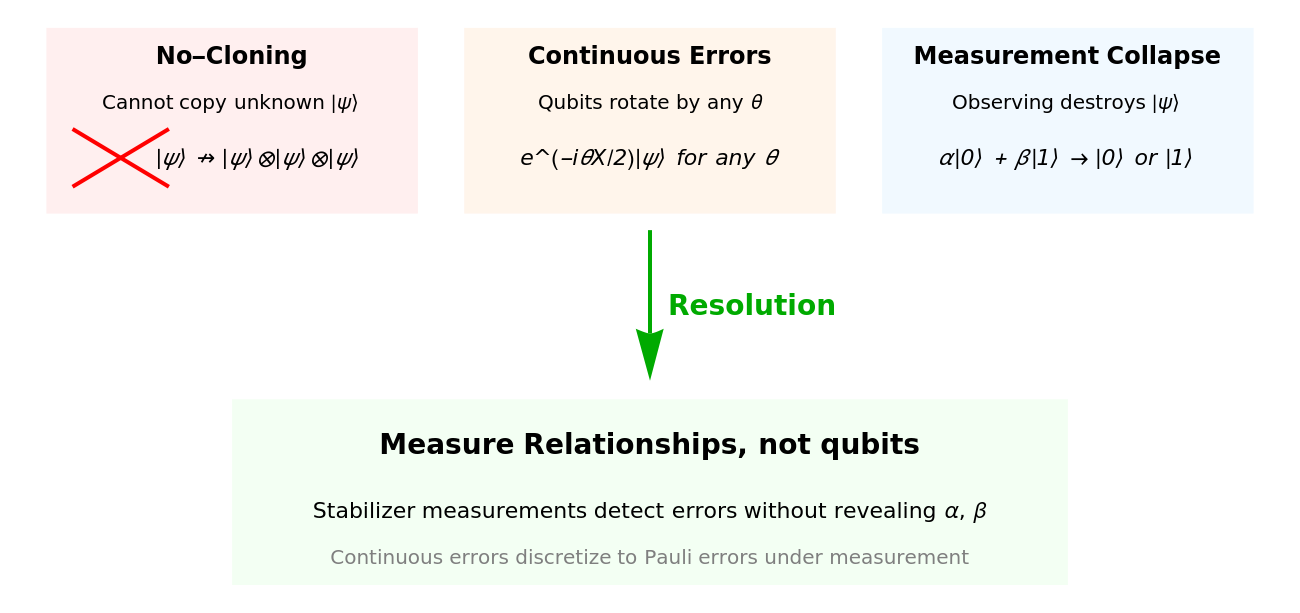
Quantum error correction faces three fundamental obstacles:
1. No-Cloning: We cannot copy an unknown state |ψ⟩ = α|0⟩ + β|1⟩
2. Continuous Errors: Unlike classical bits, qubits can rotate by any angle
3. Measurement Collapse: Observing a qubit destroys its superposition
Each obstacle seems insurmountable. Yet all three have the same resolution:
we measure relationships between qubits, not the qubits themselves.
Out[]=
2.1.1 Encoding Preserves the Logical Qubit
2.1.1 Encoding Preserves the Logical Qubit
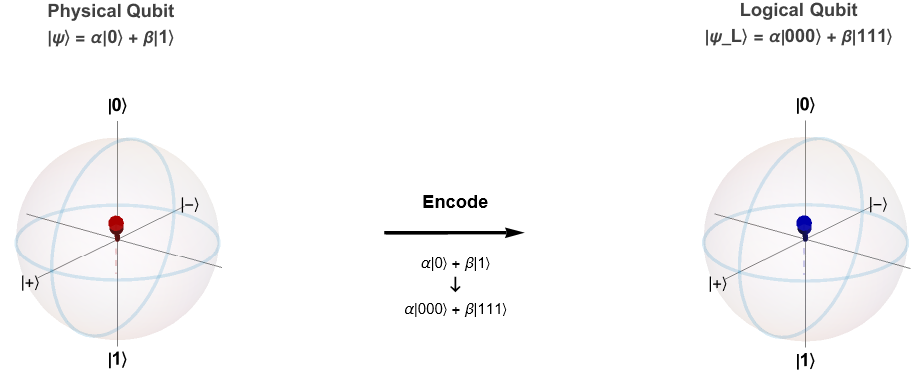
A single qubit can be visualized on the Bloch sphere using the following representation: The encoding process involves mapping this state to a three-qubit logical state: This transformation ensures that the coefficients and are preserved, embedding the logical Bloch sphere within the larger Hilbert space of three qubits.
ψcos|0+sin|1
θ
2
iϕ
e
θ
2
ψcos|000+sin|111
ψ
L
θ
2
iϕ
e
θ
2
αcos
θ
2
βsin
iϕ
e
θ
2
2.1.2 Encoding vs Cloning
2.1.2 Encoding vs Cloning
Cloning would produce: |ψ⟩⊗|ψ⟩⊗|ψ⟩ = (α|0⟩ + β|1⟩)³
This expands to 8 terms with coefficients like α³, α²β, αβ², etc.
This expands to 8 terms with coefficients like α³, α²β, αβ², etc.
Equation visualization:
In[]:=
cloningEqBox=FramedTraditionalFormRow"|ψ⟩ ⊗ |ψ⟩ ⊗ |ψ⟩ = ",Superscript[α,3]" |000⟩ + ",Superscript[α,2]β" |001⟩ + ",αSuperscript[β,2]" |010⟩ + ",Superscript[β,3]" |011⟩ + ",Superscript[α,2]β" |100⟩ + ",αSuperscript[β,2]" |101⟩ + ",αSuperscript[β,2]" |110⟩ + ",Superscript[β,3]" |111⟩",FrameStyle->Gray,Background->Lighter[Gray,0.9]
Out[]=
Encoding produces: α|000⟩ + β|111⟩
In[]:=
encodingEqBox=FramedTraditionalFormα" |000⟩ + "β" |111⟩",FrameStyle->Gray,Background->Lighter[Gray,0.9]
Out[]=
Only 2 terms! The original coefficients α and β appear unchanged.
The three qubits are entangled; none carries a copy of |ψ⟩.
The three qubits are entangled; none carries a copy of |ψ⟩.
Define partial trace functions:
In[]:=
partialTrace12[ρ_]:=Module[{dim=2},Sum[KroneckerProduct[IdentityMatrix[dim^2],ArrayFlatten[{{i,0},{0,0}}]].ρ.KroneckerProduct[IdentityMatrix[dim^2],ArrayFlatten[{{i,0},{0,0}}]],{i,{1,0,0,1}}(*basisstates*)]]
Create logical state:
In[]:=
θ=π/3;φ=π/4;α=Cos[θ/2];β=Exp[I*φ]*Sin[θ/2]; logicalState=α*ket000+β*ket111;
Compute density and purity
In[]:=
ρFull=Outer[Times,logicalState,Conjugate[logicalState]];ρ1=PartialTrace[ρFull,{2,3}];(*Wolfram'sfunction*)purityFull=Tr[ρFull.ρFull];purity1=Tr[ρ1.ρ1];
Visualization
To see that individual qubits carry no information, we can trace out two qubits and examine what remains. The result is a mixed state; all phase information is lost.
2.2 Stabilizers: Measuring Relationships
2.2 Stabilizers: Measuring Relationships
The central idea of stabilizer codes is measuring parity, i.e., relationships between qubits, rather than individual qubit values.
For the 3-qubit bit-flip code:
• Stabilizer S₁ = Z⊗Z⊗I measures “do qubits 1 and 2 agree?”
• Stabilizer S₂ = I⊗Z⊗Z measures “do qubits 2 and 3 agree?”
The logical states |000⟩ and |111⟩ both have all qubits agreeing, so both stabilizers return +1. The superposition α|000⟩ + β|111⟩ is an eigenstate with eigenvalue +1 for both stabilizers; measurement does not collapse it!
Define 3-qubit bit-flip code,visualize stabilizers,and verify logical states:
Define logical state function
Stabilizer measurement diagram
Verifying the logical states :
2.2.2 The Syndrome Table
2.2.2 The Syndrome Table
When an X error occurs, it flips a qubit: |0⟩ ↔ |1⟩. This changes parity relationships, producing a characteristic SYNDROME. The syndrome tells us where the error occurred, not what the logical state is!
Compute and visualize 3-qubit code syndromes for single-qubit X errors:
2.2.3 Syndrome Space Geometry
2.2.3 Syndrome Space Geometry
The syndrome lives in a 2-bit space: {+1,-1} × {+1,-1}. This is analogous to the classical Hamming cube, but now for quantum errors! Each syndrome uniquely identifies an error (or no error), allowing correction without ever knowing α and β.
2.3 The Dual Code: X and Z Errors
2.3 The Dual Code: X and Z Errors
2.3.1 Z Errors Go Undetected
2.3.1 Z Errors Go Undetected
Our bit-flip code uses Z⊗Z stabilizers. These COMMUTE with Z errors!
A Z error changes the logical state but leaves the syndrome unchanged.
A Z error changes the logical state but leaves the syndrome unchanged.
2.3.2 The Phase-Flip Code
2.3.2 The Phase-Flip Code
To detect Z errors, we encode in the Hadamard basis and use X-type stabilizers. This is the “dual” code—related to the bit-flip code by Hadamard transformation.
2.3.3 The Duality Principle
2.3.3 The Duality Principle
Visualize duality between bit - flip and phase - flip codes and error detection :
2.3.4 The Shor Code (Bridge to Topology)
2.3.4 The Shor Code (Bridge to Topology)
To protect against both X and Z errors, one can concatenate the two codes. Shor’s 9-qubit code implements this strategy: it first encodes against phase-flip errors, then applies a bit-flip encoding to each resulting block. However, using 9 physical qubits for a single logical qubit is resource-intensive.
Is there a more efficient approach to achieve protection against both error types?
Is there a more efficient approach to achieve protection against both error types?
Visualize Shor 9 - qubit code :
3. The Topological Leap
3. The Topological Leap
The Shor code achieves dual protection through concatenation, layering one code inside another. While effective, this approach can feel inelegant. It requires nine physical qubits to encode a single logical qubit, along with stabilizers that must be carefully engineered to detect both bit-flip and phase-flip errors.
The toric code, introduced by Alexei Kitaev in 1997, represents a conceptual breakthrough. Instead of explicitly engineering dual protection, it arises directly from the geometry of the code. The construction lives on a two-dimensional lattice with periodic boundaries, forming a torus. The two types of stabilizers appear naturally from the two basic geometric elements of the lattice, namely vertices and faces.
More remarkably, the logical information is not stored in any individual qubit, but in the topology of the lattice itself. Local errors create excitations that can be detected and corrected through local measurements. Only errors that extend around the entire torus, forming non-contractible loops, are capable of corrupting the logical information. In this sense, topology itself provides protection.
3.1 The Toric Code Structure
3.1 The Toric Code Structure
The toric code lives on a square lattice wrapped into a torus, meaning the boundaries are periodic in both directions. The placement of qubits and stabilizers follows a clear and elegant geometric logic:
• Qubits sit on the Edges of the lattice
• X-type stabilizers (stars) act at Vertices, on the four edges that meet there
• Z-type stabilizers (plaquettes) act on Faces, on the four edges that bound them
This geometric arrangement automatically produces both types of stabilizers.
• Qubits sit on the Edges of the lattice
• X-type stabilizers (stars) act at Vertices, on the four edges that meet there
• Z-type stabilizers (plaquettes) act on Faces, on the four edges that bound them
This geometric arrangement automatically produces both types of stabilizers.
At each vertex, the star operator Aₛ applies X to all four adjacent edges:
Aₛ = X ⊗ X ⊗ X ⊗ X (on the 4 edges meeting at vertex s)
This measures whether the product of X eigenvalues around the vertex is +1 or -1.
On each face, the plaquette operator Bₚ applies Z to all four bounding edges:
Bₚ = Z ⊗ Z ⊗ Z ⊗ Z (on the 4 edges around face p)
This measures whether the product of Z eigenvalues around the face is +1 or -1.
These operators define the stabilizer constraints of the surface code.
Star Operator Visualization :
Plaquette Operator Visualization:
Display side by side:
The elegance is striking: the lattice geometry automatically provides both X-type and Z-type stabilizers. Stars (X⨂X⨂X⨂X) detect Z errors; plaquettes (Z⨂Z⨂Z⨂Z) detect X errors.
The duality we had to engineer in the Shor code emerges naturally from the geometry.
The duality we had to engineer in the Shor code emerges naturally from the geometry.
3.2 Counting Logical Qubits
3.2 Counting Logical Qubits
How many logical qubits does the toric code encode? This is where topology
enters explicitly.
For an L×L torus:
• Number of edges (physical qubits): 2L²
• Number of vertices (star stabilizers): L²
• Number of faces (plaquette stabilizers): L²
But not all stabilizers are independent! The product of ALL stars equals I
(each edge is touched twice), and similarly for plaquettes. So we have:
Independent stabilizers = (L² - 1) + (L² - 1) = 2L² - 2
Logical qubits = Physical qubits - Independent stabilizers = 2L² - (2L² - 2) = 2
The toric code always encodes exactly 2 logical qubits, regardless of size!
These correspond to the two non-contractible loops on a torus.
The two logical qubits correspond to the two topologically distinct non-contractible loops on a torus: one going “around the hole” and one going “through the hole.”.
The logical operators are strings of X or Z operators that wrap around these non-contractible loops. They commute with all stabilizers (so they preserve the code space) but anticommute with each other (so they act non-trivially on the logical information).
3.3 Error Correction: Anyon Pairs
3.3 Error Correction: Anyon Pairs
When an error occurs, it violates nearby stabilizers, creating excitations called “anyons.” The key insight is that errors always create anyons in pairs.
• An X error on an edge violates the two adjacent plaquettes, producing a pair of “m” anyons
• A Z error on an edge violates the two adjacent vertices, producing a pair of “e” anyons
A single error is therefore always detectable, because it leaves behind an anyon pair. An error becomes invisible only when anyons are brought together and annihilated, which requires a string of errors rather than a single local fault.
The syndrome is simply the positions of all anyons. Since anyons always come in pairs, the syndrome has even parity, and a single anyon is impossible. This even-parity constraint is the topological signature of an error.
3.4 Topological Protection
3.4 Topological Protection
Now we reach the heart of topological protection. Consider what happens as errors accumulate:
1. A single error creates an anyon pair → Detectable
2. A string of errors moves one anyon away from its partner → still Detectable (anyons mark the endpoints of the error string)
3. A string that forms a Closed Loop → anyons annihilate, syndrome returns to normal, but logical state may or may not be affected
The crucial distinction:
• A Contractible loop (can be shrunk to a point) = product of stabilizers = no logical effect
• A Non-Contractible loop (wraps around the torus) = logical operator = Logical Error
Local noise creates short error strings. For these to form a non-contractible loop, errors must span the entire system. The probability of this decreases exponentially with system size—topology protects!
Visualization of Contractible and Non-Contractible loops:
This is the essence of topological protection. Local errors cannot form non-contractible loops. The code distance, defined as the minimum number of errors needed to cause a logical error, equals L, the linear size of the lattice.
As the lattice becomes larger, the probability of a logical error decreases exponentially, assuming the physical error rate is below a threshold. The protection does not come from clever encoding, but from the topology of space itself.
As the lattice becomes larger, the probability of a logical error decreases exponentially, assuming the physical error rate is below a threshold. The protection does not come from clever encoding, but from the topology of space itself.
3.5 The Decoding Problem
3.5 The Decoding Problem
Given a syndrome, that is, the locations of anyons, how can we infer which errors have occurred? This is known as the decoding problem.
While the syndrome identifies the positions of excitations, it does not uniquely specify the underlying error pattern. Multiple distinct error configurations can produce the same syndrome, so the decoder must determine the most probable explanation.
The key insight is that it is not necessary to identify the exact errors. What matters is that the applied correction does not introduce a non-contractible loop, which would constitute a logical error. In this context, minimum-weight perfect matching, which pairs anyons along paths of minimal total length, provides an effective and often optimal decoding strategy.
A single error generates excitations but typically does not result in a logical error. Only a sequence of errors forming a path that spans the torus can compromise the encoded information.
Visualization of Anyon Decoding Problem:
Visualize an example of Anyon on a small lattice :
Example of a Logical Error :
Several algorithms have been developed to solve the matching problem efficiently. They differ in computational complexity, accuracy, and suitability for real-time correction. The following table summarizes the main approaches:
The choice of decoder affects practical performance, but the fundamental insight remains the same across all approaches: decoding is a geometric problem. The syndrome provides anyon positions, and the decoder finds paths that pair them. No decoder needs access to the encoded quantum state. The correction is determined entirely by classical computation on the syndrome data.
This reduction of a quantum problem to a classical geometric one is not incidental. It reflects the structure of topological codes themselves, where quantum information is protected by global properties of the lattice rather than local encoding schemes.
Summary
Summary
The toric code represents a significant shift in how we approach error correction:
1. Geometry provides duality: X-type stabilizers are located at vertices, and Z-type stabilizers at faces; both arise naturally from the lattice structure.
2. Topology determines logical qubits: The two non-contractible loops on a torus define exactly two logical qubits, independent of lattice size.
3. Anyons detect errors: Errors create pairs of anyons, and the syndrome consists solely of their positions.
4. Non-locality protects information: Logical errors require non-contractible loops, meaning that errors must span the entire system. Local noise alone cannot corrupt the logical information, as the topology provides inherent protection.
In the toric code, error correction shifts from an algebraic problem—finding the correct stabilizers—to a geometric one—understanding the topology of the lattice. Information is protected not by redundancy, but by the global structure of the lattice itself.
Concluding Remarks
Concluding Remarks
We have traced a single idea through three stages of abstraction. At each stage, the protection of information becomes more geometric, more global, and ultimately more powerful.
Each stage represents a deepening of the geometric insight.
What unifies these three approaches?
In each case, information is protected by spreading it across a space in such a way that local disturbances cannot corrupt it. The classical repetition code spreads a bit across multiple physical bits. The stabilizer code spreads a qubit across an entangled subspace. The topological code spreads information across the global topology of the lattice.
The progression is not merely historical; it reflects an increasingly sophisticated understanding of what “spreading” means:
* Classical: Spatial redundancy, copying the data.
* Quantum: Entanglement, spreading the data through correlations.
* Topological: Global structure, storing the data in the topology itself.
Looking back, the story we have told is one of increasing abstraction.
From the concrete geometry of the Hamming cube, where codewords sit at opposite corners of a hypercube, we moved to the abstract algebra of stabilizers, where error correction becomes eigenspace projection. Finally, we arrived at topology, where the very structure of space encodes and protects information.
At each stage, the mathematics becomes more sophisticated, but the underlying intuition remains the same: spread information so that local noise cannot destroy it. Whether we call it “distance,” “stabilizer weight,” or “code distance on the torus,” we are always asking the same question:
How far must errors reach to corrupt the data?
The answer, in all cases, is geometric.
The practical implications are profound. The toric code and its descendants form the basis of most current approaches to building fault-tolerant quantum computers. The threshold theorem indicates that below a critical error rate, around 1% for the surface code, logical error rates can be made arbitrarily small by using progressively larger lattices.
Beyond the practical considerations, there is something deeply satisfying about the conceptual progression. We began with a simple question—how do we protect fragile quantum information?—and discovered that the answer lies in geometry itself.
Beyond the practical considerations, there is something deeply satisfying about the conceptual progression. We began with a simple question—how do we protect fragile quantum information?—and discovered that the answer lies in geometry itself.
Acknowledgements
Acknowledgements
I would like to express my sincere gratitude to my mentor and to everyone who supported me throughout this project. In particular, I would like to thank Stephen Wolfram for providing the wonderful opportunity to participate in the Winter School and for helping shape the research direction.
I am also grateful to Nik Murzin for his guidance and valuable insights during the course of the project. I would like to thank Stephanie Bowyer for leading the program and for her continuous support and encouragement.
I also extend my thanks to all other members of the Wolfram team, the wider Wolfram community, and the lecturers, whose contributions, discussions, and feedback greatly enriched this experience.
Finally, I would like to acknowledge the use of the Claude AI tool, which was prompted to assist in generating visualizations and in the aesthetic restructuring of text.
References
References
1
.A. Steane (1996), “Error Correcting Codes in Quantum Theory,” Physical Review Letters.
2
. P. Shor (1995), “Scheme for reducing decoherence in quantum computer memory,” Physical Review A.
3
. A. Kitaev (2003), “Fault-tolerant quantum computation by anyons,” Annals of Physics.
4
.E. Dennis et al. (2002), “Topological quantum memory,” Journal of Mathematical Physics.
CITE THIS NOTEBOOK
CITE THIS NOTEBOOK
From repetition to topology: the geometry of error correction
by Sanath N
Wolfram Community, STAFF PICKS, January 15, 2026
https://community.wolfram.com/groups/-/m/t/3607832
by Sanath N
Wolfram Community, STAFF PICKS, January 15, 2026
https://community.wolfram.com/groups/-/m/t/3607832