ORIGINAL ARTICLE: Alger, I., S. Dridi, J. Stieglitz, and M. Wilson (2023). The evolution of early hominin food production and sharing, Proceedings of the National Academy of Sciences, 120 (25). DOI: https://doi.org/10.1073/pnas.2218096120
Article Abstract: How did humans evolve from individualistic to collective foraging with sex differences in production and widespread sharing of plant and animal foods? While current evolutionary scenarios focus on meat, cooking, or grandparental subsidies, considerations of the economics of foraging for extracted plant foods (e.g., roots, tubers), inferred to be important for early hominins (∼6 to 2.5 mya), suggest that early hominins shared such foods with offspring and others. Here, we present a conceptual and mathematical model of early hominin food production and sharing, prior to the emergence of frequent hunting, cooking, and increased lifespan. We hypothesize that extracted plant foods were vulnerable to theft, and that male mate guarding protected females from food theft. We identify conditions favoring extractive foraging and food sharing across mating systems (i.e., monogamy, polygyny, promiscuity), and we assess which system maximizes female fitness with changes in the profitability of extractive foraging. Females extract foods and share them with males only when: i) extracting rather than collecting plant foods pays off energetically; and ii) males guard females. Males extract foods when they are sufficiently high in value, but share with females only under promiscuous mating and/or no mate guarding. These results suggest that if early hominins had mating systems with pair-bonds (monogamous or polygynous), then food sharing by adult females with unrelated adult males occurred before hunting, cooking, and extensive grandparenting. Such cooperation may have enabled early hominins to expand into more open, seasonal habitats, and provided a foundation for the subsequent evolution of human life histories.
General model specifications (foraging)
General model specifications (foraging)
In this section we find the optimal foraging strategies for females, , and for males, , which consists simply in maximizing respectively equations 1 and 2 of the manuscript.
*
a
*
b
Functions
Functions
The two functions below reproduce equations 1 and 2 of the main text representing the total amount of energy of a female and a male, respectively.
In[]:=
x[a_,g_]:=F+a((1-(1-g)θ)H)
1/2
(1-a)
In[]:=
y[b_,g_]:=F+bH
1/2
(1−δθ−g−b)
Finding the optimal foraging strategy :
*
a
In[]:=
Assuming[H>F>0&&1-g-θ>a>0&&0≤g≤1&&0≤θ≤1,Refine[Maximize[x[a,g],a]]]//FullSimplify
Out[]=
H+(-1+g)Hθ+,a1-
2
F
4(H+(-1+g)Hθ)
2
F
4
2
(H+(-1+g)Hθ)
In[]:=
asp=1-
2
F
2((1-(1-g)θ)H)
Out[]=
1-
2
F
4
2
H
2
(1-(1-g)θ)
Making sure is positive or 0:
*
a
In[]:=
as=Piecewise[{{asp,0<asp}},0]
Out[]=
|
In[]:=
x[as,g]//FullSimplify
Out[]=
|
In[]:=
δpc=Piecewise[{{1,0<asp}},0]
Out[]=
|
Finding the optimal foraging strategy :
*
b
In[]:=
Assuming[H>F>0&&1>b>0&&0≤g≤1&&0≤θ≤1,Refine[Maximize[y[b,g],b]]]//FullSimplify
Out[]=
-H(-1+g+δθ),b1-g--δθ
2
F
4H
2
F
4
2
H
In[]:=
bsp=1-δpcθ-g-
2
F
2H
Out[]=
1-g--θ
2
F
4
2
H
|
In[]:=
bsp
Out[]=
1-g--θ
2
F
4
2
H
|
Making sure is positive or 0:
*
b
In[]:=
bs=Piecewise[{{bsp,bsp>0}},0]
Out[]=
|
Figures for optimal foraging strategies, *a(g) and *b(g)
Figures for optimal foraging strategies, (g) and (g)
*
a
*
b
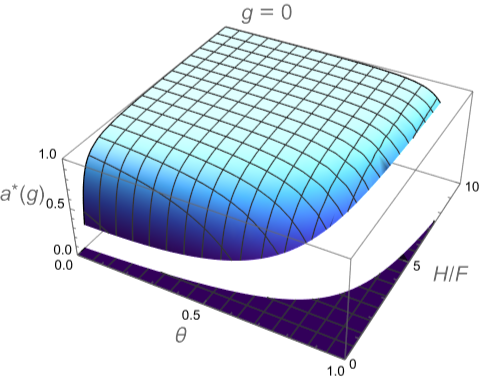
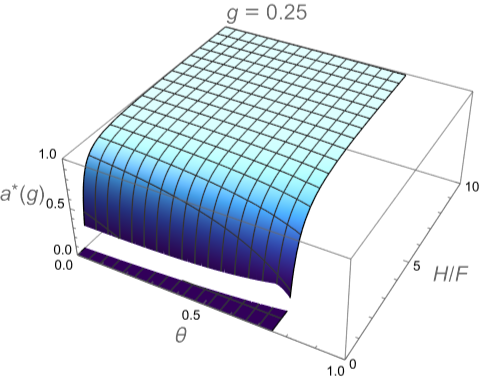
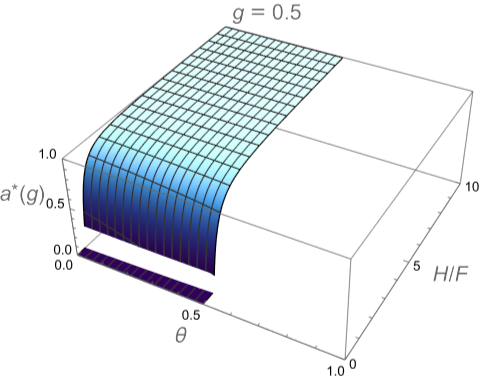
Optimal female foraging strategy, *a(g)
Optimal female foraging strategy, (g)
*
a
In[]:=
Fp=1;Np=5;gp=0;Plot3D[Evaluate[as/.{ggp,FFp,nNp}],{θ,0,1},{H,0,10},PlotRange{{0,1},{0,10},{0,1}},MaxRecursion12,AxesLabel{Style["θ",16],Style["H/F",16],Style[[g],16]},BoundaryStyleBlack,ColorFunction"DeepSeaColors",ColorFunctionScalingFalse,PlotLabelStyle[ggp,16]]
*
a
Out[]=
In[]:=
Fp=1;Np=5;gp=0.25;Plot3D[Evaluate[as/.{ggp,FFp,nNp}],{θ,0,0.75},{H,0,10},PlotRange{{0,1},{0,10},{0,1}},MaxRecursion9,AxesLabel{Style["θ",16],Style["H/F",16],Style[[g],16]},BoundaryStyleBlack,ColorFunction"DeepSeaColors",ColorFunctionScalingFalse,PlotLabelStyle[ggp,16]]
*
a
Out[]=
In[]:=
Fp=1;Np=5;gp=0.5;Plot3D[Evaluate[as/.{ggp,FFp,nNp}],{θ,0,0.5},{H,0,10},PlotRange{{0,1},{0,10},{0,1}},MaxRecursion9,AxesLabel{Style["θ",16],Style["H/F",16],Style[[g],16]},BoundaryStyleBlack,ColorFunction"DeepSeaColors",ColorFunctionScalingFalse,PlotLabelStyle[ggp,16]]
*
a
Out[]=
Optimal male foraging strategy, *b(g)
Optimal male foraging strategy, (g)
*
b
In[]:=
Fp=1;Np=5;gp=0;Plot3D[Evaluate[bs/.{ggp,FFp,nNp}],{θ,0,1},{H,0,10},PlotRange{{0,1},{0,10},{0,1}},AxesLabel{Style["θ",16],Style["H/F",16],Style[[g],16]},BoundaryStyleBlack,ColorFunction"ValentineTones",ColorFunctionScalingFalse,PlotLabelStyle[ggp,16]]
*
b
Out[]=

Evolutionarily stable sharing in the promiscuous mating system
Evolutionarily stable sharing in the promiscuous mating system
Evolutionarily stable sharing in the polygynous and monogamous mating systems
Evolutionarily stable sharing in the polygynous and monogamous mating systems
Ecological transition
Ecological transition
In this section we compare female fitness under the promiscuous vs. the monogamous or polygynous mating systems. The regions where pair bonds (i.e., monogamous or polygynous mating systems) generate higher female fitness than in promiscuous systems are where an “ecological transition” where populations relying on pair bonds are more likely to survive than populations living under a promiscuous mating system.
Figures
Figures
Division of labour
Division of labour
The figures below capture “division of labor”, i.e., they categorize the different regions of parameter space with respect to the tasks performed by females vs. males at an evolutionarily stable state. The two tasks under consideration are extraction and food sharing.
Legend
Legend
Promiscuous mating system
Promiscuous mating system
Monogamous and Polygynous mating systems
Monogamous and Polygynous mating systems
CITE THIS NOTEBOOK
CITE THIS NOTEBOOK
The evolution of early hominin food production and sharing
by Slimane Dridi
Wolfram Community, STAFF PICKS, July 3, 2023
https://community.wolfram.com/groups/-/m/t/2950821
by Slimane Dridi
Wolfram Community, STAFF PICKS, July 3, 2023
https://community.wolfram.com/groups/-/m/t/2950821