Consider a partially miscible binary mixture composed of -butanol and water; this mixture presents a heteroazeotrope with a boiling temperature of 93.49°C and a water mole fraction of approximately 0.2285. The Non-Random Two-Liquid (NRTL) model developed by Renon and Prausnitz is adequate in order to determine vapor-liquid equilibrium data.
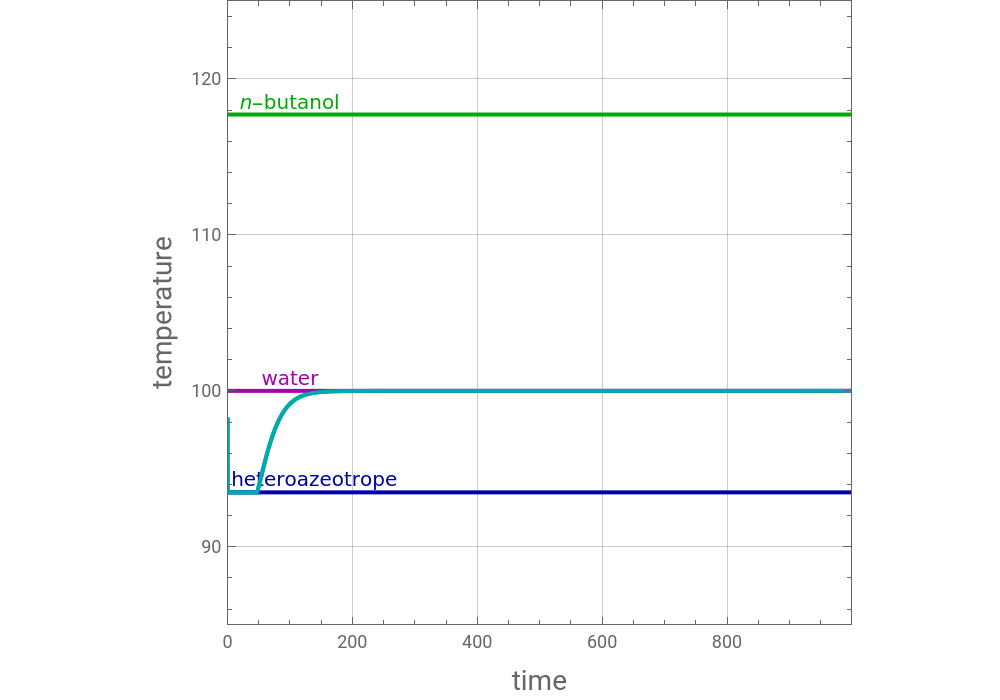
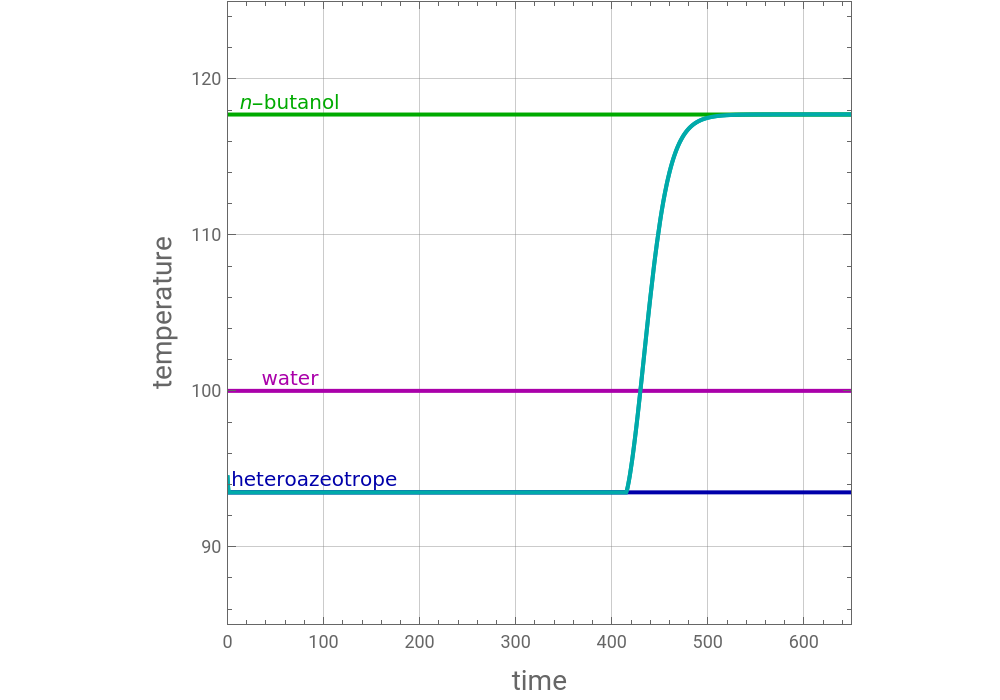
Here, we perform the dynamic simulation of a batch rectification of this mixture. The temperature is plotted versus time for selected values of the initial composition, reflux ratio, and number of theoretical stages.
The still is charged with 1000 kmol of the initial mixture. The vapor rate is assumed constant at 10 kmol/hr. This policy requires the vapor rate out of the reboiler and into the column section to be kept at a constant level throughout by varying the reboiler duty accordingly.
The molar hold-up of all stages and the condenser are 5 and 20 kmol, respectively.
It is found that (1) the first product to exit the column is the heteroazeotrope, which, as far as distillation is concerned, behaves as a low-boiling pure component; (2) if the initial composition is very rich in water (respectively in-butanol) then this component will exit the column once all -butanol (respectively water) has left the column in the form of a binary heteroazeotrope.
If the initial composition is equal to the heteroazeotropic composition then the temperature remains constant at all times and equal to the boiling temperature of the heteroazeotrope (i.e., 93.49°C).
n
Here, we perform the dynamic simulation of a batch rectification of this mixture. The temperature is plotted versus time for selected values of the initial composition, reflux ratio, and number of theoretical stages.
The still is charged with 1000 kmol of the initial mixture. The vapor rate is assumed constant at 10 kmol/hr. This policy requires the vapor rate out of the reboiler and into the column section to be kept at a constant level throughout by varying the reboiler duty accordingly.
The molar hold-up of all stages and the condenser are 5 and 20 kmol, respectively.
It is found that (1) the first product to exit the column is the heteroazeotrope, which, as far as distillation is concerned, behaves as a low-boiling pure component; (2) if the initial composition is very rich in water (respectively in
n
n
If the initial composition is equal to the heteroazeotropic composition then the temperature remains constant at all times and equal to the boiling temperature of the heteroazeotrope (i.e., 93.49°C).
Total pressure
P=760;
NRTL model for activity coefficients - binary interaction parameters and nonrandomness parameters are obtained from Aspen-Hysys
Gam[i_]:=Exp(t[j,i]G[j,i]x[j])(G[l,i]x[l])+(G[l,j]x[l])t[i,j]-(t[r,j]G[r,j]x[r])(G[l,j]x[l])/.x[1]x1/.x[2]1-x1;Gamp[i_]:=Exp(t[j,i]G[j,i]x[j])(G[l,i]x[l])+(G[l,j]x[l])t[i,j]-(t[r,j]G[r,j]x[r])(G[l,j]x[l])/.x[1]xp1/.x[2]1-xp1;G[i_,j_]:=Exp[-a[i,j]t[i,j]];t[i_,j_]:=g[i,j]/(R(T+273.15));g[1,1]=0;g[2,2]=0;g[2,1]=2794.6660;g[1,2]=570.13620;(*inkcal/kmol*)a[1,1]=0;a[2,2]=0;a[1,2]=0.47;a[2,1]=0.47;
2
∑
j=1
2
∑
l=1
2
∑
j=1
G[i,j]x[j]
2
∑
l=1
2
∑
r=1
2
∑
l=1
2
∑
j=1
2
∑
l=1
2
∑
j=1
G[i,j]x[j]
2
∑
l=1
2
∑
r=1
2
∑
l=1
Antoine equation
A1=7.36366;B1=1305.198;C1=173.427;A2=8.07131;B2=1730.630;C2=233.426;PS1[T_]:=10^(A1-B1/(C1+T));PS2[T_]:=10^(A2-B2/(C2+T));
Gas constant in kcal:kmol*K
R=1.987;
Computing VLLE data
i=0;While[i<101,{T=Evaluate[93.2468+i(117.727-93.2468)/100],Temp[i]=T,x1[i]=FindRoot[{(Gam[1]x1PS1[T]+Gam[2](1-x1)PS2[T])P},{x1,0.3,0.95}][[1,2]],xp1[i]=FindRoot[{(Gam[1]x1PS1[T]+Gam[2](1-x1)PS2[T])P},{x1,0.005,0.01}][[1,2]],y1[i]=Gam[1]x1PS1[T]/P/.x1x1[i],yp1[i]=Gam[1]x1PS1[T]/P/.x1xp1[i],i++}];tb1=Table[{x1[i],Temp[i]},{i,1,100}];tb2=Table[{xp1[i],Temp[i]},{i,1,27}];tb3=Table[{y1[i],Temp[i]},{i,1,100}];tb4=Table[{yp1[i],Temp[i]},{i,1,27}];tb5=Table[{x1[i],y1[i]},{i,1,100}];tb6=Table[{xp1[i],yp1[i]},{i,1,27}];tbf1=Sort[Join[tb1,tb2]];tbf2=Sort[Join[tb3,tb4]];tbf3=Sort[Join[tb5,tb6]];Tx=Interpolation[tbf1,InterpolationOrder1];xy=Interpolation[tbf3,InterpolationOrder1];
CASE 1 (water is in excess)
CASE 1 (water is in excess)
CASE 1 presents a nice separation where one recover a substantial amount of pure water at high reflux ratio and large number of stages. For CASE 2, all n-butanol exits first mixed with water in the form of a heteroazeotrope.
Initial composition
x0=0.002;
Reflux ratio
RefluxRatio=9;
Number of theoretical stages
Np=7;
Constant boilup rate in kmol/hr
V=10;
Reflux molar flow rate
L=;
RefluxRatioV
1+RefluxRatio
Distillate molar flow rate
Di=;
V
1+RefluxRatio
In[]:=
sol=Quiet[NDSolve[Flatten[{D[M1[t],{t,1}]-Di,D[M1[t][t],{t,1}]-Vxy[[t]]+L[t],[0]x0,M1[0]1000,Table[{5D[[t],{t,1}]-V(xy[[t]]-xy[[t]])+L([t]-[t]),[0]x0},{i,2,Np}],20D[[t],{t,1}]Vxy[[t]]-(L+Di)[t],[0]x0}],Flatten[{M1[t],Table[[t],{i,1,Np+1}]}],{t,0,999/Di}]];
x
1
x
1
x
2
x
1
x
i
x
i
x
i-1
x
i+1
x
i
x
i
x
Np+1
x
Np
x
Np+1
x
Np+1
x
i
In[]:=
plt1=Plot[Tx[[t]/.sol],{t,0,999/Di},PlotRange{{0,999/Di},{85,125}},ImageSize{500,350},PlotStyle{Darker@Cyan,Thick},FrameTrue,GridLinesAutomatic,AspectRatio->1,FrameLabel{Style["time",14],Style["temperature",14]}];
x
Np+1
In[]:=
Show[plt1,Graphics[{Thick,Darker@Magenta,Line[{{0,100},{999/Di,100}}],Darker@Green,Line[{{0,117.72},{999/Di,117.72}}],Darker@Blue,Line[{{0,93.491602`},{999/Di,93.491602`}}]}],Graphics[{Darker@Blue,Text[" heteroazeotrope ",{140/Di,94.2916}],Darker@Magenta,Text["water",{100/Di,100.8}],Darker@Green,Text[Row[{Style["n",Italic],"-butanol"}],{100/Di,118.5}]}],plt1]
Out[]=
CASE 2 (n-butanol is in excess and large number of stages)
CASE 2 (n-butanol is in excess and large number of stages)
Initial composition
x0=0.52;
Reflux ratio
RefluxRatio=5.5;
Number of theoretical stages
Np=7;
In[]:=
V=10;L=;Di=;sol=Quiet[NDSolve[Flatten[{D[M1[t],{t,1}]-Di,D[M1[t][t],{t,1}]-Vxy[[t]]+L[t],[0]x0,M1[0]1000,Table[{5D[[t],{t,1}]-V(xy[[t]]-xy[[t]])+L([t]-[t]),[0]x0},{i,2,Np}],20D[[t],{t,1}]Vxy[[t]]-(L+Di)[t],[0]x0}],Flatten[{M1[t],Table[[t],{i,1,Np+1}]}],{t,0,999/Di}]];plt1=Plot[Tx[[t]/.sol],{t,0,999/Di},PlotRange{{0,999/Di},{85,125}},ImageSize{500,350},PlotStyle{Darker@Cyan,Thick},FrameTrue,GridLinesAutomatic,AspectRatio->1,FrameLabel{Style["time",14],Style["temperature",14]}];
RefluxRatioV
1+RefluxRatio
V
1+RefluxRatio
x
1
x
1
x
2
x
1
x
i
x
i
x
i-1
x
i+1
x
i
x
i
x
Np+1
x
Np
x
Np+1
x
Np+1
x
i
x
Np+1
In[]:=
p1=Show[plt1,Graphics[{Thick,Darker@Magenta,Line[{{0,100},{999/Di,100}}],Darker@Green,Line[{{0,117.72},{999/Di,117.72}}],Darker@Blue,Line[{{0,93.491602`},{999/Di,93.491602`}}]}],Graphics[{Darker@Blue,Text[" heteroazeotrope ",{140/Di,94.2916}],Darker@Magenta,Text["water",{100/Di,100.8}],Darker@Green,Text[Row[{Style["n",Italic],"-butanol"}],{100/Di,118.5}]}],plt1]
Out[]=
CASE 3 (n-butanol is in excess but small number of stages)
CASE 3 (n-butanol is in excess but small number of stages)
Initial composition
x0=0.52;
Reflux ratio
RefluxRatio=5.5;
Number of theoretical stages
Comparison between CASE 2 and CASE 3
Comparison between CASE 2 and CASE 3
CASE 2 presents a nice separation where one recover a substantial amount of pure n-butanol at high reflux ratio and large number of stages. For CASE 2, all water exits first mixed with n-butanol in the form of a heteroazeotrope.
Conversely, CASE 3 presents a sloppy separation (all distillate is composed of n-butanol mixed with water). Such behavior is typical when low reflux ratio and minimal number of stages are adopted.
Conversely, CASE 3 presents a sloppy separation (all distillate is composed of n-butanol mixed with water). Such behavior is typical when low reflux ratio and minimal number of stages are adopted.
CASE 4 (initial composition is exactly the heteroazeotropic composition)
CASE 4 (initial composition is exactly the heteroazeotropic composition)
The distillate temperature versus time (shown by the dashed cyan line) is constant equal to the boiling temperature of the heteroazeotrope (i.e., 93.49°C)
Initial composition
Reflux ratio
Number of theoretical stages
Constant boilup rate in kmol/hr
Reflux molar flow rate
Distillate molar flow rate
CITE THIS NOTEBOOK
CITE THIS NOTEBOOK
Batch rectification of a partially miscible binary mixture
by Housam Binous
Wolfram Community, STAFF PICKS, April 10, 2026
https://community.wolfram.com/groups/-/m/t/3682155
by Housam Binous
Wolfram Community, STAFF PICKS, April 10, 2026
https://community.wolfram.com/groups/-/m/t/3682155